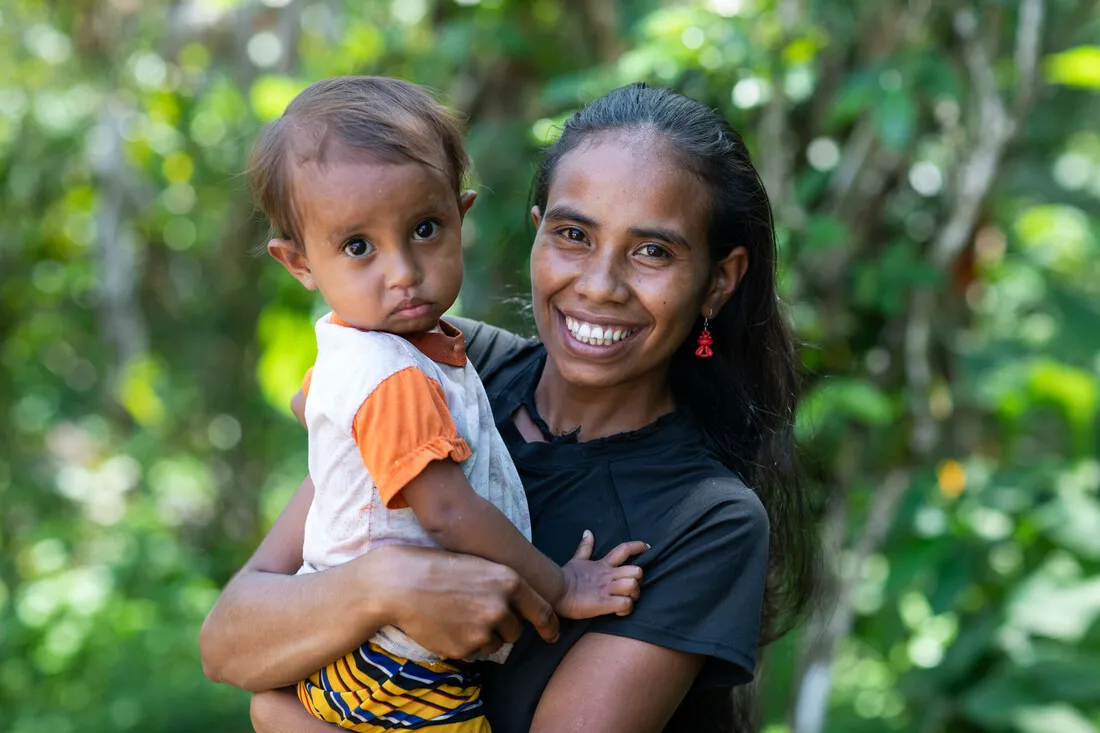
The small room of the village health center, or anganwadi, in the Indian village of Irukpal is crowded with brightly dressed women and their young children. The smell of smoke drifts in from the kitchen, where several women are preparing meal enriched with oil and molasses for the children's lunch. The women laugh and talk, bouncing the smaller children on their laps. One of the women, a CARE-trained health worker named Janaki, begins to clap, and the women start to sing.
Sisters, call the women to come,
Let us go to the anganwadi.
The song calls the meeting to order: Nutrition and Health Day is about to start. The songs the women sing are not just for entertainment, however — they help the new mothers remember the sequence and importance of immunizations and other crucial health practices.
As soon as the delivery is over,
The child should be breast-fed.
Then comes the BCG vaccine, as soon as possible.
The BCG vaccine prevents tuberculosis.
After one and a half months,
Start the diphtheria vaccine.
Along with the diphtheria vaccine,
We should give them polio drops.
We will save them from any kind of handicap.
At nine months, we should start the measles vaccine.
Along with the measles vaccine,
We should give them vitamin A.
This will prevent blindness and give good eyesight.
Sisters, if we follow these steps,
Our babies will be healthy.
Nutrition and Health Day is a monthly event at the anganwadi. For poor women with precious little free time to spend on health concerns, the day provides a wide variety of services rolled into one package. A government health worker provides immunizations, each child is weighed, and a nurse gives each of the pregnant women prenatal care.
Though the work is serious, the atmosphere is busy and boisterous. "It feels good to come here," Sumo, a volunteer health worker, explains. "We support each other. Every woman gets services, and every woman learns something."
Today's happy scene is a remarkable change from even a few years ago. In 2002, only 20 percent of the mothers in the village came to the anganwadi. Now, with the help of the health workers' outreach and education, that number is over 80 percent.
Other attitudes are changing as well. When Sumo, six months pregnant, comes out of her orenatal checkup, the nurse exclaims, "Before, they always wanted sons! Now this one wants a daughter." "I already have a son," Sumo laughs. "My husband agrees: When we have a daughter, our family will be complete."