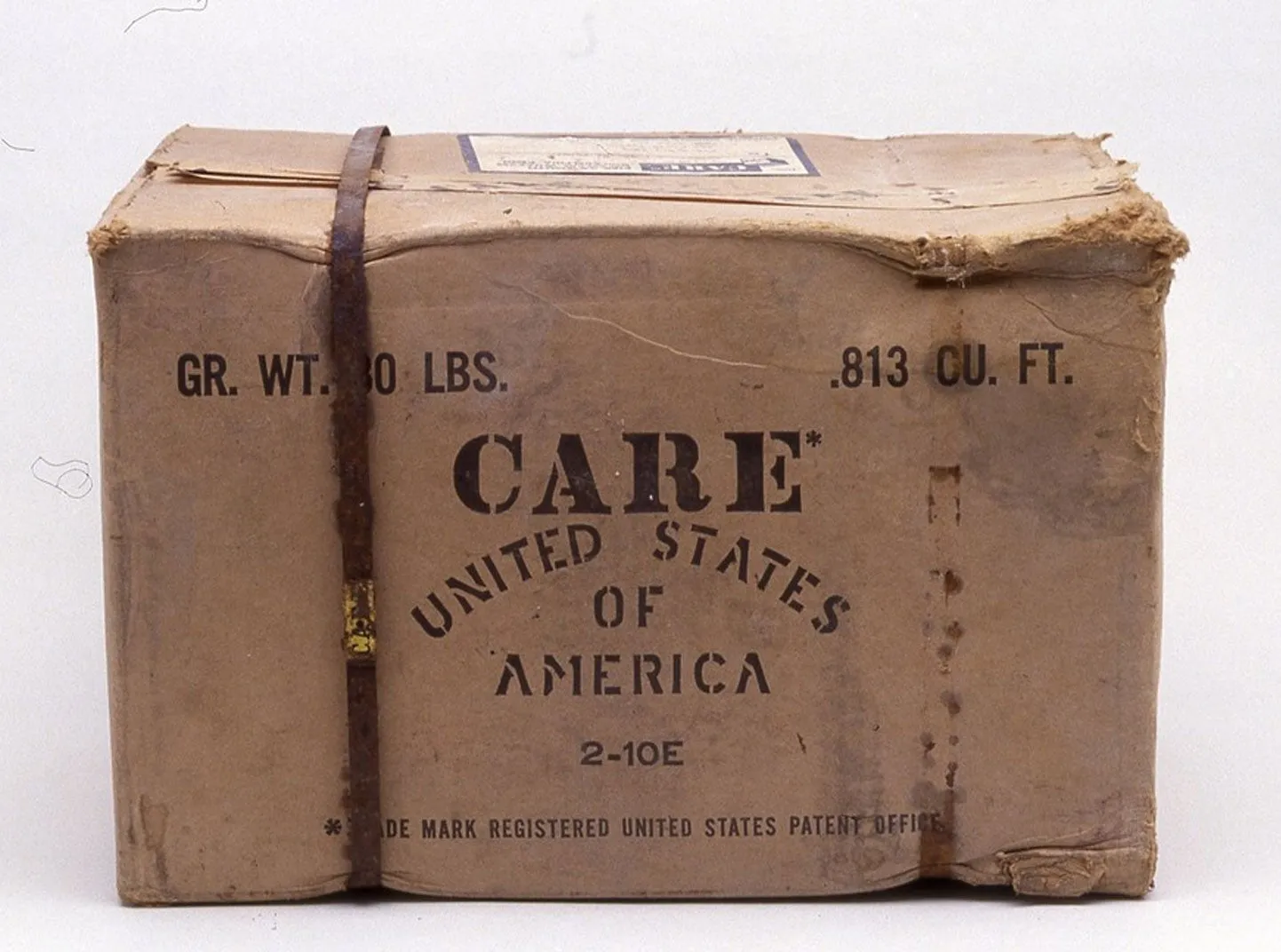
One of CARE's most inspiring staff members is Sharon Wilkinson, CARE's country director in Cambodia. In October and November, Sharon documented her attempt to live for a month on less than one U.S. dollar per day. This is her story.
Day 1 - October 16
It's a strange way to start a 'do-without' month... I was flying back to Cambodia from a series of successful meetings with CARE supporters on the West Coast of the USA. Since the 1960's I have dreamed of places with exotic names such as Los Angeles and San Francisco and to get the chance to see these cities and meet the wonderful people who support CARE was truly fantastic.
But back to the story. There I was aboard a 747 flying out of Taipei when October 16 arrived - the first day of my pledge to consume less than $1 per day. I looked at the airline breakfast - potato cake, scrambled eggs and bacon, fruits and fruit juice, yogurt, bread, butter, jam and coffee - and I knew the hardest thing to give up would be coffee!
Looking at this feast, I remembered the mid 80's in Addis Ababa, Ethiopia. I travelled there with Clare Hanbury, who was taking forward the Child-to-Child movement across Africa. I was working on introducing health services. We shared a room and went to breakfast together at a rather grim hotel. She sat, a very dignified English type of lady, spreading each slice of rapidly ageing bread with as much butter and jam as it would carry. Then she cut it into small pieces - and she left it!
'Uh Clare,' I ventured, 'what are you doing?' Then she told me the story of the street children living out of the hotel rubbish bins. 'If we cut the bread and add the butter and jam it won't be recycled to another customer, and the kids will get it,' she explained.
In Cambodia the children call the waste food that comes from the airlines 'Gods Rubbish Bins' and so I sat on the plane making tiny sandwiches, hoping the kids would get it. Imagine your child getting food from the bins; the crumbs from our table.
I have had the privilege of working to change the fact that many thousands of people go to sleep hungry each night. I do this through CARE, through my colleagues and partners in big ways such as interventions in food security - introducing improved agriculture, water catchments and water purification, and introducing a range of services that protect children such as nutrition and hygiene education, supported with kitchen gardens and immunization programmes and access to essential health care and schooling.
It's these sorts of interventions that will make the difference. So for the next month I will continue to work on the bigger picture issues while experiencing first hand how it feels to survive on less than $1 per day.
For now, I am recovering from jet lag!
Day 2 - October 17
Breakfast was an egg for 300 Riel or about 7 US cents. A dozen eggs comes in at just over $1. Oh and I had coffee!
I walked to work, which takes 40 minutes and gives me the chance to get to the market before the heat of the day ruins the produce. The market is a busy and not too clean place, but it's a whole lot cheaper than a super market! There in the market, is a man probably in his mid 50's, crippled maybe from birth or maybe from an accident. He shuffles along on his bent legs and hands asking for 'nyam' - bread. In this market there are few 'barang' or foreigners, but he asks all who come by him. There is little support for people with disabilities in Cambodia. Some small NGOs have rehabilitation and vocational training opportunities but the need is very great.
I am grateful to have change in my pocket to give him.
I bought a small cauliflower, some tomatoes, a stem of broccoli, a few green beans, two potatoes, two onions, a garlic bulb and a piece of ginger - all for the princely sum of 13,700 Riel or $3.50.
I have some rice at home - approximately $3.00 in total - and this food will be turned into curry and soup and stir fry. And it will have to last a week!
My coffee 'fix' is a small jar of the cheapest brand of instant that cost $1.80. I am hoping it will last longer than a week!
Running total, in dollars:
12 eggs 1.00
Coffee 1.80
Vegetables 3.50
Rice 3.00
Total: $8.80
And it's only day two!
Lunch was a hurried affair - just a very quick stir fry, and I walked home from work thinking 'I am going to be so fit at the end of this month.' Then the next thought hit me: 'I'm more likely to be anaemic!'
Certainly if you lived on $1 per day for a substantial length of time you would be anaemic. CARE works to address anaemia by introducing home gardens. We also supplement the government health services for pregnant and lactating mothers by providing ferrous sulphate, vitamins and training.
[Health care is a major challenge, especially for poor women who live great distances from health services because the cost of transport is high. In Koh Kong province it can cost $25 just to get to the government health services. In a country where the average annual income is $380 per year that is about three weeks wages, and explains why women are forced to deliver babies at home. It also partly explains why 423 Cambodian women die per 100,000 live births. In the UK the number is just three. Care is working hard to create Midwife and Traditional Birth Attendant Alliances, to improve medical knowledge and make a difference.
When a women needs urgent medical intervention such as a caesarean section - our work becomes a matter of life or death. In response we have started 'equity funds' that allow communities to access cash and pay back over time.]
Supper was curried vegetables and rice, prepared with help from my beloved David, my partner for 38 years and husband for 34. If you've been reading closely, you might have realized I am using (if not consuming) more than $1 per day because I am cooking on a gas stove. Those who really live on a dollar a day can't afford fuel. This fact has led to a major industry of street vendors, who make food at 4am to serve to city workers before 6am. Street food can be tasty - but it can also be highly dangerous. The street vendors cannot access toilets or running water, resulting in highly contaminated produce. For the poor with few options, cheap street food is all they can access but the price is often dysentery.
Day 3 - October 18
It rained overnight - not the gentle rain of a rainy day in downtown Canberra - but the persistent downpour of the monsoon lashing against the roof, with lightning, and a sea of water covering the streets.
Phnom Penh was built on a swamp. The drainage, dating from French Colonial times, was inadequate in the 1950's and is certainly inadequate in 2006. The city has exploded with construction sites - buildings that the poor will never live in, making drainage an even more critical issue. I can only imagine a night without shelter, waking to a day when everything I touch is soaking wet.
Breakfast is a reheated curry. I remind myself that it has only been possible to keep fresh and away from the ants because I am fortunate enough to have a fridge!
I walked to work down street 63, which used to be a dyke that held back the waters of the Mekong. Now it is a main thoroughfare across the city and it has large areas of water slowly draining away as the heat of the day gathers and the humidity rises. I carried a 'packed lunch' with me - a serving of vegetable soup and rice from last night.
I spend time dreaming of dinner - stir fry and noodles. A six pack of noodles costs $1.20.
Day 4 - October 19
I wake after another night of rain - great, that's free water!
But to collect it I need a container and THAT costs! In my case it's a large red plastic bucket worth $13, so it's just as well I already have one.
Water, without which we would not survive, is a major issue in much of the developing world. Indeed as the drought bites deep in central Australia, we are all seeing how lack water can impact so much on our lives.
A half litre of bottled water costs Riel 500, and in the heat of South East Asia we should be drinking 3 litres a day. That's Riel 3000, or 75 US cents. Obviously the poor cannot purchase clean bottled water.
[Even in areas where water is 'harvested' successfully, women drink the least. They drink little even when they are pregnant or breast feeding. It's as if they were deliberately rationing their intake. A key reason for this is the simple fact that they cannot find privacy to urinate! I call this 'living under the tyranny of daylight'. Men have no compunction about urinating against a wall or a tree, indeed there are corners of the city which have been turned into public urinals; smelly areas to avoid. But for women, it is different.
CARE is working to make water safe - first by helping communities make huge clay water jars to increase the rain 'catchment' from roof tops, and then by introducing sand filters. In 2007 we will also be working with the University of Dublin to introduce SOLDIS - solar disinfection of water.]
In the meantime, I am grateful for the water I am given and my boiled egg for breakfast.
It's vegetable soup for lunch, with half a baguette - an obvious example of French influence in South East Asia. Lunch costs Riel 500 and my small pile of Riel seems to be disappearing too fast. Then, to the rescue... an invitation!
Thank God I have a job. As a result I have an AusAID invitation to meet the delegation from the government of Papua New Guinea. His Excellencies (all 10 of them) and Her Excellencies (just three) are on a study tour taking in South Africa, Uganda and Cambodia. The tour is to expose them to best practice in addressing the AIDS pandemic and they are the most enthusiastic group. They have seen first hand what the pandemic can do - and they are clear that 'government ownership' is vital to controlling the effects of the pandemic in Papua New Guinea. It's a clear message they are determined to get across to their Parliament.
Maybe I am becoming light headed (it's the lack of food your honour!) but my first thought on meeting them is 'these Excellencies are BIG PEOPLE - they must need to eat big to maintain that size!'
I ruminate about poor people back in UK. I grew up in the North of England as one of 10 children with Celts for ancestors where the motto at meal time was 'you're either fast or hungry!' Anyway 'fat' was often the result of poverty because the only way you could feed yourself was on a diet of carbohydrates! Cheap food was fast food, and fast food was chips and spam, chips and egg, chips and more chips; all leading to malnutrition.
The reception was a modest affair with some spring rolls, amok and rice, sour soup and fruit. Amok is a terrific Khmer dish of fish cooked in coconut. I tasted it and could have eaten most of what was laid out. But an Excellency got there first! He knew these ramekin sized servings would be insufficient to meet his calorific demands. And so he corralled them fast! Maybe the Celts are his ancestors too?
Day 5 - October 20
Another night of torrential down pour, with thunder that shook the house, and this morning I wake early to a sulphur yellow sky and low threatening, clouds as dawn breaks across Cambodia. But it wasn't the thunder that woke me. It was a dull ache in my hip. Some where there is evidence that wet, damp weather triggers inflammatory arthritic conditions of the joints! All I knew at 4:00 a.m. was that I hurt.
I am not a martyr. I head straight for the anti-inflammatory meds. Since they were in my medical chest I hope I can discount the cost from my 'do without' pledge. I imagine being elderly, under the night sky in the rain, waking with hip pain and not being able to afford medication. Ouch.
[Our world does not treat all people as equals. We say 'all men are equal' but that depends on where you are born. If you are born poor in a developing country you know you are not going to get an equal chance.
In India if you are a Dalit you are not equal. Dalit is the name the untouchables call themselves, rejecting the Gandian name of 'Harijen' which means 'Child of God'. Dalit simply means 'The Oppressed'. Poverty is the result of unequal oppression. The reality of poverty is often short, brutal lives enduring the daily grind of not enough food, no clean water, and nothing to ease the pain of aging joints on a wet day.]
Breakfast is some baked tomatoes. Lunch is a bowl of noodles with some quick fried vegetables. I didn't get any invites tonight!
Day 6 - October 21
The day starts with a trip to the market, in search of some cheap, nutritious supplies.
Can it really be smellier than last week? Yes! The rains have backed up the ancient drainage system and the stall holders are sweeping mud and muck into manageable places, like the entrance to the market itself!
Three oranges, a pear and a small bunch of rambuttan cost me one dollar, and I sally forth for a few hours of dealing with weekend emails at our new office.
Rambuttan is a wonderful lychee - red and fuzzy on the outside with sweet white flesh around a small black seed. They are delicious. Normally I can buy the best of the crop to cut in half so the shell forms its own cup around the fruit - it's a dramatic desert and as a centrepiece on the table, it looks terrific alongside the alien looking dragon fruit.
The dragon fruit has a thick dark pink wax peel, like the wax around Gouda cheese. It peels back to a white fruit with zillions of tiny edible seeds. It's delicious - but too expensive.
I demolish the pear in a nanosecond, but try to hoard my small store of rambuttan and oranges. They have to last a few days.
Saturday and the office kitchen is locked. NO COFFEE. A DISASTER!
My colleague Alex suggests a walk to the corner garage where good brewed coffee is served and I am sorely tempted. But I can't on a dollar a day! Maybe it is time to wean myself off caffeine!
Day 7 - October 22
Sunday the 22nd is Diwali - the Indian Festival of Light. Today we are invited to celebrate this great festival at a friend's home - which means I will get something to eat!
The gathering starts with a Puja, or devotion. Blessings and prayers are offered, and a sacred flame is lit in front of an icon. A tikka is placed on the forehead of each child - one little chap wriggles and ends up with three! Sacred smoke wafts over all, and then come the fireworks - and more fireworks!
On the food front, I eagerly accept the sweetest of sweet Indian gulabs, dripping in syrup. They were too good to say no to.
My colleagues from Gujarat have also written, to wish me Happy Diwali. Here is what they wrote
'This year Diwali and Eid are falling next to each other and this is a matter of great joy and celebration for our Indian friends. The hallmark of Indian society is its multi-religious nature and respect for all religions. However in recent times our tolerance and respect for each other has been put to severe test and we have to stand up to this challenge. Celebrating Eid and Diwali together will be a symbolic act for our togetherness. Both festivals signify triumphs of the spiritual over the material, and so guide us towards peace and harmony.'
So let me too wish you all a very Happy Diwali and Eid, and let us commit ourselves to promote better understanding and respect for all religious communities.
Day 8 - October 23
Monday dawns - wet, but with a brightening sky that promises heat and humidity later.
No time for breakfast, but enough time to pack my left-over supper of rice and curried egg, and a flask of vegetable soup. It's week one and I dream of sinking my teeth into something more substantial than soup, rice and noodles. But an apple is unaffordable and a steak will just have to wait until November 16!
Walking to work is a great opportunity to see more; to really see what someone has to do to earn a dollar. There are the street scavengers who collect tin cans and paper to recycle; there is the mother who trails a four year old as she sells small sweet bananas, grilled on an early morning fire; and there are the construction workers who travel from the Provinces to hire themselves out for the day. These workers, mostly men, stand within the shadow of Independence Monument, often barefooted - hoping to be hired for one of the construction sites that fill every corner of this city.
I watch a foreman arrive on a motorbike to haggle for workers. Once they agree to terms three men - yes three - straddle his bike and head off to work.
I pass such sites across the city. There are no safety regulations in place and often the whole family works together. Across the developing world, children spend their childhood in the shadow of new cities being formed, with no school and very poor nutrition. They are a generation going to the wall. So it is good to report the International Labour Organization is starting to address this situation by bringing in regulations and helping children access some schooling. CARE also works with local NGOs who are helping. One NGO 'New Hope for Cambodian Children' provides day care for children living with HIV/AIDS, whose parents still have to work. The children get care, food and developmental activities. This is the only free day care that I know of in a city of almost 2 million people, where 48 percent of the population lives below the poverty line.
This evening I attended the memorial service of a former CARE colleague who died in a vehicle accident on Friday last week.
Rattana was a senior Programme Manager with the NGO Action Aid. Monks led the service, and many former colleagues noted how this young man had affected their lives. They spoke of his commitment to development in Cambodia and his love of his family. Afterwards at the reception (at which I ate one of the small triangles of sticky rice and coconut delicately folded into a pyramid wrapped in banana leaves) we spoke of the young family that Rattana had left behind. We spoke about the gift that is life, and how it is indeed so fragile. We wondered about the impact on this family of the death of their key bread winner.
It's a sad note on which I end my day. And supper was an unimpressive event.
Day 9 - October 24
Breakfast is an egg, and as I worked through lunch I was starving by 4:00 p.m. I resist the temptation to just buy fast food. I am able to stay the course until evening when a blast of rice and vegetables brings my sugar levels back up.
I am still walking everywhere and I am losing weight. The weight loss is slow, as I actually eat well, largely thanks to my huge social network. This is an aspect of poverty that we really have to tackle. Poverty is not just about the lack of material goods - it is about being marginalized and socially invisible.
I am able to eat and make connections that allow massive opportunities because I have what the development world calls 'social capital'. It is social capital that means I am invited to receptions, celebrations and memorials - all of which include that most human of acts - the breaking of bread.
There is an aspect of social capital which challenges us. How do we create it, and how do we create situations in which all others can engage in a social network, and feel welcome at family events. My husband, DJ, carried a candle and wine to our friends Diwali, and I carried flowers and a financial contribution to our former colleague's memorial. But for the very poor, without the means to reciprocate, they are as likely to exclude themselves from broader society as much as others would exclude them.
Day 10 - October 25
Walking to work along Street 59, I meet some children who gain my attention by shouting the one English word they know: 'money'!
I never give children money directly. I ask them what they want it for and they usually say 'nyam' - food! So I take them for breakfast. All five gather around a street vendor and make their orders. 'I want an egg with that... I want more rice... don't add chilli, she doesn't like it.' After a quick O-kun - thank you - I am on my way. The cost was just 7,500 Riel or $1.90. A dollar can go along way in Cambodia, and it can put smiles on the faces of street children.
The rest of the day I am working with my colleague Syngoun, who manages CARE's sub-contracts in the health sector. Our sub-contracts with local organizations extend and deepen our work with communities. Today we are reviewing the New Hope for Cambodian Children Program. We are with a team of child health experts, care givers and children - most of whom are orphaned and HIV-positive. They are small scraps of life, vulnerable to every opportunistic infection. But with CARE's support they are accessing anti-retroviral medications and they have food, shelter, schooling and a chance of a life that - because of this work - will not be short and brutal.
There are days in this work that are full of joy. When I arrive home I say to DJ, 'And they pay me for this!' Such was my day.
I had soup and bread for lunch and dinner - and I am counting myself blessed.
Day 11 - October 26
It is a busy morning full of meetings. One was with Sabine, a colleague from CARE Deutschland, visiting our programs and providing technical advice. It's great to think how wide our CARE net is. We have colleagues and friends around the globe from Canada to Japan. Imagine what the daily email traffic looks like. Yes, horrible!
I travel to Sisophon, which is a five and half hour drive north west. Tomorrow we officially close a programme that has supported thousands of young people, with access to literacy, life skills and education scholarships.
En route we stop for lunch. Rice and vegetables costs Riel 6000 and I am thinking DAYLIGHT ROBBERY! Such meal elsewhere would cost less than a dollar. I decide to halve the amount I eat, and I ask for a 'doggy bag'. This meal has to last!
Day 12 - October 27
I have breakfast with Bron Ives, the head of our Education Program. I have a slice of French bread, which may have started out this morning fresh and soft, but we asked for toast and so the bread was baked hard and crusty. It still acts as a filler for my morning scrambled egg.
The closing ceremony is held in an otherwise empty public building, with a stage, high-level Provincial government officials, plastic flowers for decoration and half-liter bottles of water.
There are certificates for the people who made this possible, and to the CARE staff who have done such a terrific job that now we are able to hand the program over to the community and school management committees.
We have a final meal together - another meal I would not have if not for my work connections. We are a river people in South East Asia, so fish is always on the menu. Today there are three fish dishes to choose from; a full fish with fins and eyes and all, a fish soup, and squid and fish in pepper. They were delicious.
We travel back to Phnom Penh. Since I ate so well at lunch, I don't have any supper.
Day 13 - October 28
It's a day of clearing up my home. With long days at work my home sometimes gets neglected. I come across recipe books and I indulge in fantasies.
It's a day of soup and bread... and dreaming of steaks!
Day 14 - October 29
It's time for some stock taking.
So far in total I have purchased slightly less than $9.00 in vegetables and some fruit. With 16 days to go I have just $9.50 left.
I walk to work. Yes, on a Sunday. Only by sitting at this machine can I clear the incoming emails!
I put on the slow cooker and let it make ratatouille.
Day 15 -October 30
Thank God I still have coffee!
I have breakfast at the fast-food stand just outside the CARE office. Since we moved in here recently the stall owners have being doing a roaring trade.
Noodle soup is the standard Cambodian breakfast. It is fat white noodles cooked in vegetable stock, some vegetables, and sprinkled with spring onion. It's really delicious and a bargain at Riel 1000 or about 25 cents. Of course there is a key concern about street food: e-coli and the possibility of food poisoning!
Lunch is packed ratatouille and a small pear - worth another 25 cents.
Dinner is reheated ratatouille. I am indeed getting bored with this!
Day 16 - October 31
A mango for breakfast - they're in season and selling at four for a dollar - yippy!
Lunch is the last of the ratatouille. If I see that particular combination of vegetables again in the next year, it will be too soon.
This evening I walk to meet DJ and friends on the river front, where crowds are gathering for the water festival. It's the highlight of Cambodian festivals; a visual delight of boat races and fireworks and a doubling of the population of Phnom Penh.
The boats are province-specific. They have backers - usually politicians and governors, but sometimes just ordinary communities. The crews of up to 20 row standing up as a helmsman shouts the stroke. The bright boats cut through the water of the Mekong all striving to win, each one bedecked with its colours, and some featuring a decorative eye to ward off bad luck.
At any one time, four or five boats will be racing down stream to the winning post at the point where the Mekong, Tonle Sap and Tonle Bassac Rivers all meet in front of the Royal Palace. I've watched this race for 7 years now and I still don't know how they get a winner! I ask people every year and they can't tell me who wins. But afterwards we always hear it was a boat backed by a high official and everyone seems happy with the outcome.
Alongside the hordes of holiday makers with disposable income in their pockets come the rural poor, sometimes with items to sell. Toy birds on sticks are common. They are made from folded, dried and painted rushes, then hung on a thread from small sticks. Sellers wander with 'trees' of these toys held high above the crowd to attract attention, selling them for less than 15 cents. But the sellers are competing with other toys - plastic and shiny items coming from China. No prizes for guessing which toys the children are demanding.
I take great pleasure every year in purchasing an entire tree of birds and watching the seller beam, because now he can spend his time looking at the races, enjoying the sights and chancing his hand and the many games of luck that characterize every holiday event.
My bird tree has substituted for a Christmas tree and has graced my balcony over the years. By January it usually becomes a sadly faded, dust collecting, cobweb bedecked facsimile of its previous glory - but for a few short months I have the beautiful handicraft of a village home to brighten my days.
Supper is a risotto of rice and vegetables.
Day 17 - November 1
I miss breakfast and notice later that I'm not feeling hungry. Is this a good sign?
It does mean my ability to live on less has allowed for a shrinking of
a) My body mass - I am 8 pounds lighter!
b) My stomach - I fill up on less and now.
c) My appetite - although I still hanker for a steak, I think a more modest size steak than I envisaged two weeks ago will be just fine!
I think this is a good sign for someone who has always fought a losing battle against weight gain, but what does it mean for those who normally have to live on less, every day, every week, year after year?
It means the body has the capacity to adapt to starvation - the millions of underweight, stunted children across are testament to that. We call this the 'silent disease' where generations are being slowly, imperceptibly starved.
Walking into work and there is Yen. Yen must be all of 10 years old. He is a street scavenger, collecting paper for recycling. He has a smile you would go to war for; a smile that gets you to dig very deep into your pockets and give him whatever he asks for.
All my friends have done so - many, many times. But handing Yen cash is not doing it. He is still on the street, still scavenging, still smiling. In conversations I hear people say 'but they are little thieves' and its probably true, they are. But then, if society fails to give them the basics of food, school, and shelter - indeed fails to even see them as part of society - should we be surprised when they fail to abide by the rules of that society?
Yen had a great breakfast today, from a street vendor, and I got that beautiful smile in return. It was a fair reward.
As for my meals today - I skipped breakfast, had packed leftovers for lunch and supper was roasted carrots, potatoes and a small slice of pork, which is the cheapest meat in Cambodia. It was delicious.
|