New York, NY
October 17, 2007
Good afternoon. It is a great pleasure to be with you.
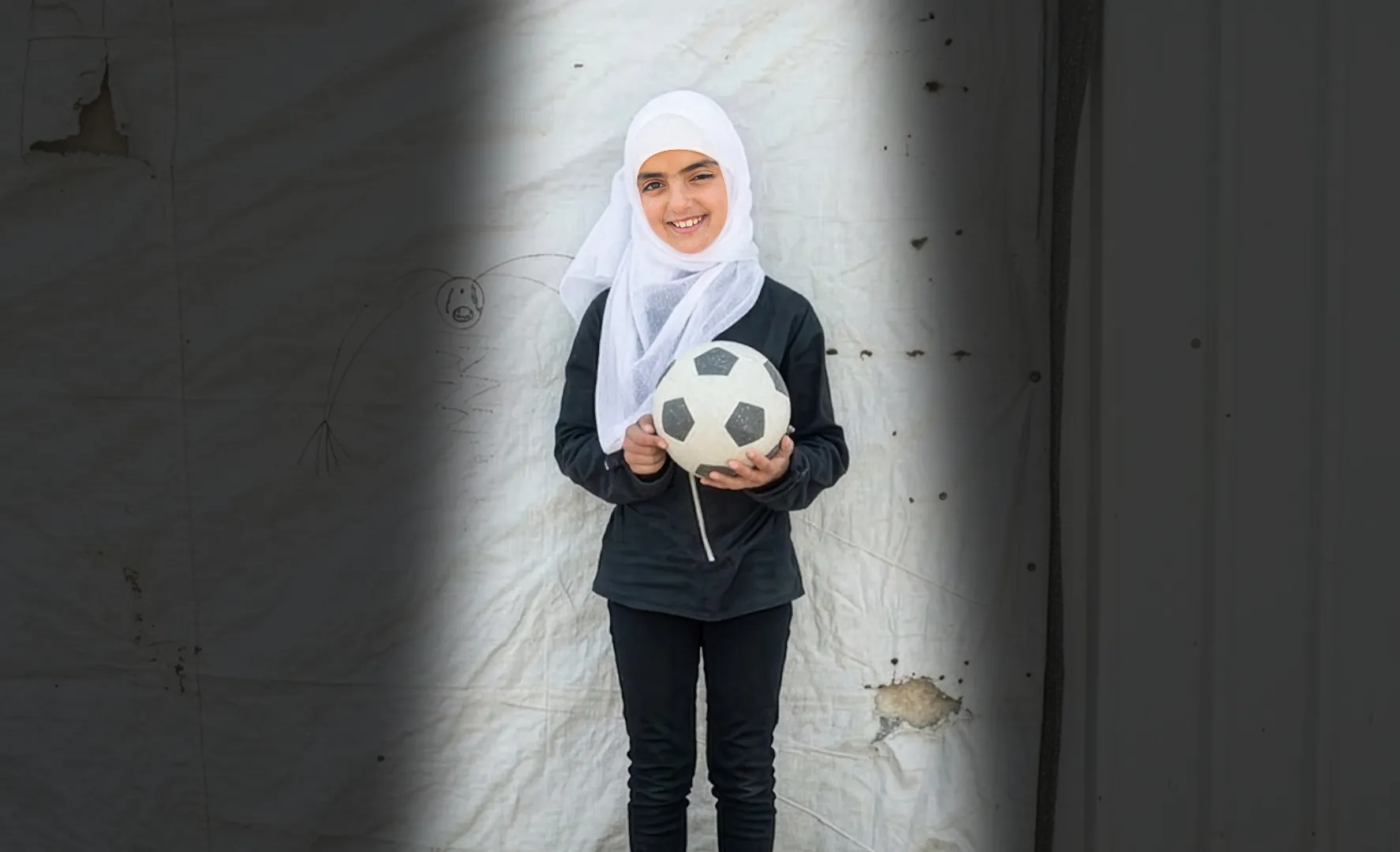
| Hadia, 9, lives in Charqallah Village. Her mother, Asma, is a widow in the poultry program. Her father fell down a water well in Iran in 2000. She is an advanced 3rd grader and enjoys math and art. She wants to be a teacher, but her mother hopes she will be a doctor. (© 2005 Phil Borges ) |
|
Your conference theme – a passport to success – strikes a chord with me for two reasons. First, most of my career has been focused on international issues. I spend a whole lot of time crossing borders and time zones. Secondly, my work is about creating opportunities for people who are trying very hard to improve their world and broaden their horizons, particularly women.
I'll share a bit about my personal journey. And then I want to talk about some other women – our counterparts in the developing world – and ways that we can build solidarity with them.
I grew up on the other side of this state, in Buffalo, and was fortunate to be raised in a family that placed a high value on giving back to the community. My parents instilled in me and my brothers and sisters the belief that a person’s most noble calling was to create positive social change.
I was also shaped by the issues that were part of my childhood and teenage years – civil rights, the anti-apartheid movement, women's rights, struggles for liberation from colonialism, and the Vietnam War. In high school, I liked to think of myself first and foremost as a social activist.I once jokingly summed it up like this: Nixon. Racism. Sexism. Apartheid. Bras. You name it, I protested it.
These issues really developed my sense of a collective responsibility for the future of our world, a sense of something greater than myself and a belief in the possibility of achieving social change.
My commitment to social justice led me to medical school and, ultimately, into public health. Becoming a doctor seemed like a concrete way to contribute to society and to use a focus on health status as a way of addressing inequities between the haves and the have-notes. Health inequities are almost always intertwined with social and economic inequities.
After finishing my training in pediatrics I decided to get additional training in public health to allow me to focus more on the interface between medicine and societal factors and on influencing the health of populations.
That took me to the Centers for Disease Control and Prevention. I ended up spending nearly 20 years at the CDC, working primarily on HIV and AIDS, both domestically and internationally.
When I first went to the CDC in 1984, HIV was just becoming an issue in this country and many people advised me to stay away from this strange medical curiosity that would most likely be controlled and disappear soon. I didn’t follow that advice for long. I chose to work on HIV, or HIV chose me, because of the societal challenges that it imposes.
HIV infection is caused by a virus, but it is fueled by gender inequality, racism, poverty and homophobia. Having an impact on HIV necessitates addressing issues of social injustice and inequity.
I then moved to the Bill & Melinda Gates Foundation to help build their global health program, with a focus on HIV, tuberculosis and reproductive health. After almost five years at the Foundation, I was privileged to become the president and CEO of CARE, an organization dedicated to eradicating extreme poverty. We have about 12,000 employees around the world in almost 70 countries and most of our employees are from the countries where we work.
In many ways, I feel as if I have come full circle. The same issues that initially led me to medicine and public health are at the heart of CARE's work: defending the dignity of the world's poorest and most marginalized people. I can't imagine a better way to use what I have learned in my years in public health than being engaged in the fight to end global poverty.
I firmly believe that one must be true to knowing and following one's own path and passion in life. But we all know, as women, there are often obstacles even when we do follow our right path.
As a woman in a leadership role, I have thought about the special challenges we may face.While much has changed, there are still obstacles. I recently reviewed a study done by the Association of American Medical Colleges on women's leadership in academic medicine.I think the findings are similar for women in most fields.
Some of the key findings include:
- Women face many more challenges than men in obtaining career-advancing mentoring, often leading to a sense of isolation that reduces their risk taking and can translate into a reluctance to pursue professional goals;
- Many men have difficulty effectively mentoring women;
- Without being conscious of their "mental models" of gender, both men and women still tend to devalue women's work and allow a narrower band of assertive behavior in women;
- Even when women achieve leadership roles, they still experience more resistance to men reporting to them and more constraints on their decision-making and leadership styles;
- And, finally, women physicians face more difficulty than men in garnering help from nurses and other staff within the workplace and, thus, more difficulty controlling their work lives so they are more likely to burn out.
I can hardly do justice to this very rich report, but there was one final concept that I found telling. It is fair to say that most professionals believe that they work in a meritocracy and that they are not influenced by stereotypes. But as one male author noted: while individual men do not feel powerful, power is so deeply woven into their lives, that is most invisible to those who are most empowered.
I'm sure some of this must feel very familiar to many of you. My point, of course, is not to gripe about men or any of this, but to remind ourselves of the challenges we face. And to emphasize why it is important to support one another and continue to find ways to overcome obstacles to greater balance in our workplaces and allow greater and fuller participation for women in all aspects of society.
In that regard, let me say a little more about how we do that in the context of our work at CARE.
I spoke earlier about social and economic inequities. If we are going to successfully attack the root causes of poverty, we have to look at the factors that make and keep people poor. These include policies and practices that are deeply entrenched. For instance, cultural norms often keep women and girls from achieving their full potential. As a result, 70 percent of people struggling to get by on less than $1 a day are female.
When women and girls can't go to school, can't gain skills to earn money, and don't have proper health care, they lose out – and so do their families and societies.
Let me share some facts to illustrate this point:
- There are 900 million illiterate adults in the developing world. Two-thirds of them are women.
- Every minute, a woman dies from pregnancy-related causes. The leading cause of death is bleeding, for which there are simple and cheap solutions. For every woman who dies, 30 more are injured, infected or disabled.
- Women produce half the world's food, but own only one percent of its farmland. Likewise, they are often denied the right to own property or assets.
- Finally, nearly two-thirds of children out of school are girls. For those who are in school, their achievement rates often fall below that of boys. Girls are kept from school for many reasons: they may have to work at home; or their parents may not be able to afford the school fees – or may prioritize educating a son; or the schools are far away and it isn't safe for them to walk there.
Whatever the causes, one thing is very clear: women and girls bear the brunt of poverty.
Consider for a moment what our world loses when so many of our sisters are held back. We need their bright ideas. Their initiative. Their compassion. Their contribution.
You are here today talking about ways to achieve your dreams. In Bangladesh, Ethiopia, Guatemala, Haiti, there are women just like you, dreaming big and working very hard to attain their goals.
Those of you who have spent time in the developing world know first-hand what I am talking about. You sit in someone’s home and you realize how much you have in common. We all want options for a better future for our lives, our children, our families, our communities and our world.
In Africa, Asia, Latin America, Eastern Europe and the Middle East, women are accomplishing extraordinary things, often in spite of tremendous barriers.
| Women like Bharthamma Balamalu, a participant in a CARE microfinance program, are our greatest hope for overcoming poverty. (2005 Lynn Heinish/CARE ) |
|
Here is just one example. You may know the city of Hyderabad in India, where the Microsoft development center is, as well as offices for GE, IBM, Motorola, Oracle, Google and other Fortune 500 companies. Just a few hours north of Hyderabad is a village so poor that, until recently, it lacked a paved road. Because there was no road, there were no services, such as electricity or running water. This all changed because of a woman named Bharthamma Balamalu.
Had you met her 10 years ago, you would probably have underestimated her. She was married at age 14, had two sons and rarely left the house. Her husband was killed in an automobile accident nine years after they married, and she was forced to learn his farming business.
She joined a women's savings group organized by CARE, which gave her access to money and financial services and, perhaps more importantly, a support network. She and the members of her group pooled their money. In their first year, they saved enough to open a bank account. They then decided to pave the road.
Fifty women worked all day long for five days, carrying buckets of gravel and concrete on their heads, until they had a road nearly one mile long. Bharthamma then fought for a month with local officials so they women could get paid.
In the past decade, she has taken out several small loans from the group and, eventually, larger ones from local banks. Her loan size increased from $33 to $400, allowing her to purchase fertilizer and pesticides, hire a tractor and laborers, and dig wells. Having established a credit history, she then took a $700 loan from the bank to buy a jeep for her son's transport business.
More than 300,000 women in India have participated in CARE programs like this one, and secured loans totaling roughly $13 million. That's an amazing amount of money when you consider where they are starting from. Many of the women in Bharthamma’s group, for instance, earn 88 cents a day rolling cigarettes at a local factory.
Bharthamma told CARE she was considering running for local office. These are her words exactly: "I am 100 percent sure I will win because there is no competition for me here."
This is a woman who had to fight for everything she has achieved.
"Before," she said, "if I ever knew something, I didn't have the courage and confidence to speak up. I had ideas, but people never used to listen to me because I was alone. Now that I am in the group, people start to support my ideas. Before, I was leading only my house. Now I am leading so many people."
As significant as her words are, there's something else that gives me even more hope. It's a signal of where things are headed. None of the women in Bharthamma's group went to school. None of them. Every one of their daughters does.
Women like Bharthamma are our greatest hope for overcoming poverty. Improving women's lives can be the crucial first step toward creating lasting social change in poor countries. For example, each extra year of primary education that a girl receives boosts her wages later in life by 10 to 20 percent. In Africa, children of mothers who attended at least five years of school are 40 percent more likely to live beyond the age of five.
We know what works. The challenge – and the opportunity – is engaging people in the effort to eradicate global poverty.
And this is where all of us come in. My parents taught me that to whom much is given, much is expected. In this country, we've been given an exceptional amount. The average per capita income is nearly $40,000. Meanwhile, half of the people in this world live for an entire day on less than what we spend for a cup of coffee. They are trying their best in terrible circumstances to reach their goals. We are in the privileged position of being able to help them.
It doesn't take a lot. Ten dollars can buy clean birthing kits for six women. Forty dollars will send a child to school for a year.
But giving money isn't the only way to help. As with any social movement, in order to be successful, people have to speak up. We need to let our policy makers and our elected officials know that we care about ending extreme poverty, and that we believe that we, as a rich nation, can and should do more.
Our world is interconnected like never before, and some of us have limitless opportunities. Your conference today underscores that very clearly. I wish each of you success as you pursue the possibilities and navigate your careers. And I hope, as you advance, that you remember women like Bharthamma Balamulu.
As the tagline for our "I Am Powerful" campaign goes: She has the power to change her world. You have the power to help her do it.
Thank you.