Key findings
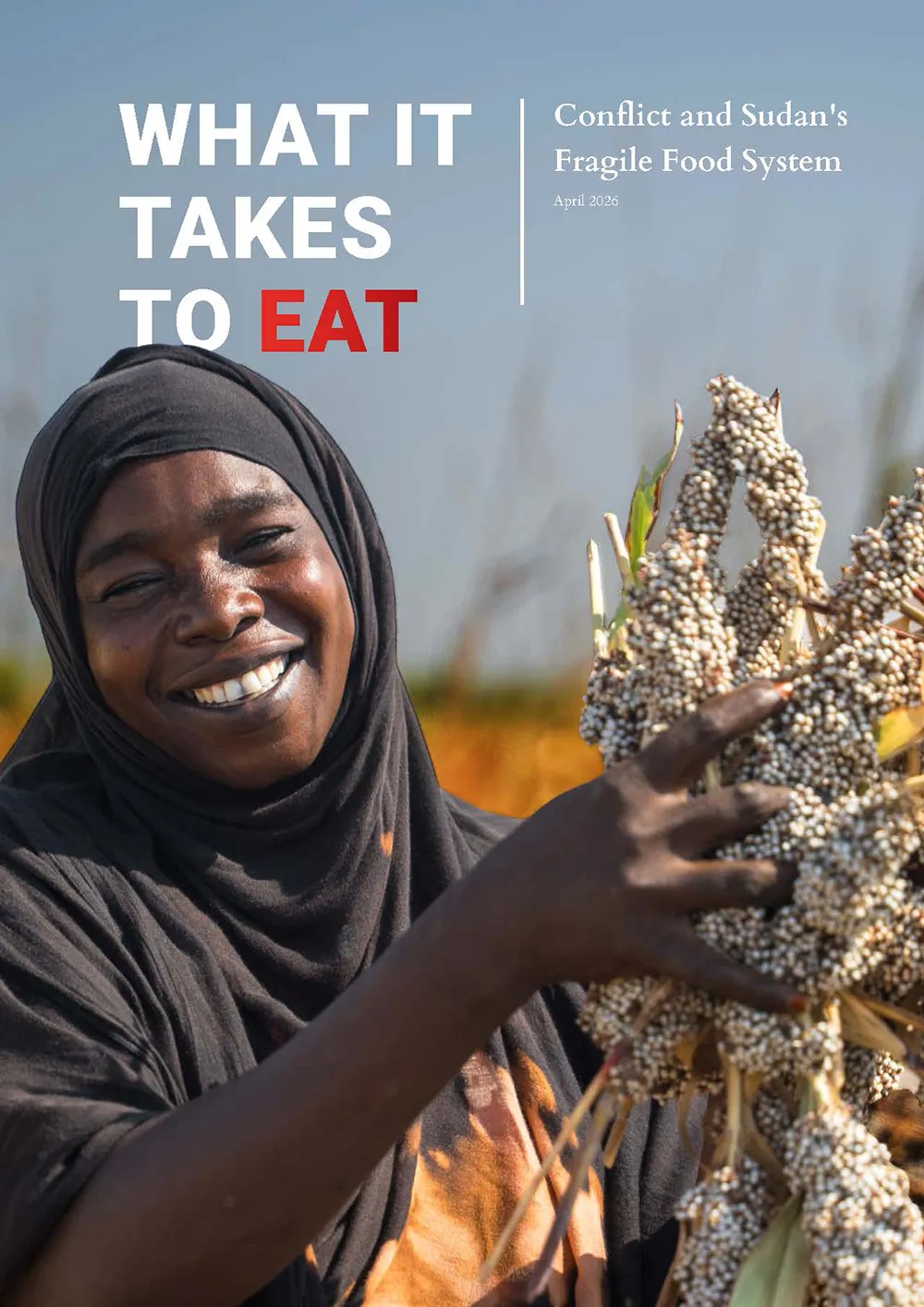
Key findings of What It Takes to Eat: Conflict and Fragile Food Systems in Sudan include:
- Millions of people are surviving on one meal a day or less
- Families are resorting to eating leaves and animal feed
- Female‑headed households are three times more likely to face food insecurity
- Community kitchens are scaling back or closing as funding runs out
Executive summary
The perilous path of food in Sudan
In several areas of Sudan, each meal eaten by a family is made up of ingredients that have crossed one or more battlefields. In fact, these meals are only made possible thanks to efforts by farmers, suppliers, traders and volunteers who risk their lives and safety to feed themselves and others, keeping a fragile food system running. The unrelenting conflict between the Sudanese Armed Forces (SAF) and the Rapid Support Forces (RSF), reinforced by allied armed groups, has made the path of food from farms through markets to household plates treacherous, with devastating consequences.
In the two areas worst hit by the conflict – North Darfur and South Kordofan – millions of families can only access one meal a day. Often, they miss meals for entire days. Many have resorted to eating leaves and animal feed to survive, with child malnutrition spiking. Communal kitchens set up to collectively prepare and share meals are struggling to stretch the scarce food available as resources dwindle.
An Integrated Food Security Phase Classification (IPC) report from November 2025 confirmed famine in El Fasher and Kadugli, and identified a risk of Famine in 20 more localities across Sudan’s North Darfur and South Kordofan. It further alerted last month to famine-level acute malnutrition detected in two more localities. According to the 2026 Humanitarian Needs and Response Plan, more than half (61.7%) of Sudan’s population – 28.9 million people – is now acutely food-insecure, of whom over 10 million are experiencing severe and extreme levels of food insecurity. Sudan’s food crisis is deepening and threatening to spread. The Crisis is being compounded by a worsening economic crisis and climate change.
Nearly three years of conflict, marked by violence, displacement and siege tactics, have systematically eroded Sudan’s food system – field by field, road by road, market by market – producing mass hunger. The United Nations (UN) Independent International Fact-Finding Mission has documented a “war of atrocities” against civilians, including the use of starvation and sexual violence as weapons of war, with direct and large-scale attacks on civilians and civilian infrastructures. 1 Millions of civilians have been attacked, abused and harassed in their homes while attempting to flee and during displacement. Women and girls have faced brutal sexual and gender-based violence that has further restricted their safety, mobility and access to food and essential services, 2 sharply increasing their risk of starvation. Thousands of farmers have been killed, and entire farmlands destroyed. Markets are fragile and vulnerable to violent attacks, closures and predatory taxation.
Still, while the path of food in Sudan has been marked by fragility and catastrophe, it also stands as a testament to Sudanese courage and tenacity in the face of extreme adversity. Sudanese communities are adapting with extraordinary ingenuity and solidarity: planting under fire, trading by the cup, rationing one meal across many mouths and sharing food even when there is barely enough for one family. Across these regions, farmers’ associations, suppliers, transporters and traders, women’s savings groups, Emergency Response Rooms (ERRs), other mutual aid groups, and village committees are keeping food moving – often with no formal funding, little external recognition and at great personal risk.
This report documents the path that food items take in Sudan’s North Darfur and South Kordofan, states that remain active battlefields experiencing famine-like conditions. The path of food in these areas, from its production in farms to consumption by families, is fraught with impediments that demonstrate how the conflict has compromised the country’s already fragile food system. The report combines analysis of secondary data with extensive, primarily qualitative, data on the experiences of Sudanese communities and aid actors drawn from 80 key informant interviews and 40 focus group discussions with displaced farmers, traders, women, men, local responders and humanitarian actors across North Darfur and South Kordofan, as well as in White Nile and Gedaref.
To prevent further death and suffering, it is imperative that parties to the conflict in Sudan cease all actions that exacerbate conflict-induced hunger and that violate their obligations under international humanitarian law (IHL), including the use of starvation of civilians as a method of warfare, unlawful denial of humanitarian access, and targeting of civilians and civilian objects. 3 Restoring Sudan’s food systems will require concerted actions to support production, protect markets, ensure safe movement of civilians and food items, maintain community purchasing power, and address the political economy that weaponises food. Aid interventions must address blockages and disruptions at each stage while building on the sources of resilience already present.