Every year, $1 trillion in food is lost. Women-led solutions are ready to fix this problem.
The global food system has been absorbing shock after shock: wars have sent fertilizer prices surging, a new “super” El Niño could threaten food production, and over 300 million people already suffer from acute hunger. Yet, we continue to lose or waste approximately $1 trillion worth of food every year.
Reducing food loss and waste isn’t just a niche goal: it’s one of the most powerful and immediately actionable investments we can make for food security, women, and the planet.
War and weather: Compounding crises are making hunger worse
Wars in Ukraine and Iran have disrupted roughly a third of globally traded fertilizer. Urea and ammonia prices have surged by around 50% and 20%, respectively, since February 2026. This has left farmers across Sub-Saharan Africa and South Asia facing shortages at the start of planting season.
Meanwhile, the likelihood of a strong El Niño developing in 2026 continues to rise, with NOAA forecasting a 61% probability of emergence between May and July. El Niño is historically linked to maize yield failures in southern Africa, less rainfall in South Asia, and drought across the Sahel — disruptions that will be compounded by conflict-driven instability in food and fertilizer supply chains.
These shocks don’t land evenly. Acute food insecurity has risen for six consecutive years in fragile regions, and women-led households are consistently among the hardest hit.
Why it matters: Reducing food loss and waste builds resilience
Communities that reduce post-harvest losses, convert agricultural waste into biochar or biofertilizer, and store grain safely can be partially insulated from global price shocks. But technological approaches alone are not enough.
Food loss and waste solutions grounded in circular economy approaches – where byproducts become inputs, and nothing goes to waste – reduce dependence on external inputs and build resilience from the ground up.
What works:
- Solar dryers, with products linked to buyers
- Hermetic storage bought through Village Savings and Loans Associations (VSLAs)
- Biodigesters with co-financing with farmers
- Using farm waste to produce biochar
- Women-led food processing businesses
Conditions required for solutions to scale:
- Women’s time burden must be reduced
- Business models must be viable from the start
- Market demand must be reliable, not assumed
- Producers must have access to financing
The core insight: Including women in solutions that work
Women do up to 50% of post-harvest processing, yet they are consistently less likely to adopt food loss and waste technologies. This isn’t due to a lack of desire or ability. It’s because food loss and waste technologies are rarely designed for women.
Barriers to adoption for women include limited control over land, income, and credit; mobility constraints; and invisible labor that measurement systems don’t count.
“Women process the grain, manage the household budget, and absorb the losses when systems fail. Design for women, and you’ve built something that actually scales.”
– CARE Resilient Futures, No-Regrets Investments, 2026
Evidence from the field: What we’ve seen work
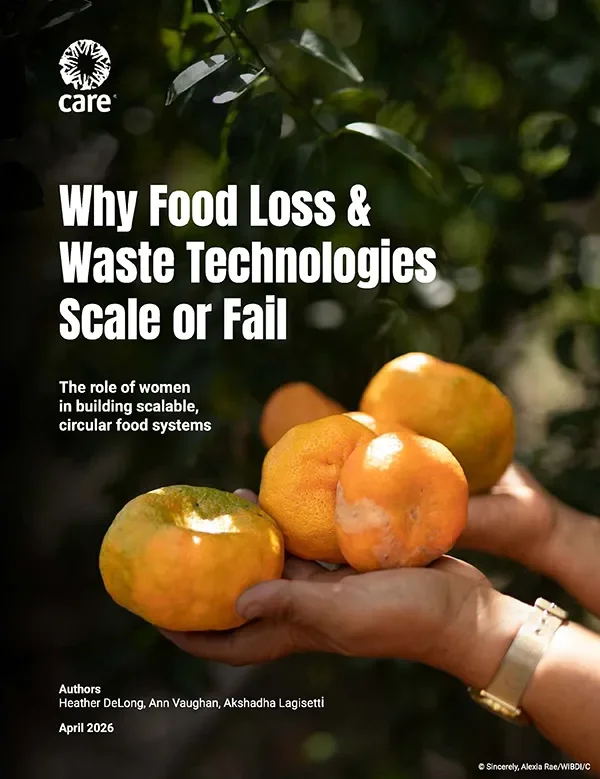
CARE’s 2026 Scaling Food Loss and Waste report draws on evidence from more than 21 countries and over 25 projects. The results are clear: when women have financial tools they control, adoption follows with enduring results.
- In Honduras, 100% of biodigester households are still operating 2+ years after the project ended. Biodigesters with co-financing close the circular loop on agricultural waste and generate income–and they keep running long after the project ends.
- In Niger, biodigester households earned $1,330 of additional annual income and saved women 45 min–1.5 hours of labor daily. Co-financed biodigesters generate income and dramatically improve yields through the biofertilizer they produce.
- In Zambia, there was a 47% increase in hermetic storage adoption among VSLA members compared to non-members. When women control the financing, adoption doesn’t just increase. It sticks.
- In Vietnam, purchase contracts unlocked widespread adoption where years of training alone did not. Solar drying linked to “offtakers” ensures women farmers capture real value, not just extend shelf life.