Heart of the Andes: Indigenous women revive the native Shungo potato

By Becca Mountain November 26, 2025

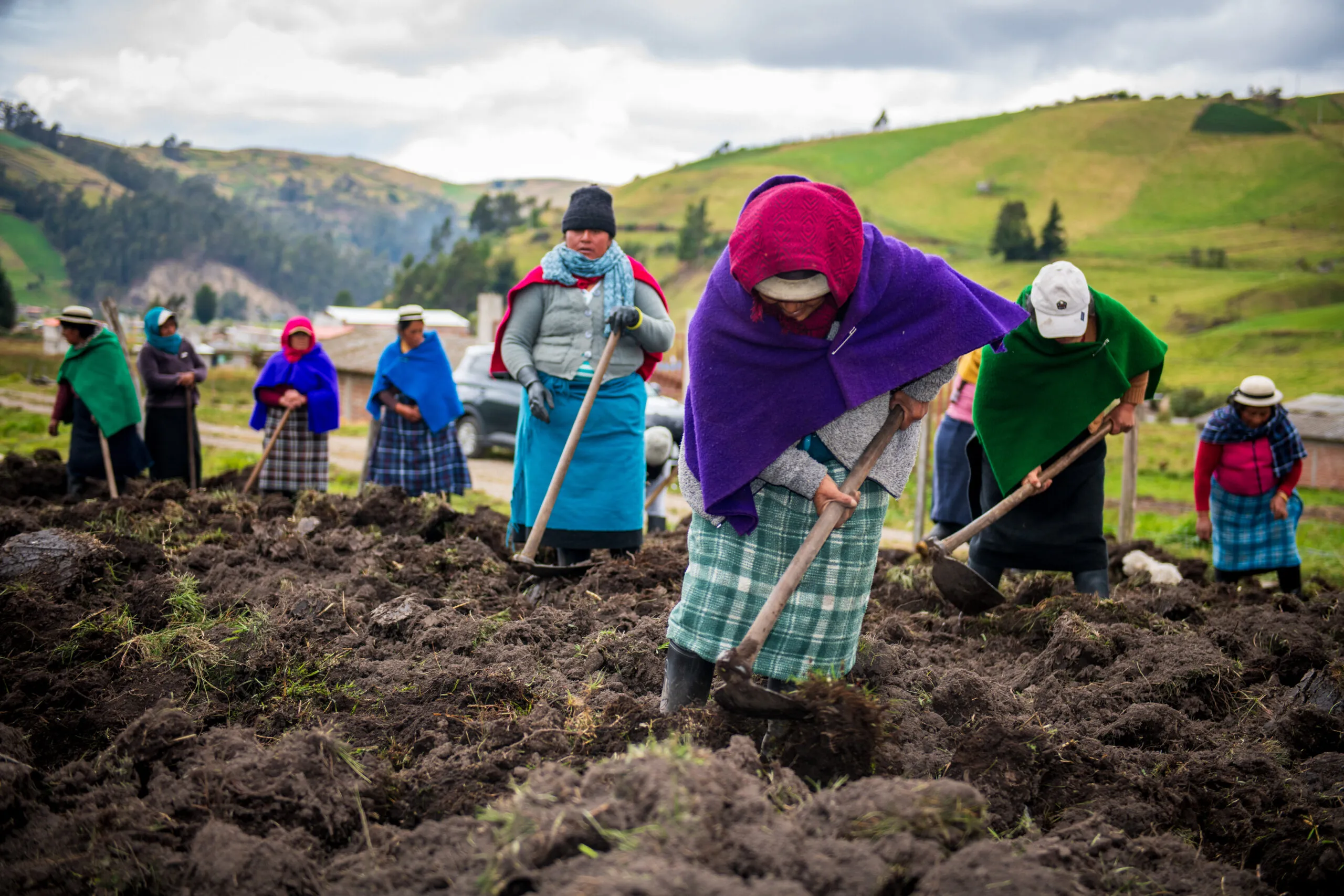
The San Juan Women's Group VSLA tills the field they rent, readying it for planting. Photo: Brooks Lee/CARE.

The wind carries smoke across the highland fields near Riobamba, Ecuador. Someone nearby is burning trash and agricultural scraps, but neither the smoke nor the wind bothers the group of women who have come out, tools in hand, to work their hillside farm.

Want more stories like this?

Sign up for the CARE News & Stories email newsletter to find out more about what’s happening around the world through vibrant, engaging stories that put humanity at the center.

Subscribe.

Dogs of all shapes and sizes trail behind the members of the San Juan Women’s Group, at least one for every farmer. Some boast more robust entourages of two or three scampering mutts, who flop happily onto tufts of bright green grass or into the freshly turned earth, napping in the sun while their humans toil. Rising just over the ridge, the snowcapped, volcanic peak of Chimborazo watches silently over their work.

Here at nearly 10,000 feet above sea level, the soil is rich but stubborn. The farmers, most in woolen skirts and brightly colored shawls, labor with broad-headed hoes. Step by step, they turn over the dark earth lent to them by a local landowner. Their strong, sure strikes carve diagonal furrows designed to catch just enough moisture without letting the potatoes rot.

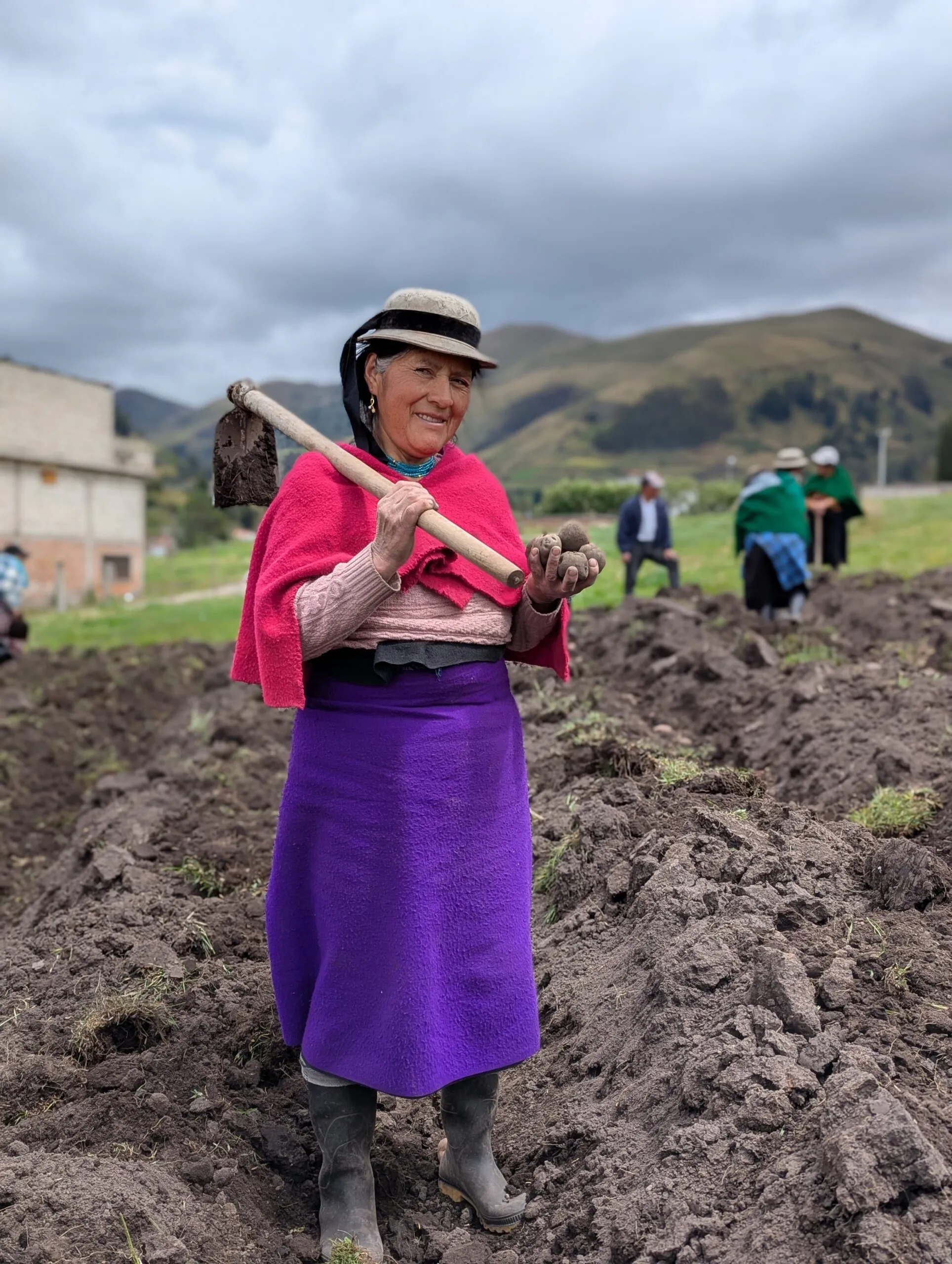
“This variety is called shungo,” says Ana Hortensia Tacuri Socas, smiling as she holds up a small purple tuber. It looks almost black in her strong, work-hardened hands. “Shungo means ‘heart’ in Kichwa. When you cut it open, you see a little corazoncito inside.”
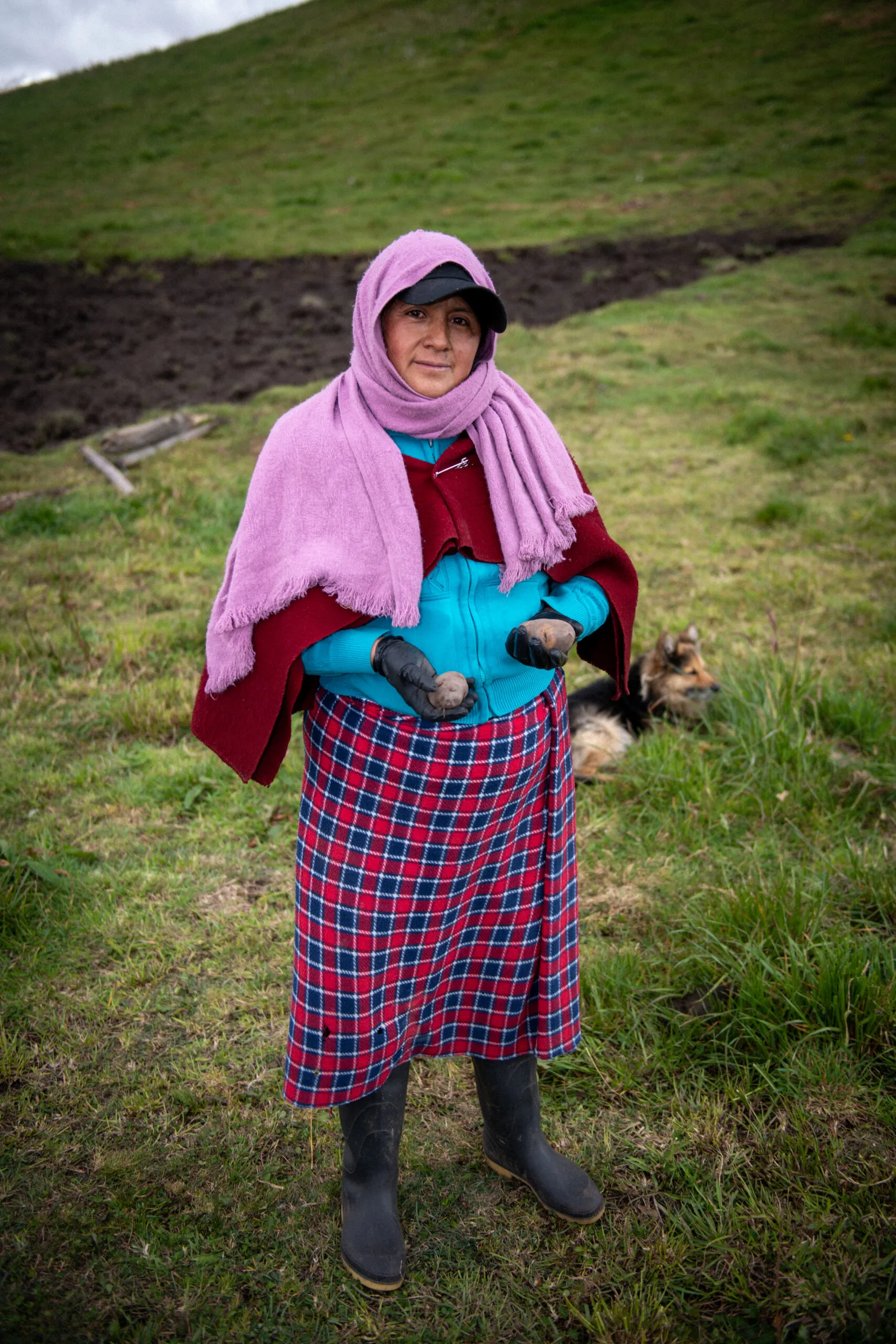
An indigenous woman farmer holds a native variety of potato in San Juan, Ecuador.
Hortensia says that hope "comes from agriculture itself. We grow our own food, we help other communities, and we keep going. That gives us strength.” Photo: Brooks Lee/CARE.

The shungo potato is native to the Andes Mountains. Over 4,000 types of potato have been cultivated in Ecuador, Peru, Bolivia, and Chile, where the Incas are believed to have domesticated potatoes for consumption by at least 3400 B.C.E. These traditional potatoes are richer in vitamins than the uniform crops grown for industrial markets. But despite their dense nutrition and cultural value, many traditional potatoes have all but disappeared from cultivation.

Hortensia carries knowledge about these native potatoes close to her heart — their names, their seasons, their strengths.

“When I was a girl, I learned it all from my grandparents,” she recalls. “They planted varieties like Cecilia Puña, Ratona, Chaucha Roja, and Chaucha Amarilla, all without chemicals, only fertilizing with sheep or cow manure. People were healthier then. Our ancestors and grandparents lived longer. Today, with all the chemicals, even young people are getting sick with cancer, gastritis, and other ailments.”

The San Juan Women’s Group is determined to change that. Together, they are reviving native potatoes and the ancestral ways of growing them, honoring knowledge that was nearly lost. At the same time, the women are pushing their community forward, placing themselves at the center of agricultural leadership.

Hortensia and fellow farmer Mariana plant the potatoes in diagonal furrows designed to retain enough moisture to let the tubers grow while preventing rot. Photo: Brooks Lee/CARE.

“Growing crops naturally feels good,” Hortensia says, describing how they learned to make biol, a natural fertilizer, through a CARE-supported advanced permaculture school. “We mix cow manure and herbs, let it ferment, then spray the potatoes every 15 days. We tested natural, biochemical, and chemical methods to see what would help the potatoes grow best.” She smiles, proud. “The natural methods helped most.”

But the climate here is changing. “Sometimes it rains, sometimes it doesn’t, and sometimes frost destroys everything,” says Fabiola, a fellow farmer and one of the group’s leaders. “Before, we grew crops like oca, mashua, melloco, and habas without chemicals. The food was all delicious. Now, as the weather changes, sometimes the plantings just fail.”

On frosty nights, the women burn piles of trash or place buckets of water in the fields to draw away the frost. “We fight against the cold with whatever we have,” Fabiola says.

When harvests are good, the women store potatoes in the traditional way: straw laid down like a bed, ash sprinkled to keep the tubers from rotting, then covered again with straw. “Like that, they last a year,” Hortensia explains. “In hard times, we could eat them and share with families who had none. The potatoes are good for everyone’s health, worth cultivating and worth preserving.”

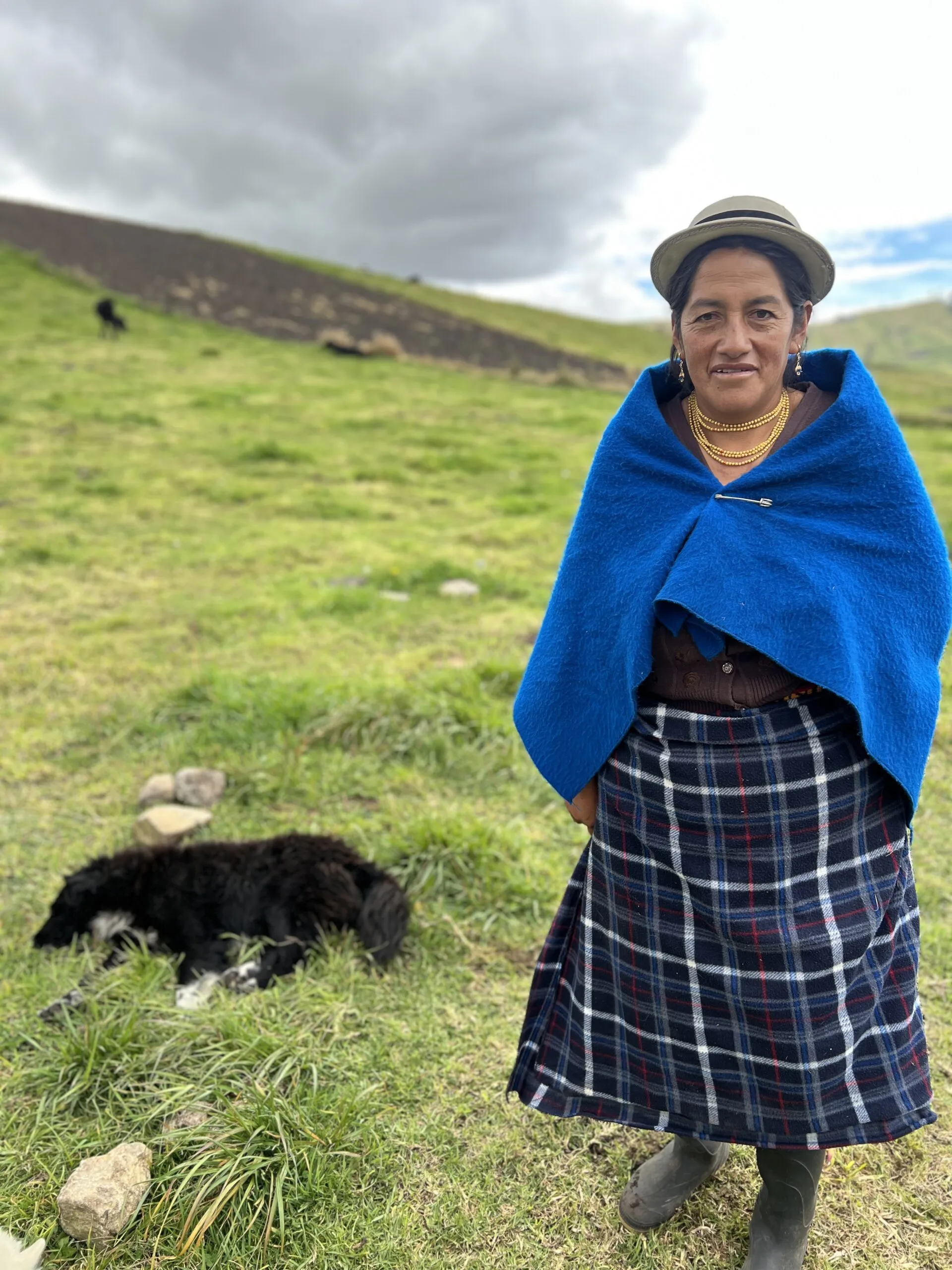
An indigenous woman farmer in San Juan, Peru. She wears an indigo wool wrap around her shoulders.
Fabiola remains undaunted in the face of challenges and setbacks. "We women are like grass," she says, gesturing to the green all around her. "They cut us and we grow back." Photo: Becca Mountain/CARE.

Water, however, is harder to keep than potatoes. “When I was a girl, we dug wells to wash and cook,” Fabiola recalls. Now, cracked storage tanks leak, and what comes through the pipes is often contaminated. “We boil it, but we need clean water. Politicians make promises during campaigns, and then once they’re in power, they forget us.”

It’s not just water that the women struggle with. “We shoulder much of the work. The men go off to find jobs,” Fabiola explains. “The women stay here with the animals. We lead the community meetings and the mingas,” she says. Mingas are traditional Andean work projects where neighbors labor collectively.

“I’ve led meetings and mingas many times,” Fabiola says. “Sometimes I want to quit, but they always choose me again. I think it’s because I like to encourage others, especially women who don’t yet have the courage to say, ‘I can.’”

This is a much different reality than either woman grew up with. “Years ago, when I was young, women couldn’t speak in public,” Hortensia tells us. “There were no women leaders. But now, there are women presidents of communities, women professionals. We are respected, too, because we have knowledge that makes a difference. That makes us happy.”

An indigenous woman farmer in a vibrant purple skirt holds a hoe and native potatoes in San Juan, Ecuador.
Members of the San Juan Women's Group have already graduated from two CARE-supported agricultural programs. Nearby communities now often come to them for advice, education, and guidance. Photo: Anell Abreu/CARE.

Around them, laughter carries on the wind as the women bend over the earth, their dogs chasing each other around the craters left by hoes or soliciting scratches from passing hands. Neighbors pause on the path to greet the farmers, curious about the day’s labor.

“We women are teaching our daughters and sons to keep planting these potatoes,” Hortensia says. “I feel very happy to be called a guardian of these potatoes and this community. If we lose this knowledge forever, it will be very hard to return. I would feel so sad. But if it flourishes again, it would be a happiness for us, and for the whole world.”

These women are proud of their work. They talk of their next goals: a new water pump, an early warning system for drought. They want to save up to buy their own land and have plans for a tourism project involving a cheese shop and overlook for the many visitors who come to see or climb Chimborazo.

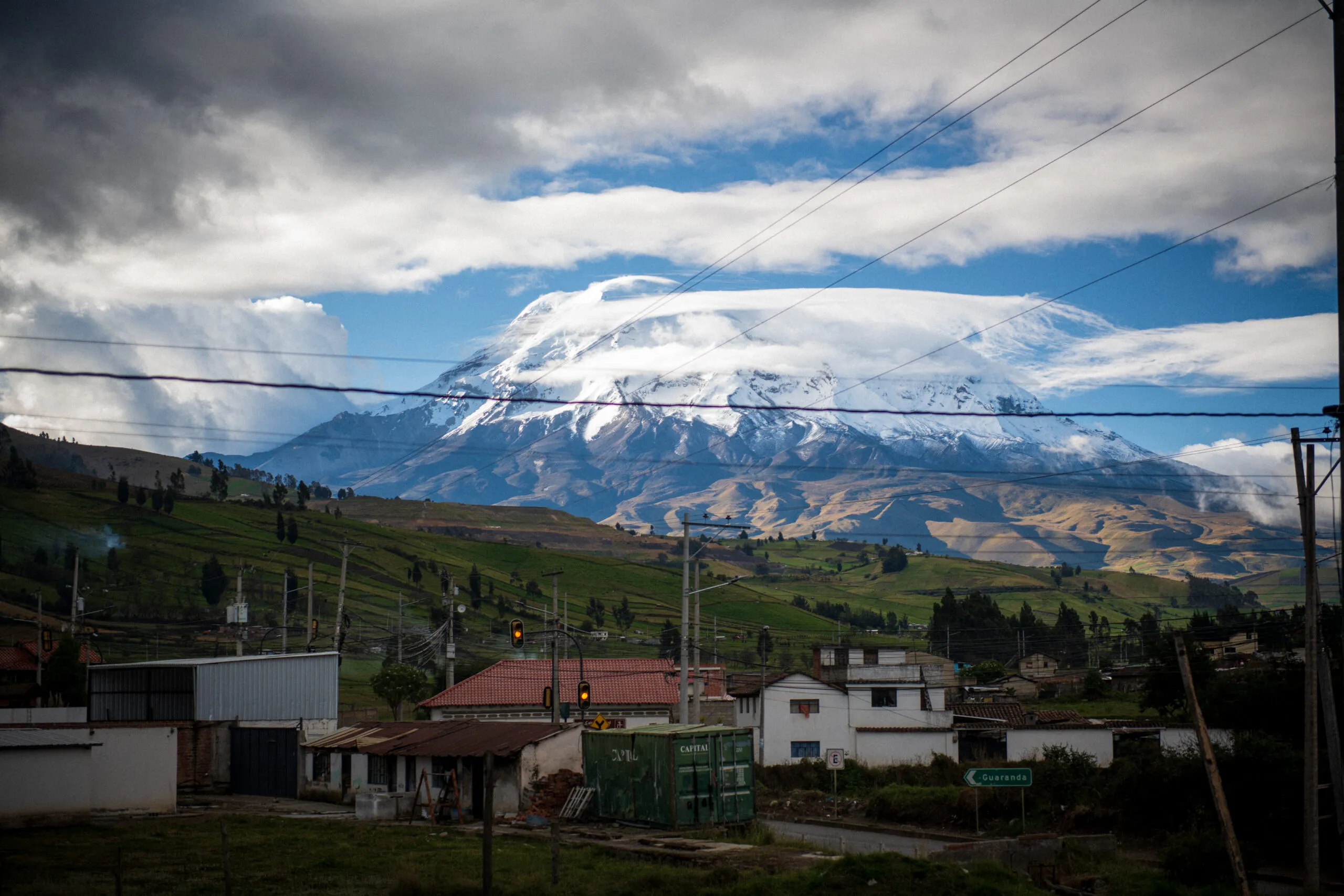
Chimborazo’s famous peak rises above the shungo field, a steady reminder of what these women are working to strengthen and protect. Photo: Brooks Lee/CARE.

“This is a beautiful place, near Mount Chimborazo. It is our great colossus that surrounds our lives,” Hortensia says.

She looks across the rows of earth, the happy dogs, the laughter of her compañeras, and the monolithic figure of Chimborazo rising in the distance.

“Our hope comes from agriculture itself,” she says. “We grow our own food, we help other communities, and we keep going. That gives us strength.”

Fabiola nods. “What gives me hope is unity. Perseverance. If we say, ‘Let’s do this,’ and keep going, we’ll succeed. We women can’t just wait for our husbands. We can weave, we can plant, we can sell. Together, we’ll move forward.”

As the dogs doze and Chimborazo’s snowcaps glitter in the distance, the women carefully plant row after row of heart-shaped potatoes — ancient crops made new again, carrying with them culture, resilience, and the strength of women who refuse to be invisible.

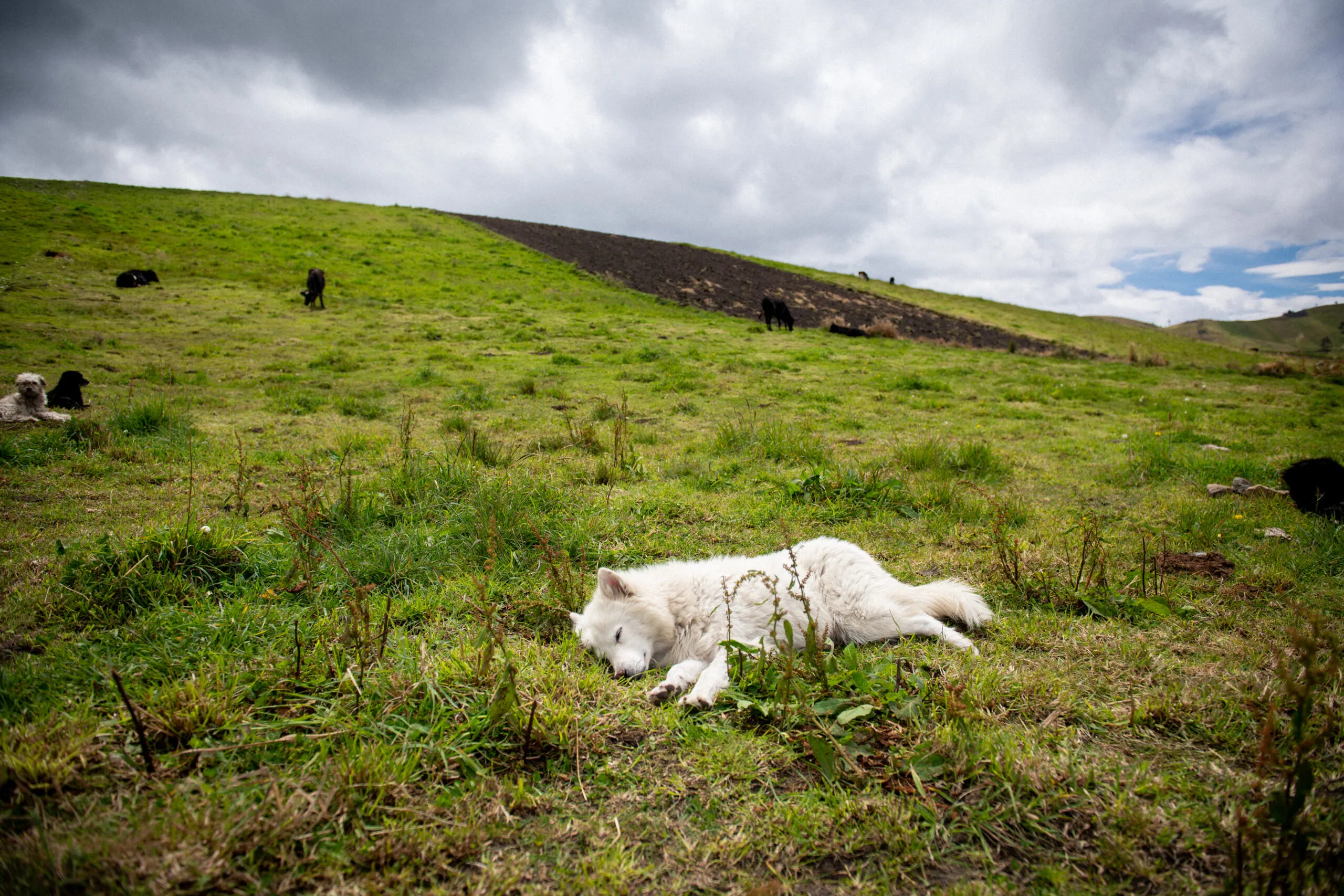
A white dog naps in the sun. In this quiet moment, the hillside holds the warmth, hope, and strength the women have planted here. Photo: Becca Mountain/CARE.
Back to Top