From the plant to the pot: Women farmers in Cotopaxi build dignity and a future

By Becca Mountain March 13, 2026

Portrait of Josselyn Vega standing in front of the De la Mata a la Olla agroecological market in Latacunga, Ecuador.

Josselyn Vega, president of the De la Mata a la Olla (“From the Plant to the Pot”) agroecological fair, finds a moment to rest during a busy market day. Photo: Brooks Lee/CARE.

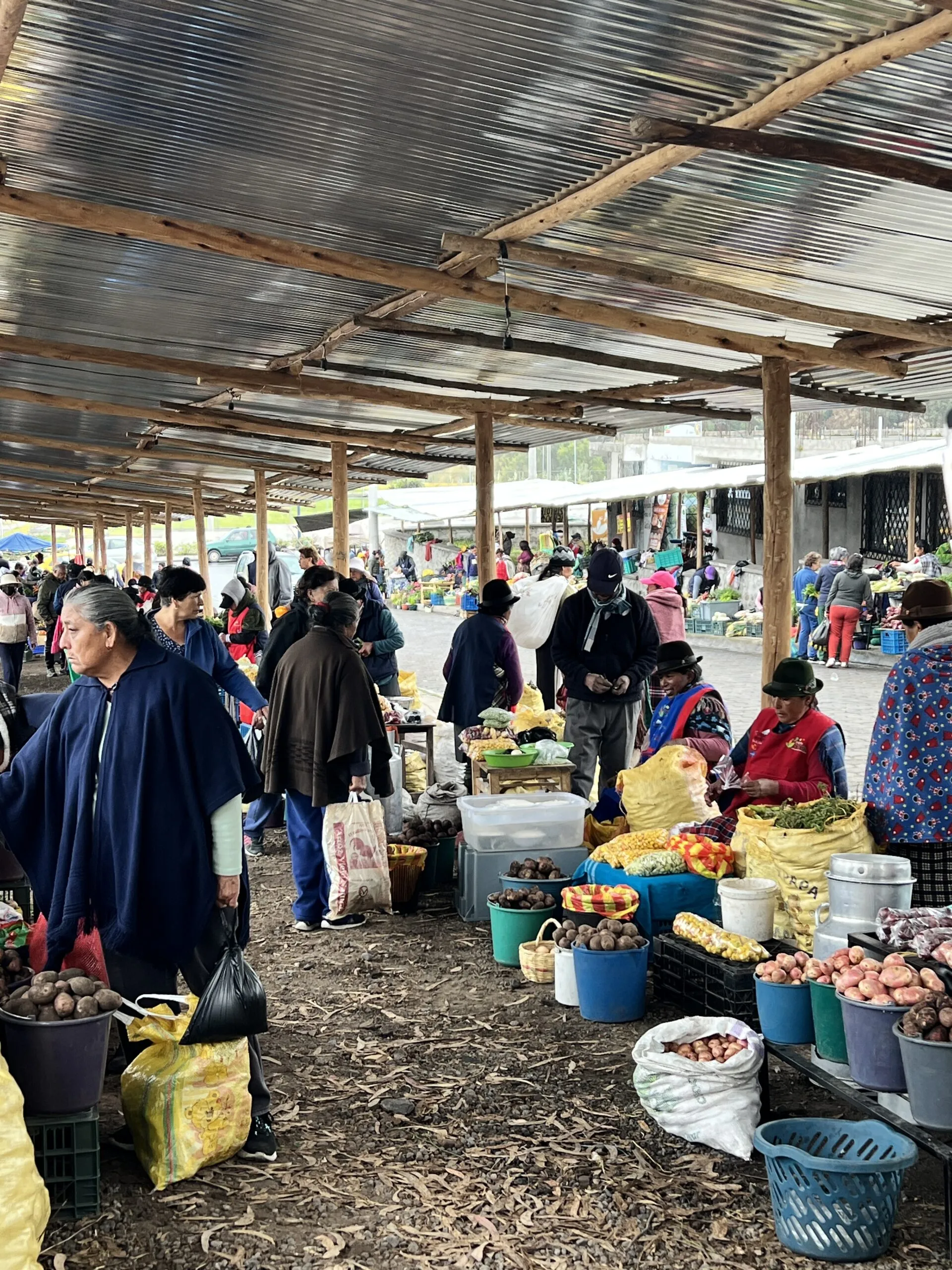
The weather shifts quickly in Latacunga, Ecuador. Misty drizzle cools the market before the sun breaks through the overhanging clouds, warming shoppers who “dress like onions,” layering ponchos, sweaters, and jackets. The fair is wedged between a busy roundabout and a quiet cobbled side street in the shadow of Cotopaxi, the most threatening active volcano in all of Latin America.

Be part of what CARE makes possible.

Get stories, updates, and actions you can take to support women and families worldwide.

Subscribe

A living market

Beneath tall wooden posts and corrugated iron roofs, women in red aprons and felt hats arrange baskets of corn, herbs, and a rainbow of potatoes: deep purple, cherry red, golden yellow. Coins jingle as couples, mothers with children, and men carrying baskets meander past the stalls, looking for just the right ingredients. The smell of rain on dust mixes with savory fried corn kernels, coffee, and soup simmering across the cobbled street in a modest food hall, where vendors serve breads, stews, and pastries all made from local produce. One stall offers homemade wine. Another has brown sugar chipped from heavy loaves, sold by weight.

“This fair is about more than money,” says Josselyn Vega. She brushes soil-stained fingers against her apron and sweeps her long black braid behind her shoulder. “It’s about sharing, about caring for our land so that our families and our customers are well-fed. Here, I see happiness. I see peace.”

Vega is the president of a collective of 120 women farmers who created the De la Mata a la Olla agroecological fair. Held every Monday and Thursday in Latacunga, the fair’s name means “From the Plant to the Pot.”

“Our produce doesn’t go through middlemen,” Vega says proudly. She has a soft face made for smiling and bright, brown eyes that shine with pride as she looks over her own stall, which is laden with lettuce, tomate de árbol, onions, carrots, kale, and zucchini. “It comes straight from our farms — fresh, direct, and alive.”

Selling produce directly to consumers instead of going through middlemen allows the members of the farming collective to keep more of their income. Photo: Brooks Lee/CARE.

From discrimination to dignity

That sense of dignity was hard won. Eight years ago, the market began with just seven women, compañeras who recently graduated from an agroecology school. Their first chance to grow came when the Prefecture allowed them space at a wholesale market. But what they’d hoped would be a dream quickly soured. “We were discriminated against in many ways,” Vega says. Some days, the women earned as little as 25 cents total. “Looking back, we now see it was violence. At the time, we just endured.”

Later, they moved to another plaza, but they faced difficulties there, too. They were pushed out of the plaza and into the streets whenever festivals or other events were held, which made it difficult to build a reliable client base. When sales failed, they survived by bartering amongst themselves.

“If I didn’t sell my lettuce, I’d trade it for oranges or papayas. At least that way, I didn’t go home with the same produce,” Vega remembers.

The turning point came when they joined forces with the Indigenous and peasant movement of Cotopaxi, who welcomed them and helped secure a permanent space. Through minga — a local, traditional form of collective work — they built the covered stalls that now protect them from the Andean sun and rain. They also established a Village Savings and Loan Association (VSLA) supported by CARE, a self-managed savings system that freed the women from predatory bank loans.

“Finally, we were able to sell with dignity,” Vega says with a smile that dimples her round cheeks. “Now, nothing is wasted. If even an onion is left over, it becomes soup or compost. Everything is used. We take more food home to our families. We never return with empty hands.”

Josselyn Vega holding a microphone while speaking to members of a women farmers collective.
Josselyn addresses members women farmers collective. Once excluded from leadership roles, Vega now represents producers across Cotopaxi province. Photo: Brooks Lee/CARE.

Stepping into leadership

For Vega, the transformation is deeply personal. “At first, many of our members couldn’t even leave their homes without their husbands’ permission,” she says. “If we wanted to attend a workshop, we had to prepare breakfast, lunch, dinner, and care for the animals and children before even stepping out the door.”

Now, she says, things have changed. Families share the work, and women have space to grow. “Today, we are seen as capable women. We are able to feed and care for our families, but also to be independent, to lead, to organize.”

That shift hasn’t always come easily. Even within their own associations, women weren’t trusted to lead.

“They didn’t believe a woman could be president,” Vega remembers. “It was always men’s work. Sometimes it felt like they were just waiting for me to fail.”

But she didn’t give up, and she didn’t fail. Vega is president of the Asociación de Productores Agroecológicos de Cotopaxi, representing more farmers across Latacunga, Pujilí, Salcedo, La Maná, and Pangua.

“Now, I’m not afraid,” she says. “I can lead meetings, answer questions with confidence, even travel to other countries to share our experience.”

Wide view of shoppers and farmers at the De la Mata a la Olla agroecological market under a covered structure.
The covered stalls were built through minga, a tradition of collective community work, and now provides a reliable space where women farmers can sell their harvest with dignity. Photo: Becca Mountain/CARE.

A future grounded in tradition

For many of the women here, most of whom are of Indigenous ancestry, the fair is also a way of making their language, traditions, and farming knowledge visible in a society that has often marginalized them. They speak a mix of Spanish and Kichwa as they chat with customers and their neighbors. They carry that heritage, too: potatoes so deeply purple they are almost black, mashwa roots that are seen both as medicine and as food, corn of all shapes and colors, beans the size of a toddler’s fist. Crops like these have been cultivated in the Ecuadorian highlands for generations.

Vega’s proudest moments come not only in the market, but at home. On the holiday when we visited, her daughter — usually in school during market hours — stood beside her stall, confidently weighing bunches of beets and heads of cabbage for customers.

“So few young people want to be in agriculture anymore,” Vega says, watching her daughter counting out change. “But my children understand the importance of keeping Pachamama alive, of caring for water, of not wasting.” (Pachamama, often translated as Mother Earth, is an Andean concept of the earth as a living being.) “They are growing up conscious, and that makes me proud as a mother.”

Her journey hasn’t been without doubts. When authorities once ordered them to sell near a trash dump with no shelter, she nearly gave up. “I couldn’t sleep, thinking no one would follow us,” she admits. “But I told myself: we are the only agroecological fair in Latacunga. People will come. And they did.”

For her, the fair is more than a market—it is proof of women’s power. “We are visible now as capable women,” she says. “We can feed our families, but we can also earn, organize, and live the lives we deserve.”

Josselyn Vega holding fresh lettuce in front of her produce stall in the agroecological market.
For Josselyn and the farmers she represents, this market is more than a place to sell food. It’s proof that their knowledge, work, and leadership are shaping a stronger future for their families and communities. Photo: Brooks Lee/CARE.

Growing strong

Today, Vega dreams of even more. “I don’t want to be an old woman who’s sad or in debt,” she says. “I want to be free, capable, still organizing, still doing big things.” She envisions a family tourism project with cabins, gardens, and a pool, somewhere visitors can harvest food and learn about her community’s way of life. “I want to keep growing, and I want my children to grow up empowered, doing what they love.”

Her strength, she says, comes from her close family: her husband, her mother, her kids, and even her three dogs. “Just seeing them, hugging them, asking about their day… That solves half of life’s problems for me,” she says with a laugh.

As one wave of shoppers leaves with armfuls of vegetables, flowers, bread, and other products, another group arrives to take their place. All are greeted by the laughter and bargaining chatter of women who have transformed a once-hostile market into a safe haven of possibility and resilience. Beyond providing food and income, the fair safeguards their precious cultural heritage. Every stall is a reminder that traditional Andean crops, once at risk from industrial agriculture, are still feeding families and communities today.

“This is success,” Vega says, her eyes bright. “We are producing, living from what we produce, eating from what we grow. That’s the life we deserve.” For her, that life is built on the care that has turned struggle into strength, and a market into a movement.


CARE Ecuador supports organizations like the Association of Agroecological Producers of Cotopaxi through the Rural Women project. Since 2021, this initiative has worked across Ecuador’s central highlands to strengthen local leadership and promote action on environmental concerns. In Cotopaxi, CARE’s support includes strengthening women’s participation and leadership in local decision-making, providing training on influencing local public policy, developing community initiatives and marketing strategies to expand the reach and visibility of women-led agroecological enterprises, and more.

Back to Top