Nigeria: VSLA Women and the Global Food Crisis
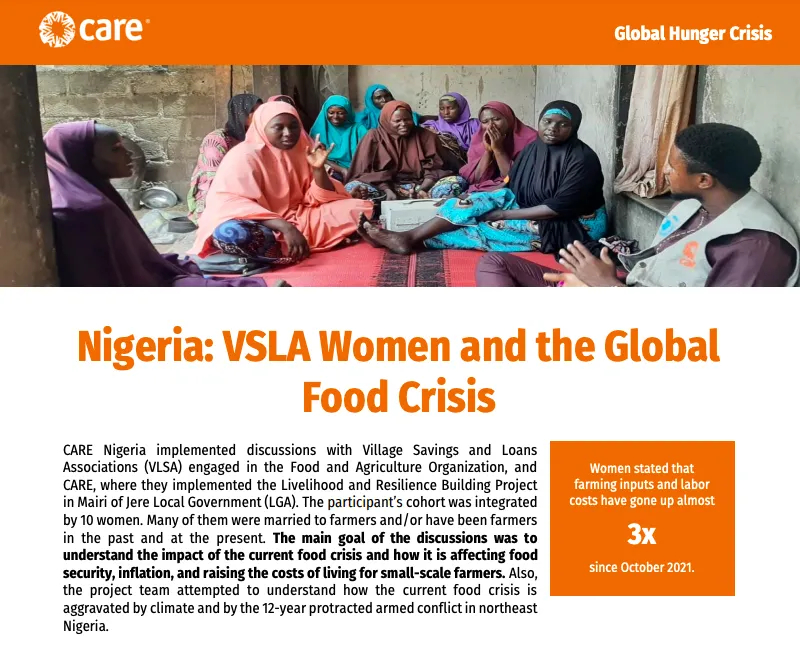
CARE Nigeria implemented discussions with Village Savings and Loans Associations (VLSA) engaged in the Food and Agriculture Organization, and CARE, where they implemented the Livelihood and Resilience Building Project in Mairi of Jere Local Government (LGA). The participant’s cohort was integrated by 10 women. The main goal of the discussions was to understand the impact of the current food crisis and how it is affecting food security, inflation, and raising the costs of living for small-scale farmers. Also, the project team attempted to understand how the current food crisis is aggravated by climate and by the 12-year protracted armed conflict in northeast Nigeria.
Related Reports
Women (in VSLAs) Respond Report: What women told us in 2025
This report shares the voices of VSLA members in seven countries, who told us compounding crises are leaving them hungrier, poorer, and less resilient than before. Despite this, once again, women tell us they are stepping up, supporting each other, and leading the response in their families and communities.
Building Financial Resilience Against Digital Risk
Digital access without protection isn't inclusion. For a woman running a micro or small business, going digital is a growth strategy. A mobile wallet lets her track high volumes of transactions. Social media reaches customers her storefront never could. Digital access to her bank account keeps her money safe. But the same activity that drives her growth also expands her exposure. Every new channel is another way for a scam to reach her.
From Evaluation to Action: Locally Financed Water Funds in Ecuador
CARE, CARE France, and CARE Ecuador are excited to share the results of an ex-post evaluation of the Pedro Moncayo Water Fund, a conservation financing mechanism established in 2019 that protects, conserves, and restores freshwater ecosystems used by 200,000 people for drinking water and livelihoods in Ecuador.