Executive summary
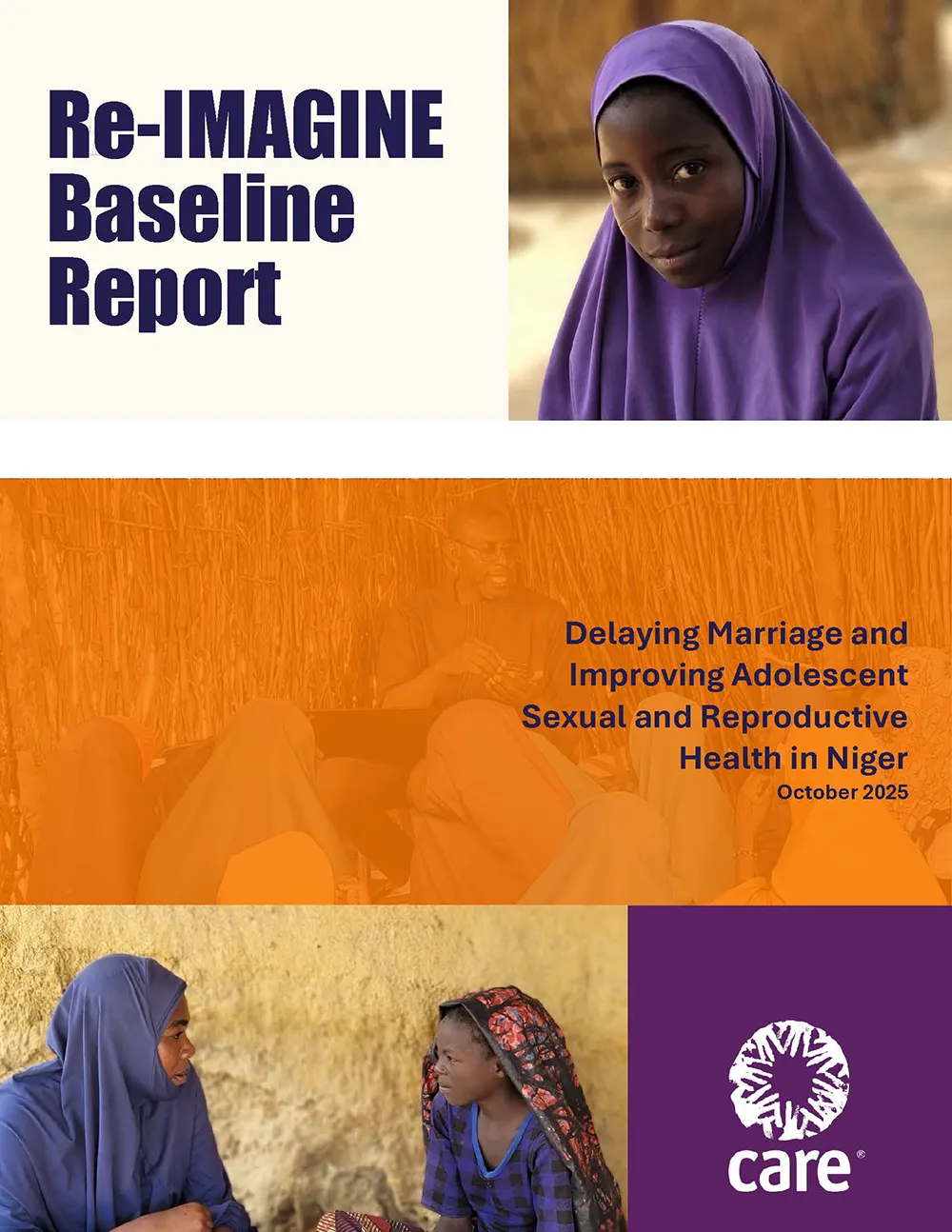
The Re-Inspiring Adolescent Girls to Imagine New Autonomous Pathways (Re-IMAGINE) program (2024–2029) seeks to delay child, early, and forced marriage and unions (CEFMU) and delay first pregnancy among out-of-school, unmarried adolescent girls aged 11 to 15 years in Zinder, Niger. Adapting the successful “Pathways” model implemented by the Center for Girls Education (CGE) from Nigeria, CARE and its partners are implementing a cluster-randomized controlled trial (cRCT) to test a comprehensive intervention package that includes academic catch-up programming, social norms engagement, and schooling support as the default pathway for girls, with livelihood training as an alternative pathway. As Niger faces the highest rates of early marriage and adolescent pregnancy for girls in the world, with rates in the Zinder region even higher than the national average, Re-IMAGINE aims to demonstrate the changes and cost-effectiveness of evidence-based interventions to support girls’ futures, adapted from the success achieved for girls in Nigeria.
Re-IMAGINE’s baseline study, conducted in mid-2025, consisted of quantitative and qualitative data collection. The quantitative survey randomly sampled 2,500 unmarried, out-of-school adolescent girls (ages 11-15), 900 religious and community leaders, 690 fathers of girls, and 690 mothers of girls. On average, girls who participated in the quantitative survey were 13.1 years old. For the qualitative component, a cross-sectional social norms assessment was conducted, including 22 in-depth interviews and 16 focus group discussions (FGDs) to explore social norms, attitudes, and behaviors among out-of-school adolescent girls and key reference groups in two communities.
Following baseline data collection, 4,500 girls were randomized to receive the Re-IMAGINE program interventions, with 1,125 girls randomized to the control group. The first qualitative follow-up assessment will be conducted in mid-2026. The endline evaluation consisting of both quantitative and qualitative studies will be carried out in 2027, following the conclusion of the program. A post-hoc assessment is planned for mid-2028 to assess longer-term program outcomes. The program will also collect costing data over the two years of implementation to assess the cost-effectiveness of the Re-IMAGINE model. Re-IMAGINE’s baseline study provides critical insights into the pre-intervention context, highlighting the challenges and opportunities that shape adolescent girls’ lives in Zinder.
Findings from this mixed-method baseline study across 95 villages in the Zinder region of Niger confirm that early marriage is deeply entrenched, with 87% of girls marrying before age 18 and a median marriage age of 15.4 years. Findings suggest educational attainment is low—only 41% of surveyed girls had ever attended school, and only 24% reported they could read and write. Participating girls completed an average of 1.7 years of school, while those who had ever attended school completed an average of 4.3 years. Despite these barriers, girls expressed strong aspirations: 70% said they would attend school if they could decide for themselves, and 44% hoped to complete senior secondary education. Reasons girls gave for never attending school included the need to work and their families’ refusal to allow them to attend. Reasons girls gave for dropping out of school included the need to work, not wanting to attend school, and academic stagnation. Girls, parents, and leaders perceive that it is acceptable for girls to drop out of school. Compared with the CGE Pathway program at baseline, Re-IMAGINE girls are 33% less likely to have attended school. Additionally, girls in Nigeria are 13% more likely to report that they can read and write. Parents and leaders found that continuing education is acceptable when girls show strong academic promise, especially if financial support or clear employment prospects are available. Girls reported their ideal marriage age was 16.7 years, which is largely aligned with their parents’ reports of 16.4 years. Fathers and community leaders were, on average, much less likely than girls themselves to agree or strongly agree that girls marry before 16: while 81% of girls strongly agree or agree, only 61% of fathers and 56% of leaders do so.
In Niger, social norms strongly support early marriage, reinforced by religious and community leaders. Girls perceive greater community pressure to marry early than parents or leaders report, and fathers are widely seen as the primary decision-makers for both education and marriage. However, mothers often play a more active role in shaping daughters’ choices, while recognizing that these decisions are influenced by a complex web of factors and people, including siblings, extended family, peers, and community leaders. While marriage decisions involve broader networks and more female voices, girls rarely discuss marriage directly with their parents, often relying on intermediaries like older siblings or aunts. Marriage and education are competing choices guided by the same logic: faced with poverty and social pressures, families often view early marriage as the best solution for their daughters’ overall well-being, economic stability, safety, and social standing, often at the expense of continued education. Additionally, negative sanctions for girls who do not marry early, and for their families, and perceived benefits of early marriage, influence families’ decisions. Delaying marriage is viewed as more acceptable by community leaders and parents when they view girls to be “too young,” not physically mature, or not engaging with men and boys in “dishonorable” behavior.
Girls who have been educated are more likely to delay marriage and pursue further education first. As Re-IMAGINE is adapting the Pathways model from Nigeria, this report also compares quantitative results from the Pathways to Scale baseline conducted in 2025 to Re-IMAGINE results. These findings underscore the need for interventions that not only provide access to education but also build girls’ confidence and self-determination. Compared with girls participating in the Pathways to Scale baseline, Re-IMAGINE girls are 33% less likely to have been to school and 13% less likely to report that they can read and write. In Nigeria’s Pathways baseline, girls reported an ideal age of marriage of 18.7 years, 2 years older than the 16.7 years reported by girls in Niger.
Given the prevalence of social norms that drive early marriage, this report also underscores the need to closely engage religious and community leaders and parents who serve as gatekeepers and can become allies for building a shared vision for girls’ futures. As fathers are the primary decision-makers for girls’ education and marriage, interventions engaging fathers as allies are critical to leverage the slightly lower acceptance of early marriage among fathers compared to mothers and girls. The program may also have specific opportunities with younger girls aged 11-13 and their families to shape aspirations early, while working with girls aged 14–15 who may be facing imminent marriage and school dropout. Given the multiple reasons contributing to school non-attendance and dropout, results indicate the need for multi-level interventions that pair social norms shifting and improvements in educational quality with financial support for girls’ school-related costs. Finally, the program should leverage “cracks” in prevailing norms—such as support for academically promising girls or delays in marriage due to financial constraints —to promote positive change and expand opportunities for adolescent girls in Zinder.
The Re-IMAGINE program has integrated these recommendations into its implementation plan with girls’ groups for academic catch-up programming and building girls’ self-efficacy; into its continual engagement of religious and community leaders and school management committees; the social norms interventions among parents, boys, and community leaders; and schooling and livelihoods support that will be tested for their added contribution in delaying marriage and first pregnancy.