
Executive summary
Women-led micro and small enterprises (MSEs) are already delivering climate solutions across critical sectors, from clean energy and food systems to waste, water, and digital services. Yet despite more than USD 1 trillion flowing into climate finance each year, only a small fraction reaches these businesses, and less than 5% supports adaptation (Climate Policy Initiative 2023). This gap is not due to a lack of viable opportunities, but to a mismatch between how capital is structured, where it flows, and how these businesses operate. Women-led MSEs consistently outperform on loan repayment and community adoption, yet receive a fraction of global climate finance (IFC 2023).
This is not a pipeline problem. It is a market design problem.
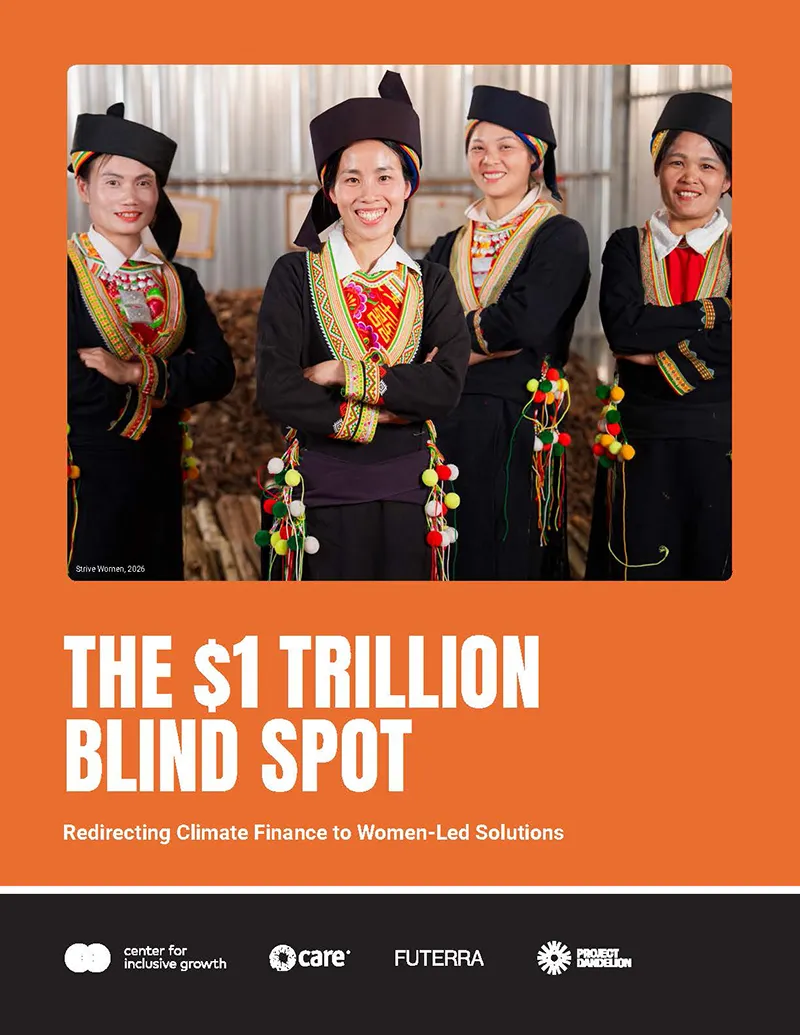
The $1 Trillion Blind Spot: Redirecting Climate Finance to Women-Led Solutions examines 10 economic systems where women-led enterprises are active in climate solutions and where better-designed finance could help them grow. The report highlights practical opportunities for investors, financial institutions, companies, policymakers, and multilateral actors to align capital with businesses already strengthening resilience, reducing emissions, and meeting community needs.
Findings
- Women are delivering solutions and can grow impact with the right support. Women-led enterprises are active across sectors that matter for climate mitigation and resilience, distributing solar products, running agro-processing businesses, managing waste streams, and providing essential local services.
- Finance is not reaching women-led MSEs because most climate finance is structured for large projects, large tickets, and familiar risk profiles. This disadvantages smaller, locally embedded businesses. For many women-led enterprises, the issue is a mismatch between how finance is designed and how their businesses operate.
- The financing gap has climate consequences. These enterprises operate close to where emissions can be reduced and where communities are adapting in real time. These enterprises are also trusted to deliver solutions in their communities. When they are underfunded, opportunities to scale practical, place-based climate solutions are missed.
Women-led climate solutions at a glance
The blueprint highlights 10 broad economic systems and sectors, organized by system group, where this dynamic is especially visible. These groups represent distinct but interconnected roles in the climate economy. Progress depends on all three working together.
Essential systems
Essential systems deliver the services that underpin resilience and economic participation
- Energy access and services
- USD 2.5T market by 2033. Women represent 27–30% of the off-grid solar workforce and most distribution agents in key markets, yet often lack the capital needed to scale.
- Mobility and local infrastructure
- USD 1.1T opportunity by 2035. Women-led MSEs already deliver last-mile logistics and shared mobility in informal and peri-urban markets, often without adequate access to capital.
- Water and sanitation systems
- USD 652B market by 2034, with a USD 85.6B funding gap and 3.5 billion people unserved. Women run the majority of last-mile water and sanitation services in low- and middle-income countries (LMICs) and are trusted community delivery providers.
- Skills, care, and social infrastructure
- USD 520B childcare market by 2030, care demand rising 10% this decade. Women-led MSEs are the primary childcare and green skills providers in underserved markets. Investing here supports workforce participation across every other sector.
Circular and regenerative systems
Circular and regenerative systems reshape how resources are used, reducing emissions and restoring value.
- Textiles and apparel
- USD 500B is lost annually to a linear model; circular alternatives represent USD 73B today, with a USD 10–20B profit pool by 2030. Women make up 80% of garment workers globally and already lead circular models in resale, repair, and regenerative fiber.
- Waste and circular services
- USD 530B+ market by 2030 within a USD 4.5T circular economy transition. Women make up 50–80% of the waste workforce in LMICs, often operating without contracts, finance, or protective equipment.
- Food systems
- USD 10T market by 2030, with a USD 4.5T annual opportunity from food system transformation. Women represent 43% of global agricultural labor, and up to 60% in LMICs, but receive a fraction of inputs and credit.
Enabling systems
Enabling systems provide the conditions that allow all solutions to scale
- Nature-based solutions
- Investment must triple to USD 542B by 2030. Women-led MSEs are active in nurseries, reforestation, agroforestry, and ecosystem monitoring, delivering the local stewardship that makes restoration last.
- Information and digital services
- Climate tech grows from USD 38.5B to USD 115.4B by 2030. Women-led MSEs provide critical last-mile translation between technical climate data and actionable decisions, integrating Indigenous and local knowledge.
- Financial services
- USD 5.7T annual MSME financing gap; 589 million women in countries at risk to climate shocks lack formal finance. Women-led MFIs and cooperatives are already helping to fill this gap where appropriate financial products have not previously existed.
Calls to action for investors
Finance is not reaching the women-led enterprises driving climate solutions. This is not primarily a capital shortage, but a failure of design and delivery. The financing exists, but it is not structured around the realities of women-led businesses.
- Investors and financial institutions must redirect climate finance toward women-led enterprises, channel funding through local intermediaries, and design financial products and terms that fit how these businesses operate, including appropriately sized, flexible, and blended approaches.
- Corporates must use procurement, offtake, and supply chain finance to create demand, strengthen revenue visibility, and integrate women-led enterprises into value chains.
- Policymakers and multilateral actors must ensure climate finance reaches women-led and local enterprises, strengthen local financial systems, and use public tools such as guarantees and incentives to shift investment toward underfunded sectors.
This blueprint was developed by Futerra, Project Dandelion, and CARE, with support from Strive Women, a Mastercard Strive initiative supported by the Mastercard Center for Inclusive Growth in partnership with CARE. The initiative aims to strengthen the resilience and growth of women-led MSEs through improved access to finance, digital tools, and ecosystem support.
This blueprint is a continuation of Project Dandelion’s “Invest Where the Impact is Greatest” project and aims to answer the next logical question: If finance can strengthen women-led MSEs, where should it flow to accelerate both economic and climate transitions?
Together, the authoring partners bring complementary expertise in climate systems, cultural narrative, development that responds to women’s needs, locally led adaptation, and financial health for MSEs.