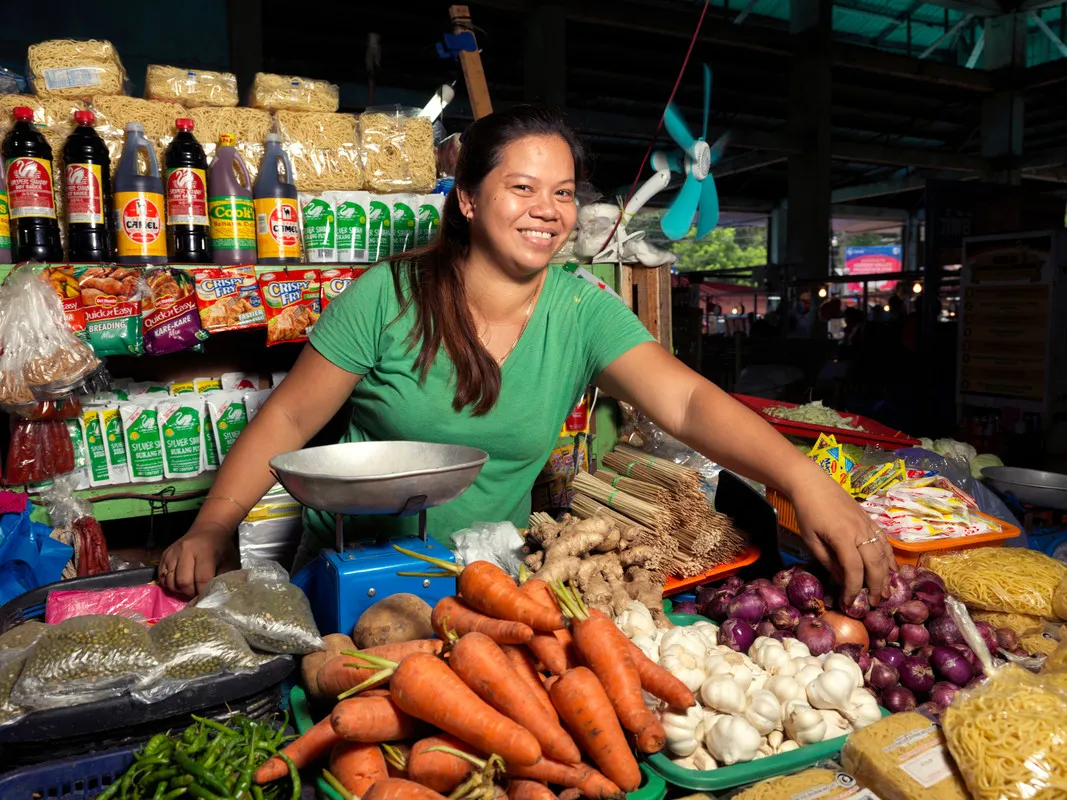
This partnership aims to equip 1,500 frontline community health workers in the Philippines with a comprehensive digital professional development platform by the end of 2026. By blending CARE’s local expertise, data and community relationships with Takeda’s resources and experience, together we are enabling community health workers to have access to the resources they need to deliver the care that is needed.
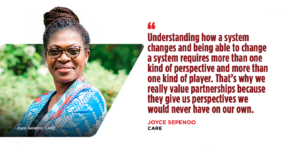
Takeda sat down with Joyce Sepenoo, senior director of health, equity and rights, and Emily Janoch, associate vice president for thought leadership and design from CARE, to explore how CARE aligns priorities and mobilizes partners, like Takeda, to create societal value.
CARE’s health strategy aims to impact 50 million people by 2030. From a health equity perspective, what does “impact” mean for CARE, and how do you translate that into action on the ground?
For us, impact means more than just reaching people with information or services, it’s about ensuring sustainable life-changing outcomes, especially for women and families. We take a localized approach, drawing on data and multi-stakeholder partnerships, including like the one we have with Takeda in the Philippines, to address the specific access challenges that health care systems and individuals face. Central to this is engaging with and listening to communities.
Through engaging with women’s groups, youth-led groups, community leaders, government officials, and of course health workers, we are able to understand the health needs and health behaviors of different groups in local settings. This allows our programs not only to reach them, but to drive impact. Take, for example, pregnant women looking for antenatal care, we want to ensure they not only know how to access health facilities or professionals, but that they are taking the steps to do so to support a safe and supportive delivery environment.
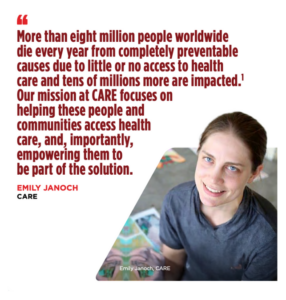
Data is often described as the foundation for system transformation. From your perspective, how can data, and partnerships around data, drive impact and create value?
Every health care system has its own approach to data, responding to the nature of their specific geography. Integrating into these local data systems is central to truly driving impact. At CARE we look to utilize existing data to support program development and delivery with our partners but also feed data from initiatives back into these systems to support wider access and policy development.
“She Heals the World” is an example of this approach in action, where, together with Takeda, we are actively working with the government to connect the data that is generated by the initiative back into the existing Ministry of Health system in the Philippines.
You’ve highlighted the importance of working directly with communities. How do you bring together data and community engagement?
It is vital to understand the unique set of challenges within individual systems, and data only tells part of the story. Health care workers in the Philippines, for instance, face a number of challenges such as limited skills, being underpaid, or in some cases not paid at all, and not being connected effectively to the wider health care system and heavy workloads. It is only by spending time in communities that, together with our partners, we are able to fully understand how these challenges manifest.
This engagement, especially at the local level, is critical when it comes to grounding data from initiatives such as She Heals the World in the realities on the ground. It enables us to identify what more could be done and how social norms around care-seeking are shifting. It allows us and our partners to align the health system’s perspective of what is working well with the community’s perspective, and then work together to solve problems and bridge gaps. We have found that this approach drives better solutions and, critically, better relationships between communities and health workers.
In fact, some of our best solutions come from communities saying, “This is what I’m already doing. Can you help me do more of it? Can you help me do it faster?”
How important is it for you to work with the private sector to create lasting and meaningful impact?
The private sector has an important role to play. In our experience, the private sector is able to take a chance on testing innovative pilot programs, just like Takeda is doing in the Philippines. When pilot programs such as this are successful, they provide a proof of concept that we can present to the government for adoption and integration into their health systems.
Just as important is the voice of the private sector. It’s loud. It’s large, and crucially it’s listened to. And when united with organizations such as ours, and others, on global stages, our voices are both amplified and heard. And that is when real change happens.
This interview/article is part of Takeda’s ATM report published on Takeda’s website, and the copyrights belong to Takeda.
© 2025 Takeda Pharmaceuticals International AG. All rights reserved. Takeda and the Takeda logo are registered trademarks of Takeda Pharmaceutical Company Limited. The publication of this interview/article on the CARE website does not constitute any representation, warranty, obligation, or liability on the part of Takeda.