February 24, 2026 – A new report from the Integrated Food Security Phase Classification (IPC) confirms that hunger across Somalia is rising sharply following four consecutive seasons of failed rains and steep humanitarian funding cuts. An estimated 4.8 million people were facing Crisis-level or worse acute food insecurity in January, with that number projected to rise to 6.5 million between February and March — nearly double the level recorded a year ago.
The report also confirms worsening nutrition levels. In several regions, acute child malnutrition has reached critical thresholds – a clear sign that families have already endured prolonged and severe food shortages. Over 1.8 million children aged 6-59 months will likely suffer from acute malnutrition during 2026. Malnutrition is often a lagging indicator: by the time rates rise sharply, the underlying food insecurity has been deepening for some time. That these levels are being recorded now signals that conditions on the ground are already deeply serious.
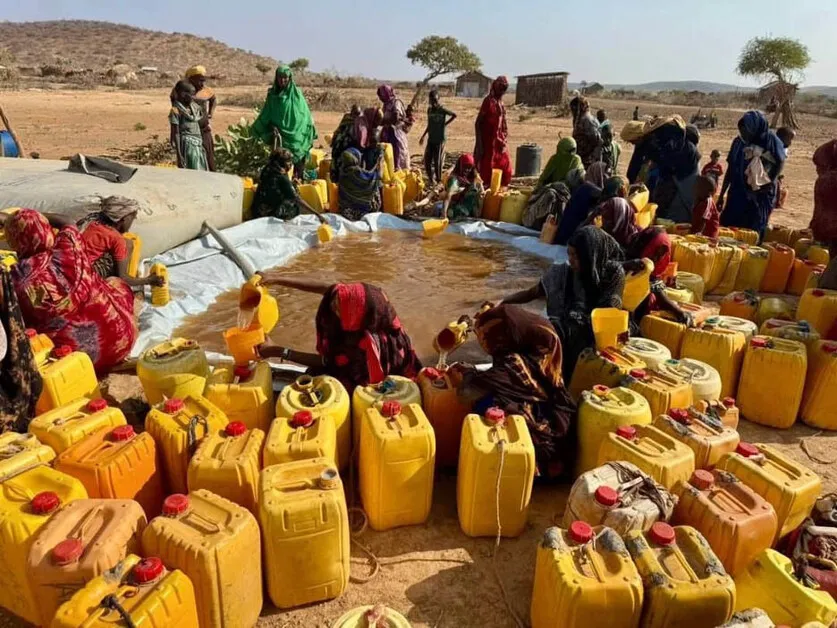
Across the Puntland, Somaliland, and Somalia’s central and southern regions, livestock deaths, crop failure, and soaring food prices have devastated livelihoods. Families are selling their remaining animals and skipping meals. In conflict-affected districts, insecurity and access constraints are further limiting the delivery of lifesaving assistance.
For families like Xaawo Maxamed Jama’s in central Somalia, the drought has wiped out their main source of food and income. “Before the drought became severe, our animals were healthy and strong,” she said. “Now they are weak and dying. There is no grass or water. We fear losing everything.”
“Across the areas where we work, our teams and partners are seeing animal herds decimated and children showing visible signs of wasting. We are also hearing of some families walking up to 30 kilometers (18.6 miles) in desperate search of water,” said Ummy Dubow, CARE Somalia’s Country Director. “The situation is especially dire for women and girls, who are the last to eat and the first to suffer when food runs short. Drought not only robs families of water and income, it also increases the risk of violence, exploitation, gender based violence, including and early marriage for girls.”
This crisis comes only a few years after the 2021–2023 drought, one of the most severe in decades. Many families have not had time to rebuild their herds or restore depleted savings. Somali communities are increasingly referring to the current drought as Abaartii Oomaan or Biyo La’aan ba’an — meaning “the severe waterless drought” or “no water.” In Somalia’s oral tradition, when a drought is given a widely used name, it signals historic severity and deep collective alarm.
“When a drought is named, it tells you how serious people believe it has become,” said Dubow.
At the same time, humanitarian funding has declined sharply. Aid organizations working across Somalia have been forced to scale back food assistance, nutrition treatment for children and mothers, water services, and emergency health support – precisely as needs are rising. The reductions are leaving communities without the protective buffer that prevents emergency hunger from escalating into catastrophe. Reduced coverage weakens the protective buffer that prevents emergency hunger from escalating further. “The UN Humanitarian Response Plan is at one of its lowest funding levels in years,” said Dubow.
Without immediate restoration of funding and scaled-up support during the critical Jilaal—the peak dry and lean season (January-March) — emergency food and nutrition conditions are likely to intensify in the months ahead. The window to prevent a deeper humanitarian crisis is rapidly closing.
CARE is urging donors to act immediately, prioritizing funding to best placed actors, including for local organizations and women-led organisations. We urge donors to step up humanitarian diplomatic efforts to help secure and unimpeded humanitarian access. The IPC findings make clear that the window to prevent a deeper humanitarian catastrophe is rapidly closing. Without high-quality, flexible funding now, millions of Somalis — especially women and girls — face worsening hunger, displacement, and insecurity.
CARE’s response is implemented in close partnership with local organizations—including WASDA Somalia, Save Somali Women and Children (SSWC), and Daryeel Bulsho Guud (DBG), enhancing access, community engagement, and protection monitoring. CARE Somalia and partners continue to deliver integrated, multisectoral assistance across ten regions: Sool, Sanaag, Togdheer, Mudug, Galgadud, Banadir, Bari, Lower Jubba, Nugal, and Gedo. CARE Somalia is providing emergency water trucking and hygiene support; primary healthcare, medical supplies, and disease surveillance; cash assistance to help families meet basic needs; and protection services for Violence against Women and Girls survivors, including women and girls’ safe spaces and dignity kits.
For media inquiries, please email usa.media@care.org, or contact Kelly Muthusi, CARE East and Central Africa, Regional Communications Associate, email: Kelly.Muthusi@care.org