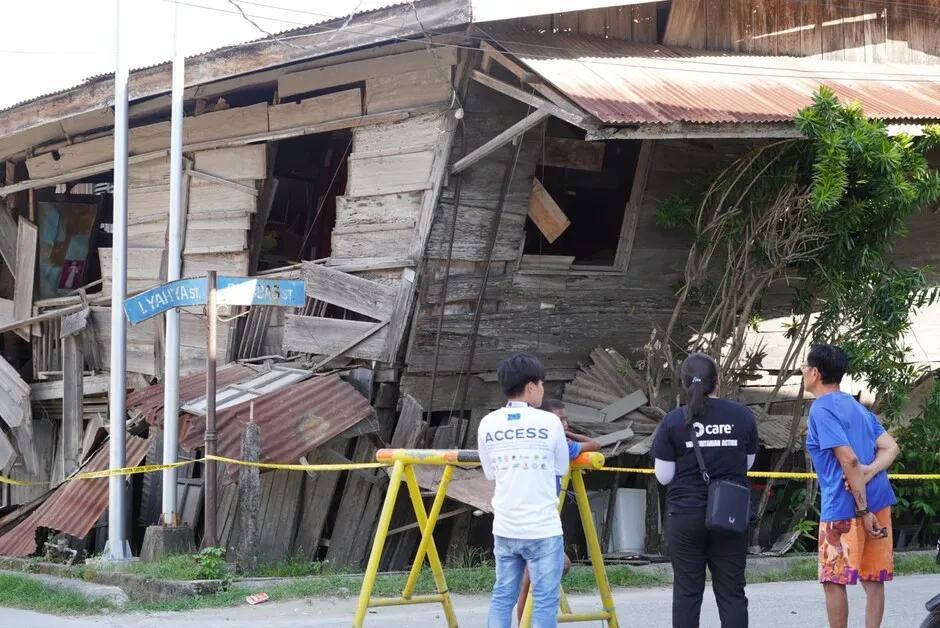
CARE Philippines, Manila, June 12, 2026 — As the Philippines marks Independence Day, more than 400,000 people have been affected, with tens of thousands displaced and many homes damaged. Forty-seven lives have been lost. Some villages can still only be reached by boat or helicopter. In other areas, entire communities remain cut off by damaged roads and impassable bridges. More than 3,000 aftershocks and three magnitude 6.0 earthquakes have been recorded since June 8, 2026 making assessment and delivery difficult and dangerous. Every day that communities cannot be reached is another day without food, clean water, or medical care.
“What will become of our land? Going back would only put us in more danger,” said Siolito Moldan, a resident of Jose Abad Santos. Cracks have spread across the mountainside above his community, and large boulders still loom over homes below. With aftershocks continuing, returning is more dangerous than staying away. “There is nothing to go back to.” His neighbor Leonila Manda shares his fear. But she has already seen the worst of it. A rockslide from the mountain damaged her home, and a landslide swept away the coconut trees that her family depends on for their income. “I am scared of what will happen to us in the days ahead,” she said. “We have lost our home and our livelihood. What do we do now?”
Reiza S. Dejito, CARE Philippines’ Country Director, said teams in the field are meeting families anxious about water, food, shelter, and the risk of further disasters on already weakened slopes. Access remains urgent. Some communities are difficult to reach because of landslides, damaged roads, disrupted transport, and continuing safety risks.
“The next 48 to 72 hours are critical,” said Dejito. “This is a moment for coordinated action. We must move with speed, humility, and discipline — supporting local leadership, filling urgent gaps, and ensuring that no community is left behind simply because it is hard to reach.”
The Philippines is one of the most disaster-prone countries in the world, and Mindanao is among its most vulnerable regions due to poverty and conflict. Many families in the upland areas are afraid to go back to their homes. They fear what another strong aftershock, or a heavy downpour, might do to a hillside that is already cracked and weakened. With the Philippine Atmospheric, Geophysical and Astronomical Services Administration (PAGASA) forecasting above-normal rainfall and possible El Nino conditions in the months ahead, this fear is grounded in reality. The risk of secondary disasters such as landslides, flooding, and further road collapse is real, and it is growing.
CARE Philippines is also concerned on the impact of the situation to women and girls who carry a disproportionate burden in this crisis and facing barriers that men do not. Evacuation centers are crowded and often lack lighting, private spaces, or separate sanitation facilities, raising the risk of gender-based violence. Dignity kits with hygiene items and sanitary products that women and girls rely on are in critically short supply. Women in isolated communities face a double burden: cut off from aid by damaged roads, and unsupported within the evacuation centers they have fled to. “Across the affected areas in Mindanao, where women already faced higher rates of poverty and violence before the earthquake, a response that does not reach them specifically will leave the most at-risk people further behind,” emphasized Dejito.
CARE Philippines, through the ACCESS Consortium — a group of 14 humanitarian organizations supported by the European Union — is already on the ground. Teams have distributed personal hygiene items and clean water supplies to 150 families in Maasim and T’boli and have provided psychosocial support to 377 people, including 77 children in evacuation centers in Malapatan. But with nearly 85,000 families affected across 349 communities, the response must be expanded immediately.
“Independence should not mean being left to survive alone,” added Dejito. “We know where the needs are. What’s missing is the speed and scale to reach them. Every delay puts more lives at risk.”
For thousands of families still waiting for help, the measure of this moment is not commemoration – but how quickly and fairly assistance reaches those most in need. As the nation reflects on Independence, CARE calls for urgent, collective action to ensure that no community remains isolated or left behind.
Notes to editors
Scale of the disaster: As of 12 June 2026, 47 people have died, 33 remain missing, and more than 630 have been injured. Some 96,614 families — 432,999 people — across 374 barangays in Regions IX, XI, XII, and BARMM. An estimated 4.13 million people were exposed to strong shaking. More than 30,000 homes have been damaged, including more than 5,000 totally destroyed.
State of calamity: Four local government units — Alabel and Glan in Sarangani Province, Jose Abad Santos in Davao Occidental province, and General Santos City — have declared a state of calamity, enabling access to emergency funds and measures.
Access and isolation: In Jose Abad Santos, approximately 50 percent of the municipality is still unreachable by land, with three upland barangays accessible only by boat or helicopter. In Glan, 10 of 31 barangays remain cut off. Road and bridge damage continues to slow the delivery of aid to the most affected areas. CARE is working with partners and authorities to find solutions to reach isolated communities as quickly as possible.
Women and girls: Women and girls face heightened risks of violence, illness, and exclusion in emergency settings. Access to dignity kits, separate sanitation, mental health support, and safe spaces remains limited. Water contamination in parts of Sarangani and Davao Occidental creates serious risks for pregnant women, nursing mothers, and young children. CARE calls for women and girls’ specific needs to be built into every stage of the response.
Education: As of June 11, more than 1,300 public schools across 37 divisions have sustained damage. Classes have been suspended for approximately 3.24 million learners. Many school buildings are currently serving as evacuation centers.
About CARE Philippines: CARE is one of the world’s leading organizations working to end poverty. In the Philippines, CARE has been working since 1949 on disaster response, supporting women and girls, and helping communities become more resilient. CARE Philippines leads the ACCESS Consortium and the Philippine Inclusive NGO Network and actively participates in the Humanitarian Country Team organized by the United Nations.
For media inquiries, email media.usa@care.org or contact Mary Therese L. Norbe, Communication Specialist, CARE Philippines, marytherese.norbe@care.org