From AI-powered diagnostic apps in the palms of community health workers’ hands, to mobile training platforms that deliver clinical education on demand — no internet connection required — technology is no longer an add-on to community health. It’s becoming essential infrastructure.
And at CARE, we’re leaning in.
The problem
Let’s start with the scale of the challenge. Over eight million people die needlessly each year in low- and middle-income countries because of poor quality healthcare. That’s 15% of all deaths in these countries, and it leads to a $1.6 trillion annual loss in productivity. Behind those numbers are mothers who didn’t get skilled birth care, children whose illnesses went undiagnosed, and communities where the nearest clinic is hours away.
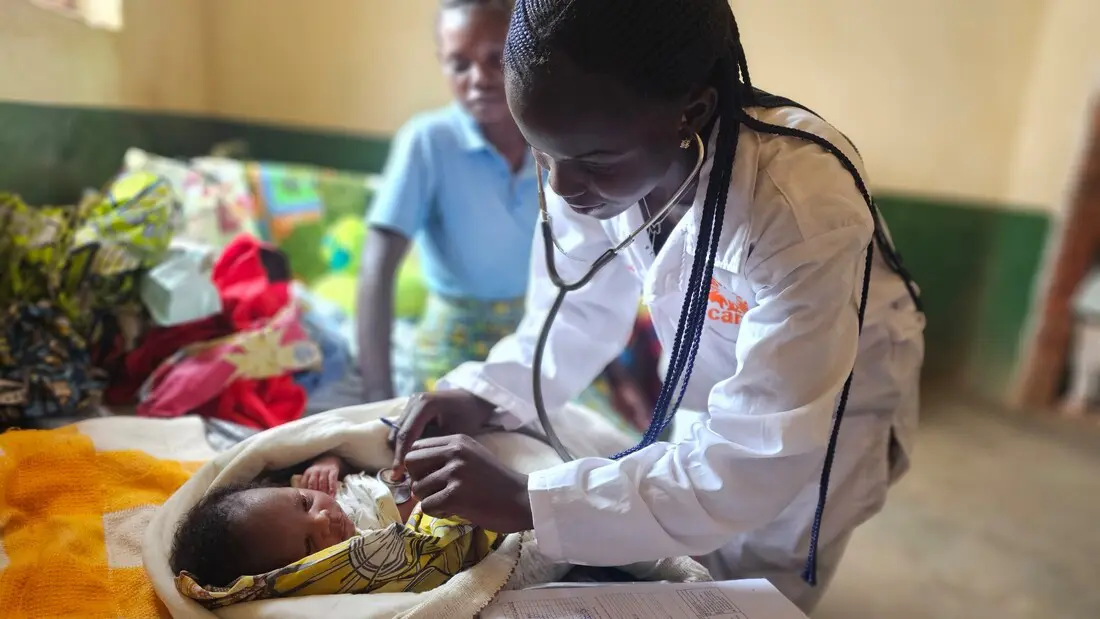
The people closest to these communities — and often the only connection people have with the formal health system — are frontline health workers (FLHWs). They provide home visits, health education and counseling, health screenings, basic first aid, and referrals to higher-level care. They are overwhelmingly women, serving in the communities where they live. And the vast majority are un- or underpaid, unrecognized by the formal health system, and under-trained.
As CARE USA CEO Michelle Nunn has put it: “Women comprise nearly 70% of health workers who deliver vital services to underserved and vulnerable populations. They are often the first — and sometimes only — line of defense against disease.”
CARE works with over 500,000 frontline health workers globally. The question we keep coming back to is: what does it look like when those workers are fully equipped, supported, and recognized? And how does technology help us get there faster?
How we’re driving change today
Through She Heals the World — CARE’s initiative harnessing AI and digital innovation at the point of service — we’re working across three interconnected areas:
- Training workers where they are. In partnership with Dimagi, Digital Medic, and national and subnational departments of health, CARE is delivering mobile-based training and professional development to thousands of frontline health workers. In the Philippines, for example, more than 1,000 health workers now access on-demand learning on maternal and child health, screening protocols, patient referral pathways, and peer mentorship — all from their phones. The result: better-equipped workers delivering higher-quality care in communities that traditional training programs were limited to reach.
- Using AI-powered diagnostics in remote settings. AI-enabled diagnostic solutions are transforming what’s possible at the point of care. From portable ultrasound machines in rural clinics to AI-powered mobile apps that screen for anemia and infections or predict malaria outbreaks, placing advanced diagnostic capability directly in frontline workers’ hands can enable earlier detection, more accurate diagnoses, and better treatment decisions at the place of diagnosis.
- Making limited resources go further. In partnership with researchers, health tech companies, and governments, CARE is harnessing large-scale data and AI to help health workers reach the right communities at the right time. By optimizing where limited human and financial resources are being used, we can strengthen follow-up care and maximize health outcomes across large populations — not just individual patients.
And in a significant signal of the sector’s trust in CARE’s leadership in this space: as of January 1, 2026, CARE is the new host organization of The Frontline Health Workers Coalition — a global alliance dedicated to strengthening and supporting the health workforce worldwide.
AI and community health
We’re at an early but genuinely important moment for artificial intelligence in this space. The potential is real — but so are the risks of getting it wrong.
Here are three places where we see AI playing a meaningful role as the field matures:
- Predictive and preventive care. AI tools that can anticipate disease outbreaks, flag high-risk pregnancies, or predict which patients are most likely to miss follow-up care will allow health workers to shift from reactive to proactive — a fundamental change in how primary care works in places with limited resources.
- Personalized health communication at scale. Generative AI, deployed thoughtfully, can deliver health education in local languages, adapted to the literacy levels and cultural contexts of specific communities — reaching people who have historically been left out of health information systems.
- Smarter workforce support. As AI matures, it can help supervisors identify which health workers need additional coaching, flag gaps in coverage across a district, and help national health leaders make better decisions with the data they already have.
The critical caveat we hold onto is that AI tools for community health must be designed with communities, not for them. They must be validated across diverse populations, work in low-bandwidth environments, and prioritize data privacy and local sovereignty. CARE’s vision for digital health is one that bridges gaps experienced by women, girls, and marginalized communities — not one that replicates existing inequities in a digital format.
An invitation
This work doesn’t happen without partnership. Tech companies, health innovators, data platform builders, researchers, and government collaborators bring capabilities we never could on our own. But, to create tools that actually work in the communities where they’re needed most, those partners need organizations with deep community trust, local presence, and an equal-first lens.
That’s what CARE brings. And it’s why the most exciting work happening in global digital health right now sits at exactly this intersection.
If you’re building technology with the potential to reach patients and caregivers where they are — or looking for a partner who can help you get there — we would love to connect.