

This story was originally published on the iDE website and has been lightly edited for CARE.org. Read more from the Lean Market-Based Sanitation Partnership series.
In a previous post, we wrote about what households in Chisekesi told us a toilet means to them: dignity, safety, pride, and the hope for something that finally lasts. As one customer said, “I am okay to wait even for one year to get a good toilet.”
That sentence is a gift to any designer. It is also a responsibility. If people are willing to wait a year, someone on the other side of the market has to be ready to deliver when they arrive. So, as our human-centered design (HCD) work moved from discovery into testing, we turned the same lens toward the entrepreneurs who would have to deliver that promise: shop owners, masons, suppliers, transporters, and savings group leaders.
Across discovery conversations with 47 people and three iterative rounds of testing with 63 participants in Chisekesi (Monze District) and Mukwela (Kalomo District), we interviewed business owners, observed builds from pit to handover, tried out business models and sales roles, and ran a community Demo Day.
One lesson shaped everything else: Supply in Southern Province is held back less by availability than by coordination. Cement, blocks, and pans can be found. What is missing is a system that brings them together reliably, repeatedly, and profitably enough for a business to keep doing it, and for households to be able to access it conveniently and without undue burden.
Households carry the coordination risk today
When a family decides to build, they become the project manager. They buy cement in one place and a pan in another, find sand, arrange transport, locate a builder, and chase every step themselves. When something goes wrong, the risk sits with them.
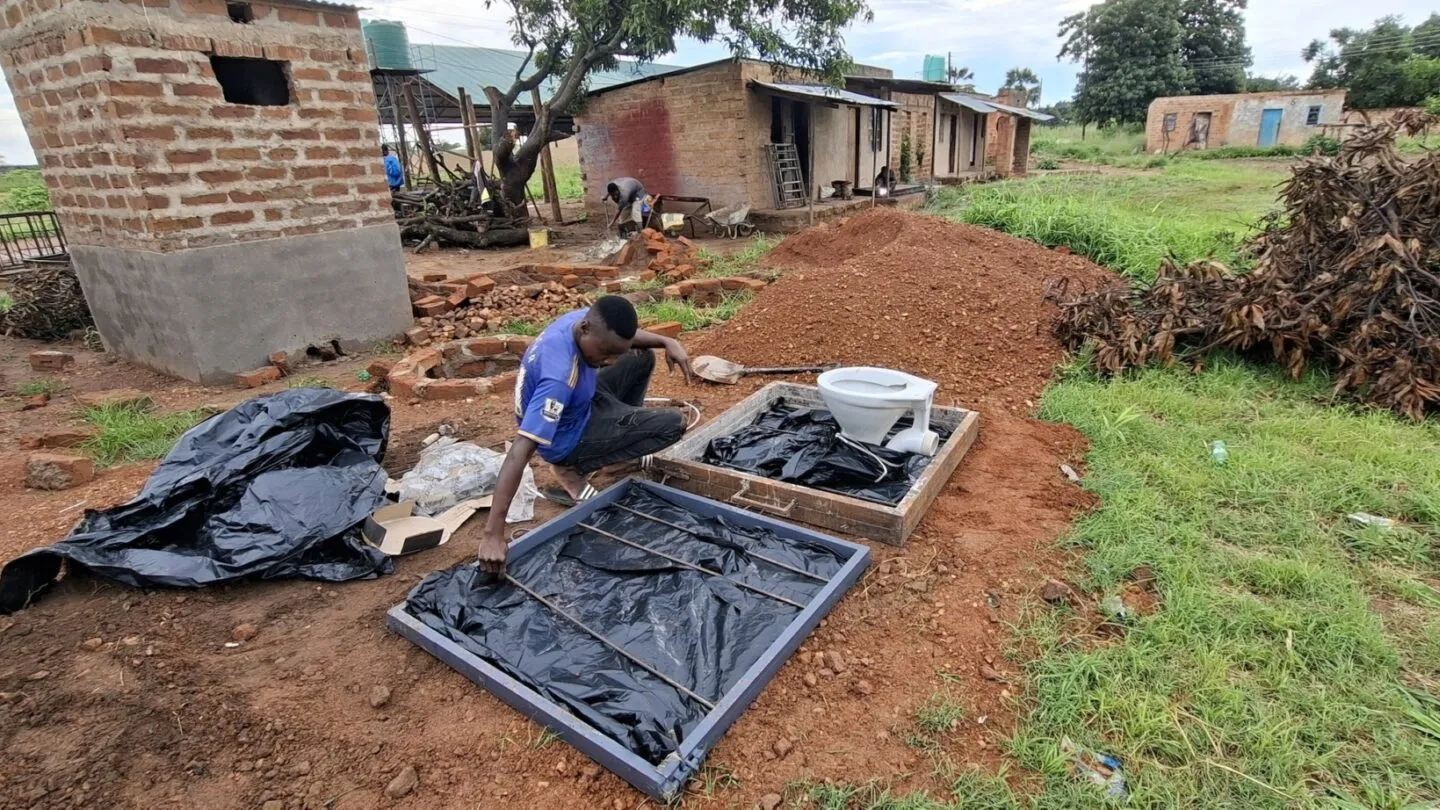
Watching the toilets being built showed us where things break. Cement, blocks, and poles were usually available locally, but sand often arrived one to two days late, and one delayed input stalled the whole build. Artisans kept pace when supervised and scheduled and drifted when other commitments pulled them away. When handoffs were unclear, delays turned into customer frustration and disputes over commission.
None of these are dramatic failures. But for households who have rebuilt collapsed latrines season after season, every small friction is a trust risk. The toilet people want cannot be separated from the service that delivers it. They wanted someone else to hold the moving pieces.
Start with the business someone already runs
In many market-based sanitation programs, masons and producers are trained to become sanitation entrepreneurs. We treated that as an open question rather than a given. In Southern Province, testing pointed toward retail entrepreneurs instead: the shop owners at the heart of rural growth centers.
Shop owners are daily access points for households. They are trusted and visible, and they already decide what products are available locally. They also tend to have what masons lack: access to materials and enough financial footing to carry a business. Masons remain essential, but as delivery partners who build to standard, not as procurement managers, salespeople, and lenders all at once.
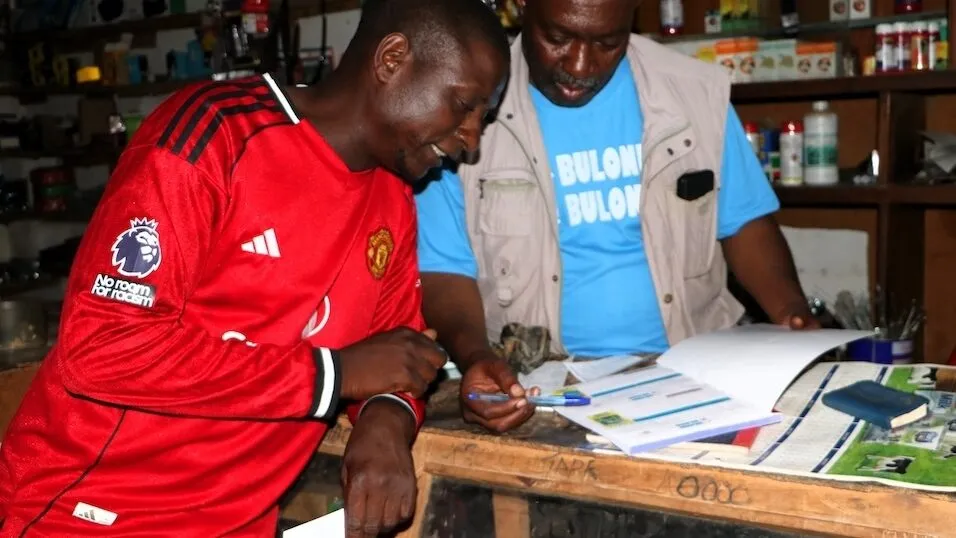
The shop owners we spoke to were interested, and they were also honest about the risk. “If people ask for it, I can bring it, but I don’t want to stock what doesn’t move,” said Mutelo Matebele, a latrine business owner (LBO).
Retailers think in fast-moving goods. A toilet is a slow, high-value, multistep sale. Owners told us they were wary of tying up cash in unfamiliar products, knew little about toilet construction, had never managed artisans or sales agents, and had little time to sell on top of running a shop. For us, this was a reminder to understand the business an entrepreneur already has before designing an additional income stream or diversification. Hesitation here is not a lack of entrepreneurial spirit. It is a rational response to risk, and the design task is to lower it.
The contrast between the two communities where the discovery research was done made this concrete. In Chisekesi, promising LBO candidates emerged naturally. In Mukwela, none did. The team eventually found a former iDE farm business advisor who was willing but lacked the capital to operate, and cement had to come from Kalomo town, adding cost to every build. Households in both places wanted better toilets. The difference was supply-side readiness.
The pilot needs to show which retailers can sustain a sanitation line alongside their core business, and whether the income justifies their time and cash.
Flexibility for one side can become a burden for the other
Households were clear about how they wanted to pay.
“We want to pay ashonto ashonto, pay slowly,” said a resident in Chiseki.
Early adopters saw 4,000 Zambian kwacha (approximately $210) as fair value and accepted higher prices, such as K6,500 (approximately $340), when paid over time. As iDE has seen in other programs, installments have to be the default, not the exception.
But when we gave the LBO an installment tracking sheet during final testing, a tension surfaced. He recognized that he had to offer installments to sell. He also admitted that managing several households at different payment stages was far more demanding than it looked. Very small, frequent payments meant repeated trips, buying materials in small quantities, and cash tied up waiting on the next payment.
This is where HCD has to design for both sides of a transaction at once. The approach we will test links a limited number of payments to visible stages of the build: pit, slab, superstructure, and finishing. When households can see progress, they are more motivated to keep paying. When the LBO knows what is due and when, cash flow becomes easier to plan. Matching payment cards, one held by the household and one by the LBO, aim to turn a potential source of disputes into a source of trust.
The pilot needs to show is whether these milestones fit household cash flow and still give the business enough working capital to deliver.
A business owner cannot sell and build at the same time
Following the LBO’s workload made one thing clear. Running a shop, procuring materials, and coordinating builds left little time to visit households, run demonstrations, and follow up. Someone else needed to own the customer conversation.
We tested five sales agent profiles: community sanitation champions, educated young people, community masons, savings group (VSLA) leaders, and last-mile advisors such as farmer business advisors. VSLA leaders and community sanitation champions stood out. They are trusted, already present when people gather, and sometimes present when people have money in hand.
We also learned where not to push. VSLAs were highly effective at mobilizing demand, but asking a savings group to operate as a single business introduced friction through group decision-making. They work best as demand and financing channels, not as business owners.
Artisans surprised us, too. At Demo Day, a mason working in Monze offered to promote Bulondo Bulondo brand toilets in his own community for a commission. For artisans who earn a small income from labor, selling can be a meaningful addition.
The pilot needs to show that the starting point is trust, not sales skill. We will learn what training, coaching, and commission turn trusted community members into effective sales agents.
Quality is where trust is won or lost
Standing beside the pit, we saw familiar gaps: coning instead of straight pit walls, irregular dimensions, slab placement issues, and uneven finishing. Skilled builders exist, but skill and consistency are not the same thing. Each gap is small, and each is visible to a household that has paid for something meant to last.
If the first toilets in a community crack or look unfinished, the social proof we are counting on runs in reverse. That is why the artisan profile we are looking for comes down to one phrase: “builds to spec, not to habit.” And it is why we are asking LBOs to treat delays as trust risks, not normal events.
From insight to roadmap
Together, these insights point toward a one-stop shop: a single business that provides the materials, labor, and installation, so the household deals with one trusted point of contact. For the pilot, that means clear roles (sales agents own the customer relationship, LBOs coordinate cash and delivery, and artisans build to standard). It also means a lean supply system that secures materials before a build starts. It includes ordering sand early, refresher training for artisans, and a Business-in-a-Box with standard pricing, as well as receipt books and matching payment cards. Startup capital matters, too, so LBOs can buy in bulk and carry builds between payments.
In keeping with the partnership’s commitment to design for scale from the start, we want none of this to become a permanent iDE or CARE function. iDE will run the first cohort of an LBO business incubator, with the aim of transitioning it to a local Technical Education, Vocational and Entrepreneurship Training Authority (TEVETA), an institution working with the Southern Water and Sanitation Company (SWSC) on standards. For finance, we will explore existing channels such as the Constituency Development Fund, water, sanitation, and hygiene (WASH) Funds, and group savings of larger VSLAs before creating anything new. These pathways still need work, but the principle is simple: connect to what already exists rather than build around it.
We are also sequencing by readiness, not geography. Mukwela taught us that demand alone does not make a community ready for market-based sanitation; a capable LBO and a working supply chain matter just as much. The three- to six-month sales pilot starts in Chisekesi, with sales timed around harvest and VSLA share-outs. In parallel, a rapid readiness assessment will identify which communities are ready next, and expansion to three or four more follows only where they pass that threshold.
A latrine business is never just a shop
In our earlier post, we argued that a toilet is never just a toilet. The same is true on the other side of the market. A latrine business is a small web of relationships: a shop owner willing to take on a slow-moving product, a mason who builds to spec, a savings group leader who knows when her neighbors have cash, and a household that trusts all of them with its savings.
HCD is often associated with understanding end users. This phase reminded us that everyone in a market is a user of the system we are designing. If we design only for the household, we risk creating an offer that people want but nobody can deliver.
The questions ahead are practical ones. Can a retailer commit cash with confidence? Can an artisan complete a good build on schedule? Can a household see where its payments are going? Households have told us they are ready. In the coming months, we will share what happens when the first Bulondo Bulondo toilets are sold, financed, and built in Chisekesi: what holds, what breaks, and what we change as a result.