Building Pathways, Breaking Barriers: Evidence and Learning from CARE’s Programming to Address Child, Early, and Forced Marriages and Unions
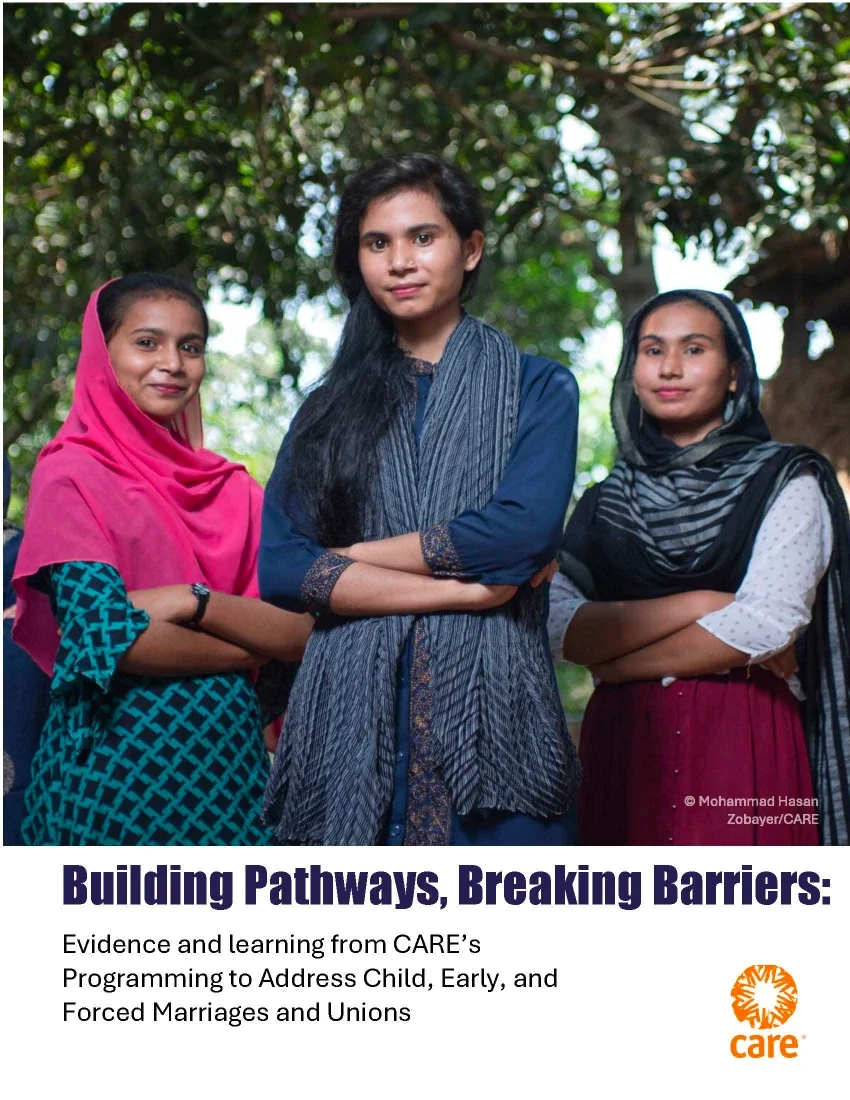
As an organization that has long worked to advance the well-being of girls in many of the countries most deeply affected by Child, Early, and Forced Marriage and Union, CARE and its local partners — including adolescent girls themselves — are well-placed to understand the context-specific drivers behind this harmful practice and to respond in ways that best meet the needs of both unmarried and married girls.
Related Reports
Still here: How Palestinian women-led organisations continue to support communities — and what must change
Through war, occupation, and deep aid cuts, Palestinian women-led organisations are still here — often the first place women and girls turn to. This brief draws on August 2026 interviews with nine of CAREʼs partner women-led organisations, from Gaza City to Jenin, Nablus, Hebron, and Bethlehem. It also draws on CARE research mapping 125 women-led organisations and womenʼs rights organisations across Palestine.
CARE’s Approach to Scaling Impact
Proven programs reach more people, and last, when local actors run and pay for them. CARE’s Scaling Playbook helps teams make solutions ready to adopt, and the Systems Orchestration Playbook helps them build local ownership with the people who will lead and fund the work. Both draw on worksheets, workshop activities, and examples from our programs.
You Can’t Blame the Weather: Preventing Hunger in the 2026–27 El Niño
"You Can't Blame the Weather" is the first in a series on the impact of El Niño. It highlights that donor choices have the power to decide the outcomes for millions vulnerable to the climate shocks posed by El Niño. These shocks are arriving at a moment of deep precarity for communities dealing with conflict, market disruption, and the compounding forces of price hikes in the wake of escalating conflict in the Middle East. The humanitarian community has deployed rapid, large-scale crises before, such as in the aftermath of Russia's invasion of Ukraine, and while these responses weren't perfect, they did measurably mitigate the worst potential impacts of the crisis. We can learn and improve from this recent history to prevent, respond, and recover from El Niño shocks in 2026-2027.