
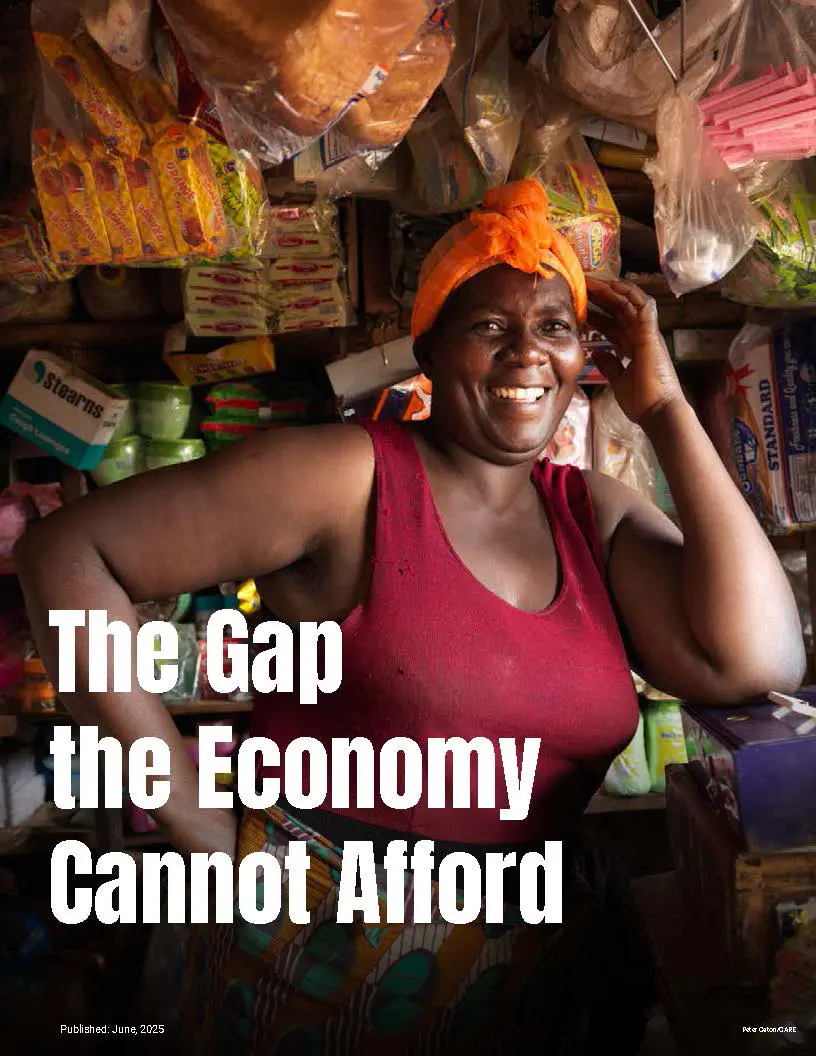
The Gap We Cannot Afford

June 6, 2025

Cover image of CARE's

Look at who is getting left behind, and how the acceleration of AI is going to cost trillions of dollars if we can't make it available to more people.

Download The Gap We Cannot Afford report (English)
Cover image of CARE's

Supporting resources

The Gap At a Glance

Check out our one-page snapshot of what a failure to address women in the economy is costing the world.
Download the one-pager

The Economic Future for Women

Look at what the future holds if we stay on the economic trends women are facing today.
Download the trends report


Key findings at a glance

The AI revolution is a major driving force in the global economy now and for the future. If that transformation
unlocks and builds on women’s skills and potential, it can benefit everyone and create substantial economic growth. But if current market trends continue, that transformation will widen gaps that women and girls face, and AI and technological advances won’t meet their potential for benefitting people, the planet, or the economy. The barriers women face to build skills and earn a living already put our food supplies, our health, our security, and our prosperity at risk. We cannot afford the gaps economies face now or in the future.

To reach our full potential, we need to address the barriers that limit women’s economic opportunities, workplace safety, and access to education and skills training. This requires making laws and building markets that create opportunities that work for everyone.

Download the report

Related Reports

Food & Nutrition

From Evaluation to Action: Locally Financed Water Funds in Ecuador

CARE, CARE France, and CARE Ecuador are excited to share the results of an ex-post evaluation of the Pedro Moncayo Water Fund, a conservation financing mechanism established in 2019 that protects, conserves, and restores freshwater ecosystems used by 200,000 people for drinking water and livelihoods in Ecuador.

Food & Nutrition

Why Food Loss and Waste Technologies Scale or Fail: The Role of Women in Building Scalable, Circular Food Systems

Around the world, CARE works with farmers, fishers, pastoralists, businesses, and governments to identify and grow practical solutions that reduce food loss and waste, strengthen livelihoods, and improve food security. This paper brings together evidence from 21+ countries and 25+ projects to understand why effective food loss and waste solutions so often fail to scale – and what it takes to achieve durable, system-level change. It reflects CARE's commitment to contributing to Sustainable Development Goal 12.3 and to advancing women-centered, market-aligned food loss and waste strategies that deliver lasting impact. 

Disaster Response

What it Takes to Eat: Conflict and Sudan’s Fragile Food System

The report, produced together with Action Against Hunger, the International Rescue Committee, Mercy Corps, and the Norwegian Refugee Council, shows how the war in Sudan is pushing communities toward famine by making access to food dangerous—and in some cases deadly.