Manila, Philippines, October 3, 2025 — In less than 10 days, the Philippines has been hit by three major disasters, a destructive earthquake and two powerful tropical cyclones, leaving communities reeling and responders racing to assess the damage and save lives.
On September 22, Tropical Cyclone Ragasa, locally known as Super Typhoon Nando, made landfall in a in the northernmost part of the country. Four days later, Tropical Cyclone Bualoi—locally known as Typhoon Opong—struck the country’s central region, battering communities with heavy rains and strong winds. Over the following days, the powerful storm crossed over multiple islands in the Philippines. According to the National Disaster Risk Reduction and Management Council (NDRRMC), the storm initially displaced more than 4 million people across 16 regions.
Days later, on September 30, a 6.9-magnitude earthquake struck offshore near Cebu City, the country’s fifth-largest urban area. Over 3,000 aftershocks have rattled the region since. Initial reports put the death toll at 68, with extensive damage to homes and commercial infrastructure. Some 370,000 people have been affected and 77,000 are displaced, according to the Department of Social Welfare and Development, with many sleeping in open fields or by the roadside for fear of aftershocks.
“These three destructive, back-to-back emergencies, show how disaster-prone our country is. Our hearts go out to the almost 5 million people affected. As we and our partners begin to provide assistance in the aftermath of Ragasa and Bualoi, we are now also assessing and mobilizing to respond to this week’s earthquake”, said Reiza S. Dejito, Country Director of CARE Philippines.
In the Philippines, CARE responds to emergencies like these directly and with the help of partners who comprise the Humanitarian Partnership Platform, a national network of local organizations convened by CARE, and the ACCESS Project (A European Union humanitarian project implemented by a consortium of 14 organizations).
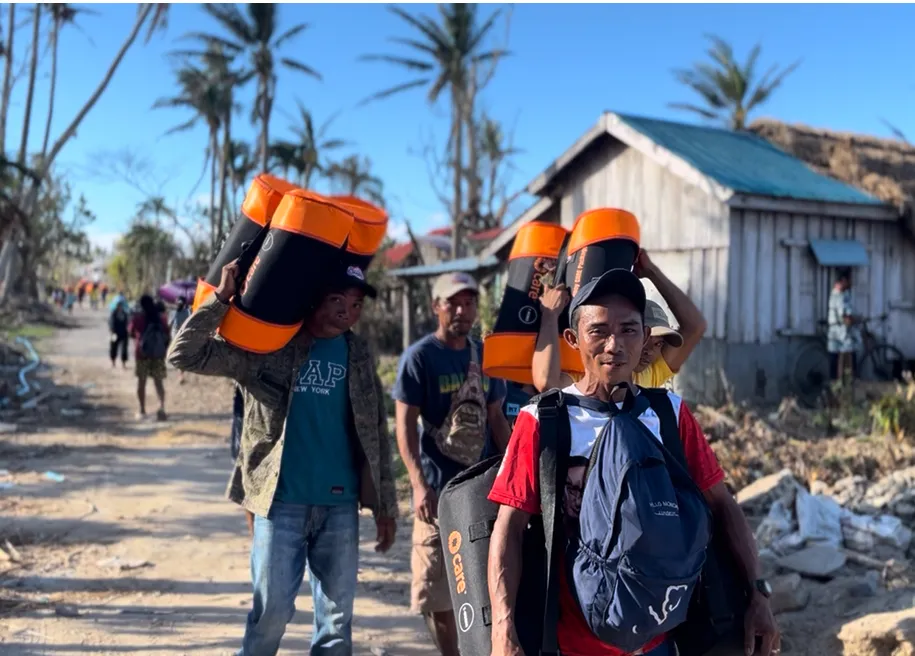
CARE Philippines, in coordination with local partners, has begun delivering life-saving assistance to communities hit hardest by these emergencies. In typhoon-affected communities in Babuyan Islands, Emergency CARE PACKAGE® deliveries reached 250 households with essential supplies for shelter, clean water, hygiene, and cooking. As lead of the ACCESS Consortium, CARE has also supported over 3,500 households — more than 14,000 individuals — across affected regions with emergency shelter, food, hygiene kits, psychosocial support, and education materials.
In response to the earthquake, CARE and its local partner CenVisNet have conducted rapid assessments and prepared emergency food packs for one of the remote communities impacted by this disaster. Plans are underway to roll out mental health and psychosocial support, including listening sessions, art therapy for children, and clinical assessments for referrals. CARE’s emergency packages are also being mobilized for 250 displaced households, while assessments continue in other affected municipalities.
“Our deepest thanks go to our partners and dedicated staff, many of whom have lived through these disasters themselves,” said Jessan Catre, Humanitarian, Disaster Resilience and Peacebuilding Coordinator of CARE Philippines. “They’ve been working tirelessly, day and night, to support their neighbours and communities. Their commitment and compassion continue to make a life-saving difference when it matters most.”
Each year, multiple tropical cyclones and monsoons affect the Philippines, leading to recurrent flooding and disruptions to essential services. The impacts of these back-to-back, interacting hazards make recovery challenging for many communities, particularly those in geographically isolated and disadvantaged areas.
Note to Editors:
CARE has provided humanitarian and development support in the Philippines since 1949. As one of the most disaster-prone countries globally, the Philippines faces significant challenges, and CARE remains at the forefront of delivering life-saving support to communities most in need. According to the World Risk Index report, the Philippines has been ranked as the country most at risk for disasters for four consecutive years. This context underscores the critical importance of CARE’s work in disaster preparedness and strengthening local capacity.
The Emergency CARE PACKAGE kit is a lightweight, 20 kg kit with 39 essential items to help a family of four for one month. It includes supplies for shelter, clean water, hygiene, and cooking.
For media inquiries, please email: usa.media@care.org or contact Mary Therese L. Norbe, CARE Philippines Communications Specialist at marytherese.norbe@care.org, contact number: +639199117534.