Funding cuts close the last door to healthcare in frontline Ukraine

By Sarah Easter and Becca Mountain November 20, 2025

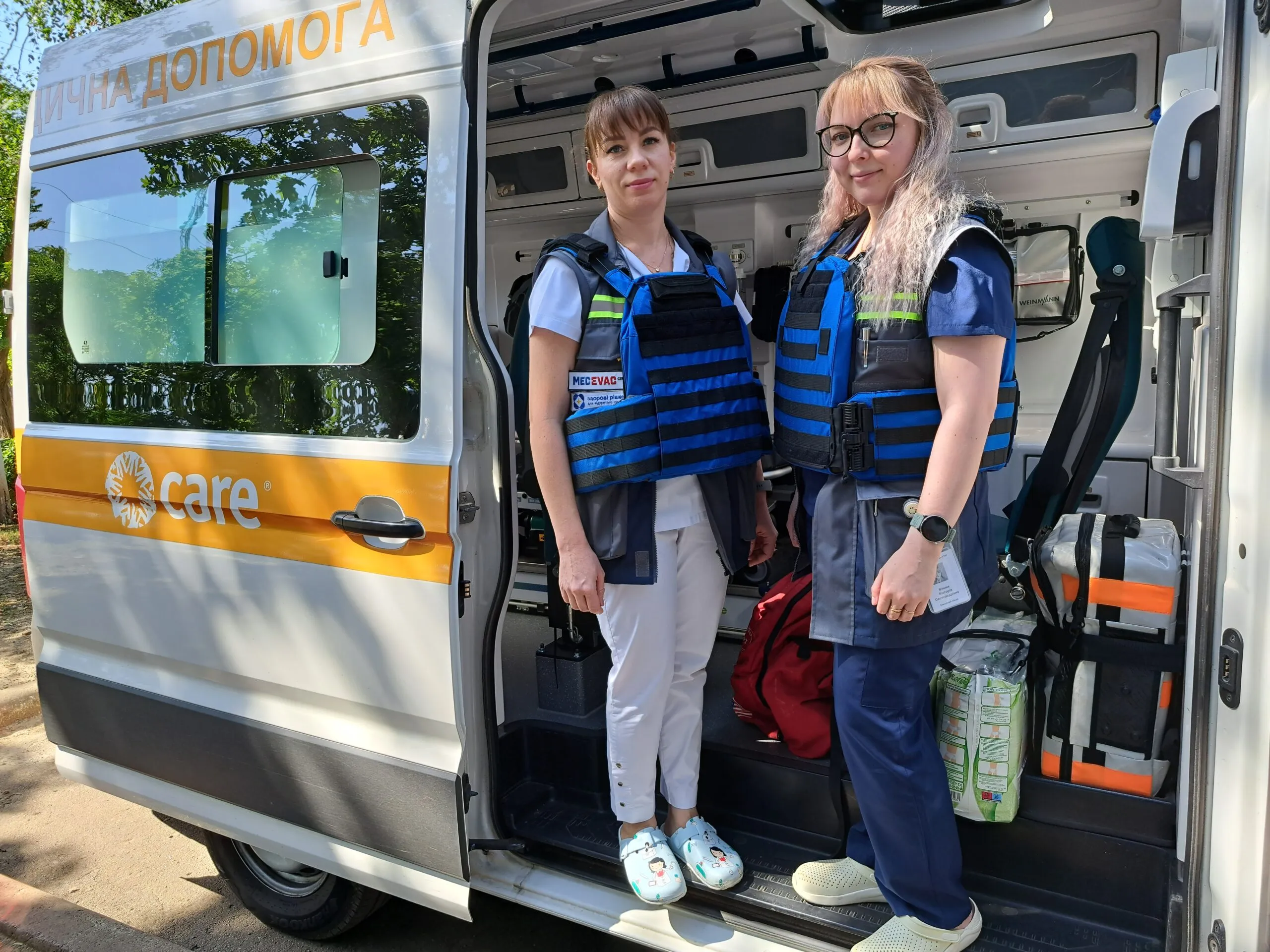
Two medical professionals stand in the open door of a CARE-branded ambulance in Ukraine. They wear blue bullet-proof vests.

Bullet-proof vests and helmets have become part of the equipment nurse Alona and Doctor Victoria carry with them every day in Ukraine. All photos: Sarah Easter /CARE

Lyudmila, 66, rushes to her courtyard gate as an ambulance pulls up to her home outside Kramatorsk in eastern Ukraine. She lives here with her husband, Yurii, 63, and their son, Maxim, 45. As close as their house is to the ongoing war's frontlines, the roar of engines can often be a source of fear. Today, however, it's a lifeline.

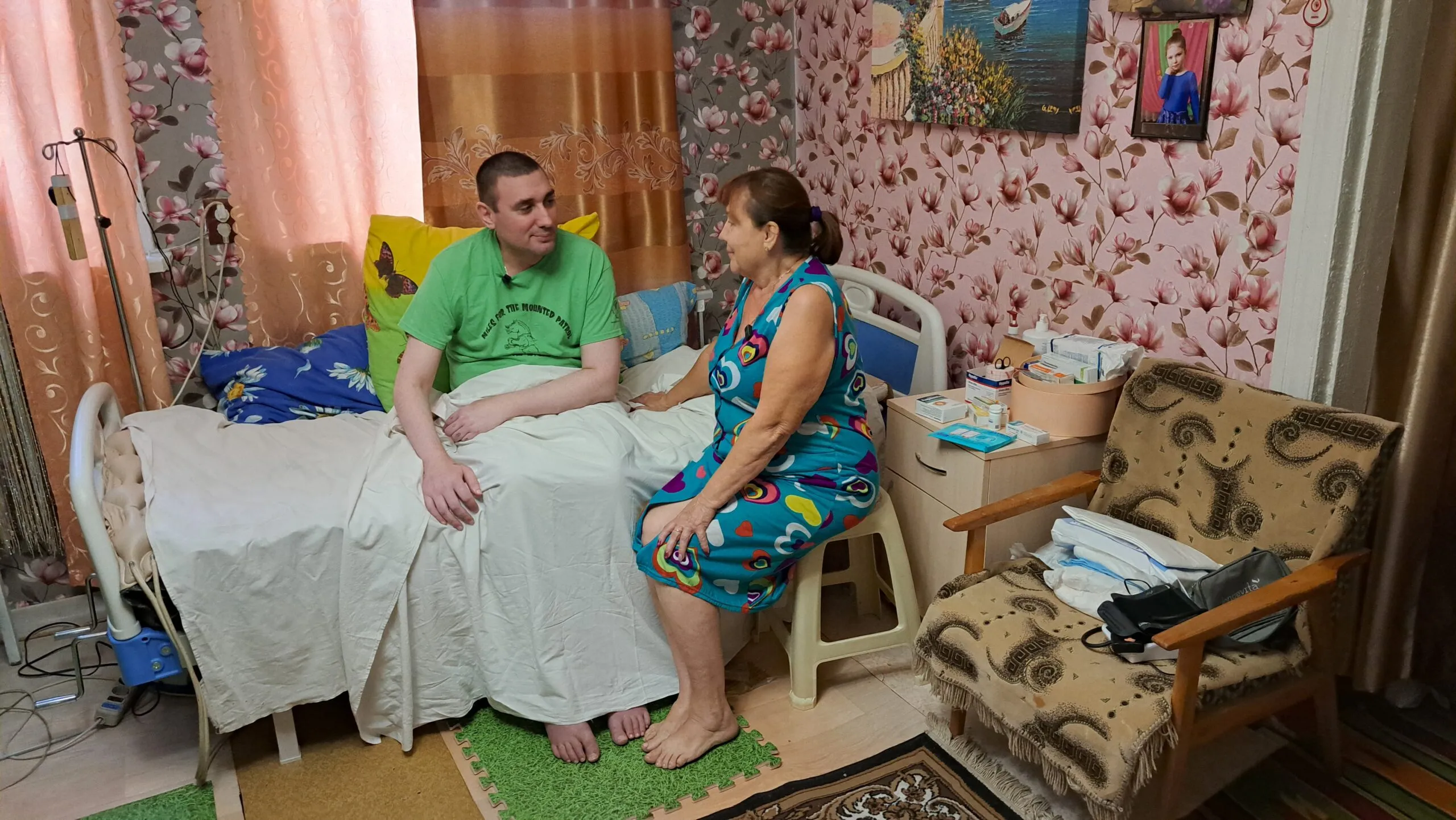
A mother sits with her adult son, who is in a medical bed.
Maxim and Lyudmila try to remain positive, but years of war and nearby fighting have made everyday life very difficult.

Stand up for lifesaving aid

U.S. funding cuts are shutting down the programs families rely on to survive. Sign our petition and tell Congress to protect funding that saves lives and builds stronger futures.

Sign now

Kramatorsk is one of Ukraine’s last strongholds in the fiercely contested Donbas region. As of writing, parts of the city lie just 12 miles (20 kilometers) from the ever-shifting frontlines. Frequent attacks by explosive drones and artillery directly endanger both civilian infrastructure and emergency services. Tens of thousands of people living in the city are under constant threat.

As she unlocks the gate, Lyudmila’s care-worn face softens with relief. “Every time I see the ambulance, my heart fills with love,” she says.

Doctor Victoria and nurse Alona also manage smiles as they clamber out of the white and orange ambulance. Lyudmila’s house is a regular stop for their team of three, which also includes Vitalii, their driver. They are here to see Maxim, who lies inside on a medical bed. Years ago, a neurological illness left him paralyzed and mostly confined to his room.

As soon as they enter the house, Lyudmila launches into motion. She answers questions from Doctor Victoria about Maxim’s condition, lists the supplies they need, and offers everyone tea. As she adjusts her son’s bed so the doctor can reach him more easily, Maxim laughs and tells his mother she worries too much.

A loving smile erases the worry lines etched in Lyudmila’s face. “He is always so positive. Never sad or depressed about his situation. He always jokes around.”

Victoria begins her examination while Alona unpacks diapers and bandages from a bright red medical bag. Outside, Vitalii waits with the ambulance, his ears pricked for the sounds of explosions.
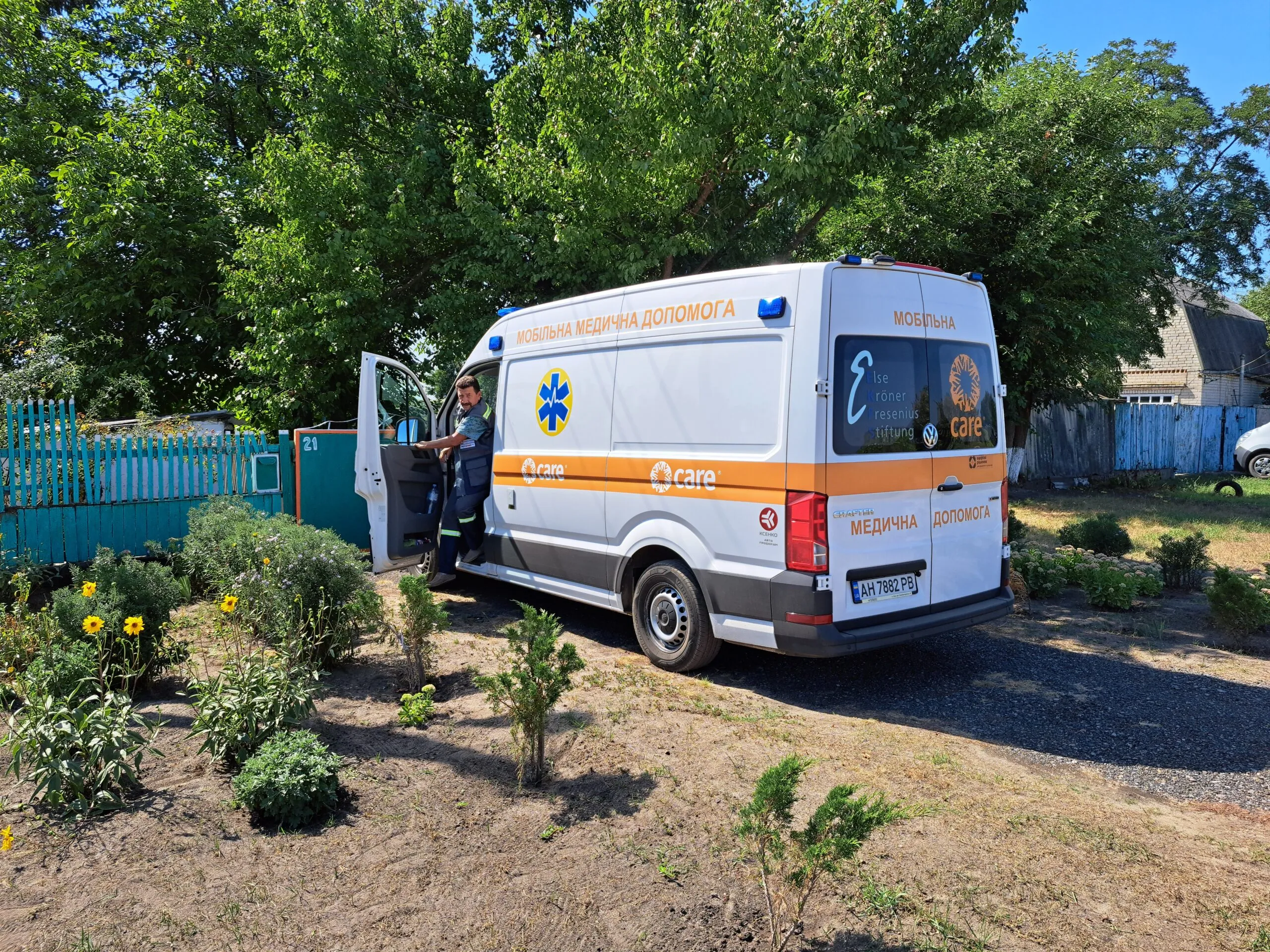
A man opens the door of a CARE branded ambulance and mobile care clinic in Kramatorsk, Ukraine.
Vitalii is not only responsible for getting Victoria and Alona to the patients who need them, but also for keeping his team as safe as possible in what is essentially a war zone.

The endless howl of an air raid siren

Victoria, Alona, and Vitalii are one of only three remaining mobile health teams in the area. Not long ago, the coordinating clinic boasted eight of these teams, each with a fully stocked, CARE-branded ambulance, bringing medical care to people who couldn’t reach clinics or hospitals. But the project, once supported by international humanitarian funding through CARE and local partners, ran out of resources in June amid widespread US aid cuts and a broader global decline in humanitarian aid.

Without renewed support or new sources of supplies, even these last few teams may not last long. Without them, their patients won’t survive, either.

The humanitarian situation in Ukraine’s health sector is dire, especially in the east near the frontlines. People have severely limited access to medicines and medical supplies, particularly for chronic illnesses like heart disease, diabetes, cancer, and asthma. Pharmacies are either closed or empty. When medicines are available, they are far too expensive for older people who often survive on a small pension of $60-100 a month.

“Our supply of medicine and medical items is nearly depleted,” says the clinic’s head physician Oleksandr. “We do not want to arrive at our patients with empty hands.”

Every morning, Victoria and Alona pack their few remaining medicines and bandages into heavy bags while their phones chime with requests for help. A mother calls Victoria to ask if they still have orthopedic mattresses available. On another call herself, Alona shakes her head sadly, taking notes about needing more diapers.

Still on the phone, she turns to Victoria and asks if they have anything to help with allergies. The doctor’s eyes light up. Finally, something she can fix. “Yes, we still do. I’ll pack something.”

As they haul their packs to the ambulance, an air-raid alarm cuts through the quiet. It wails for four long, howling minutes.

“We have bad luck today that it started directly when we wanted to leave,” Victoria says.

Vitalli helps get the bags into the car and asks, “Will we start with the alarm, or will we wait?”

Kramatorsk lies only 10.8 miles (17.5 kilometers) from the frontline. Often the alarm comes after the strikes have already hit.

“We observe the situation,” Victoria decides, swinging herself into the front passenger seat. “If we don’t hear or see explosions, then we will go.”

Ukrainians are known for using dry, dark humor to cope with adversity. Looking up into a sky that so often rains down drones and artillery fire, Vitalii observes “It’s important that nothing falls on our heads.”

For emergencies, the team carries heavy dark blue bulletproof vests and helmets — lifesaving gear for aid workers who operate close to the frontline. For now, the gear hangs casually over the seats in the back of the ambulance, like everyday jackets.

After four long minutes minutes, the siren finally fades and the ambulance moves out.

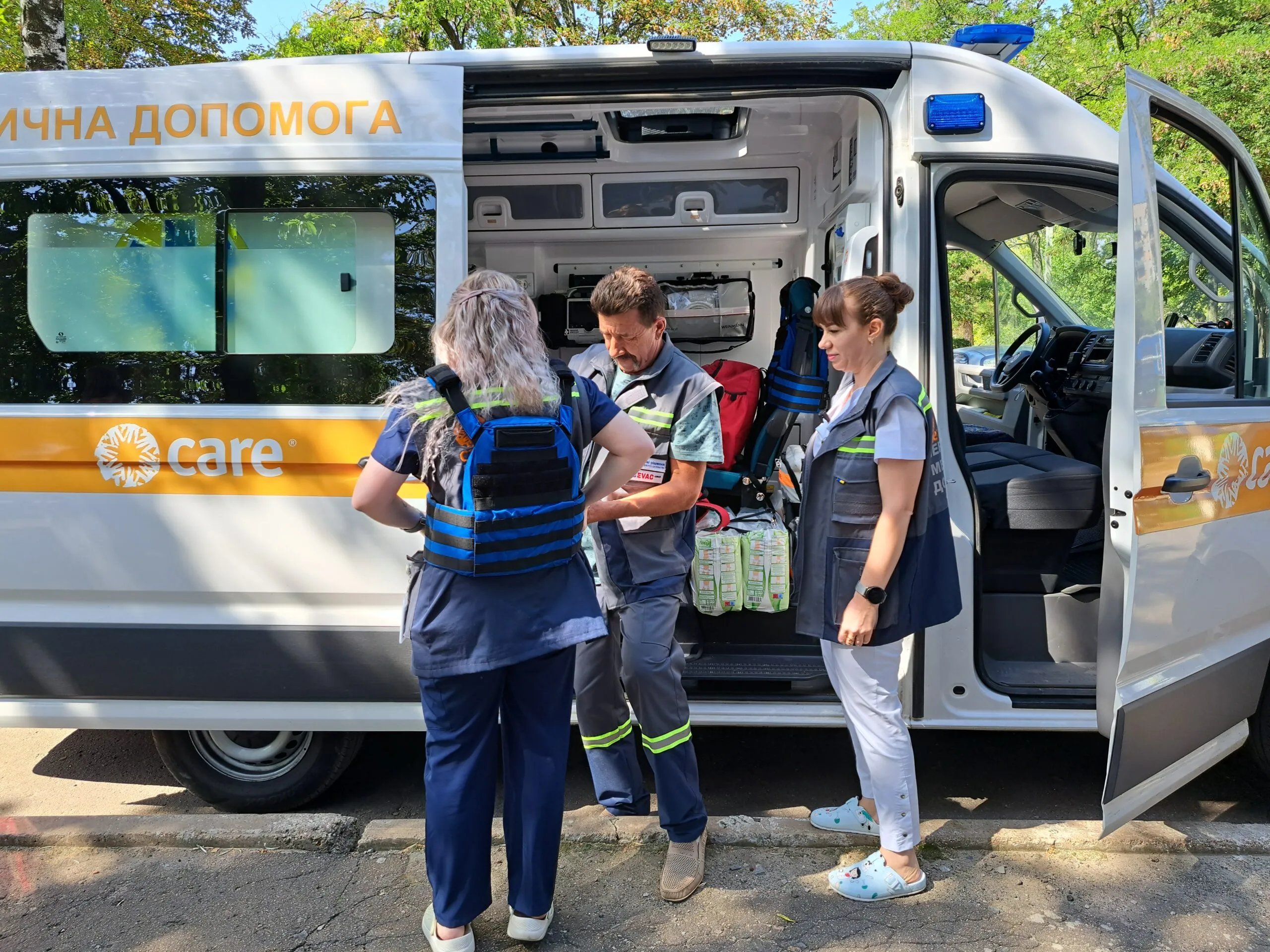
Three people in high-vis gear stand outside a CARE-branded ambulance. One helps the other put on a bright blue bullet proof vest.
Vitalii helps Doctor Victoria get into her bullet proof vest. Warning sirens and alerts for incoming bombardment can come only moments before impact, and sometimes only sound after the attack.

Relief at home

Inside Lyudmila’s small home, the familiar smell of tea and antiseptic fills the air as Doctor Victoria unpacks her tools. She begins with an ultrasound, placing the small handheld device on Maxim’s stomach. His body has grown more fragile after years of illness.

“Before the mobile team came, we struggled to find treatment,” Lyudmila says. “No one came here to help us. When the catheter needed to be replaced, we carried Maxim to the car and drove to the hospital in Kramatorsk, but no one there could help. They just took his temperature and told us to buy pain killers.”

They family went from hospital to hospital, crossing dangerous roads and areas still scarred by shelling, risking their lives for treatment that never came.

Now, Victoria replaces the catheter with calm, practiced hands. Maxim barely flinches. “She can do it on the first try,” Lyudmila says, placing a grateful hand on Victoria’s shoulder. “I can call them anytime, and they come to help us. This is such a relief.”

In this family home, surrounded by the sounds of war, this act of care and attention means everything. For families like Lyudmila’s, CARE’s mobile health teams are more than a medical service — they are the last link to survival. But across Ukraine, that lifeline is fraying. As international funding declines and attacks continue, thousands of people with chronic illnesses and disabilities are losing access to the care that keeps them alive.

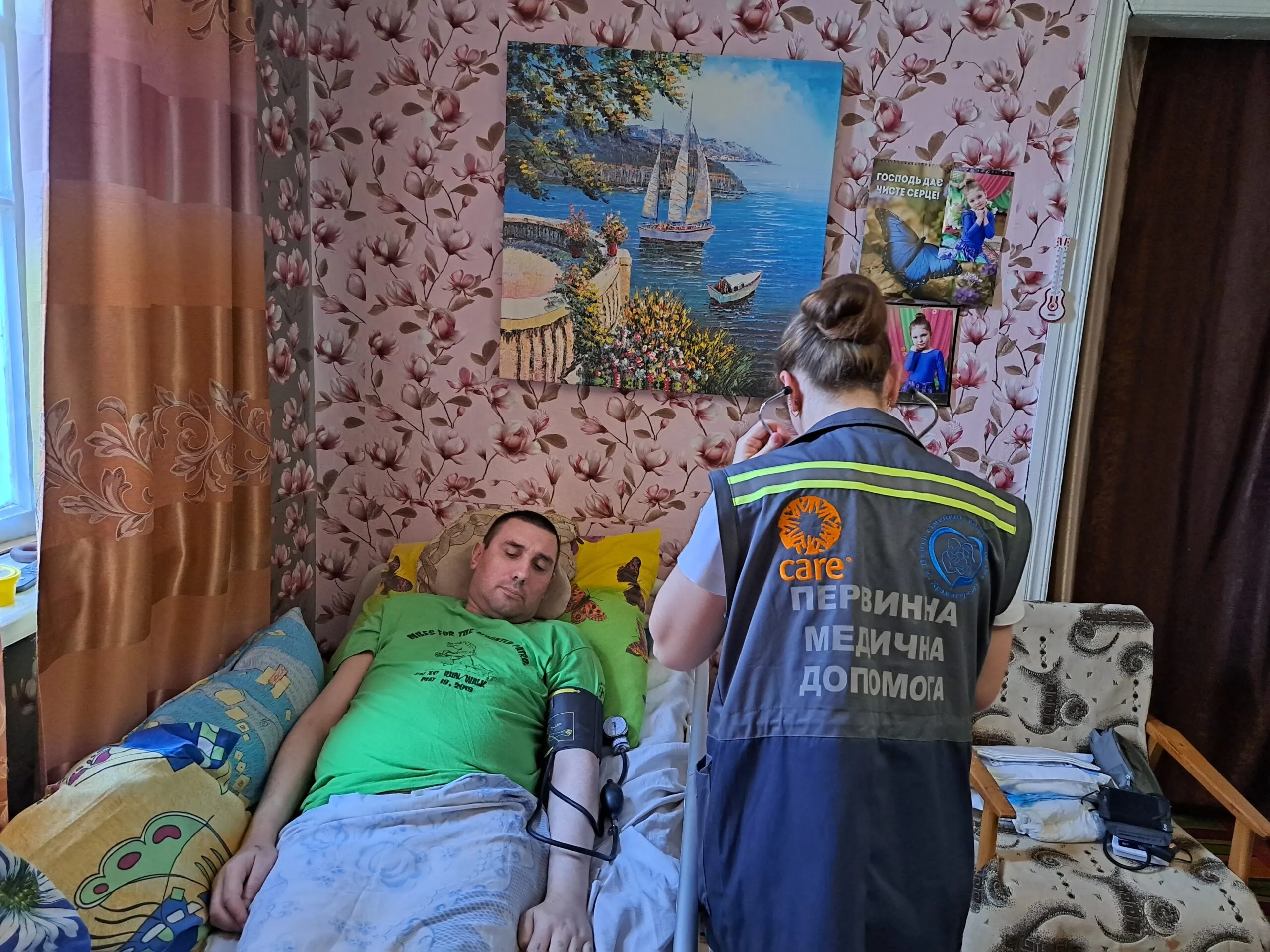
A man in a green shirt lays in a medical bed in Kramatorsk, Ukraine, as a medical professional in a CARE-branded vest performs an examination.
Nurse Alona, part of the mobile care team, examines Maxim. He is disabled and relies on mobile units to access healthcare.

Healthcare on the brink

Across eastern Ukraine, the situation Lyudmila’s family faces is repeated in thousands of homes. For people living with chronic illnesses or disabilities, access to healthcare can mean the difference between life and death. When health systems collapse — as they are now after significant international funding cuts — so do the people who rely on them.

According to joint reporting from eyeWitness to Atrocities, Insecurity Insight, Media Initiative for Human Rights, Physicians for Human Rights, Truth Hounds, and the Ukrainian Healthcare Center, there have been over 2,000 documented attacks on Ukrainian healthcare infrastructure since Feb. 24, 2022. More than 1,100 hospitals and clinics have been damaged or destroyed, and nearly 300 healthcare workers have been killed. Regular attacks on energy infrastructure affect what health services do remain, with Michael McGrath, CARE’s country director in Ukraine, calling them “an almost daily reality.”

This daily reality means that even patients who survive direct attacks may have nowhere to go for treatment and support. CARE and its partners warn that without renewed support, the country’s remaining mobile health teams will not be able to keep operating through winter.

The loss of preventative care can be equally devastating. A cough becomes pneumonia. Well-managed diabetes becomes life-threatening. Tumors that had been controlled with chemotherapy grow back. Hypertension develops unchecked. Wounds don’t heal. A diabetic in shock, a cancer patient needing chemotherapy, an elderly person with a heart condition — without access to healthcare, they all face the same outcome as those directly hit by strikes: death. Just a longer, more drawn-out one.

Through CARE-sponsored health programs, doctors like Victoria learn not only to place catheters and check blood pressure, but also to perform other essential techniques and treatments that can be done in patients’ homes. This spares patients from dangerous trips to a clinic that may not even be standing by the time they arrive.

But the ambulances and the steady hands people rely on are arriving less and less frequently. Victoria’s team now visits about 15 people per day. When funding allowed eight ambulance crews to operate, more than 100 patients received medical attention daily. Today, only a fraction of that number can be seen, leaving hundreds without the medicine or care they need.

The remaining teams often visit people with cancer, or advanced heart disease. Too often, these dedicated professionals can’t provide the treatment those patients need.

When Victoria, Alona, and Vitalii can get to their patients, they are rarely just looking for medicine. They want dignity: the reassurance that they will not be left alone in their suffering.

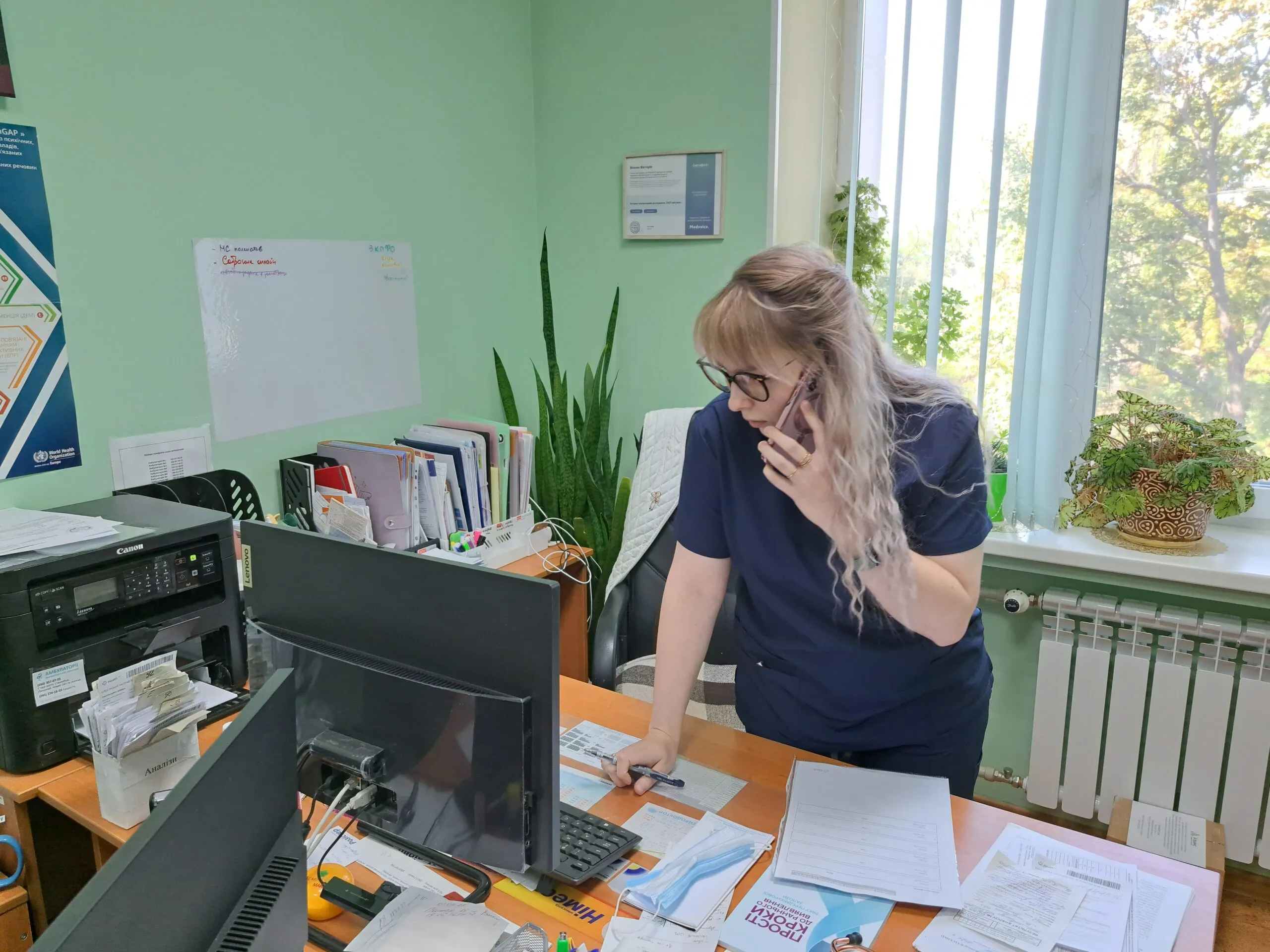
A health care professional speaks into her cell phone as she tries to coordinate a visitation schedule in Ukraine.
Doctors like Victoria and Oleksandr struggle constantly to scrape together enough people, medication, supplies, and other resources to properly serve their communities.

The last door to care

CARE’s response has been to hold the line against collapse. By supporting mobile health teams that deliver home-based care for people who are immobile, disabled, or chronically ill, CARE and its local partners ensure that families like Lyudmila’s are not abandoned. Ambulances are repurposed and equipped for diagnosis and treatment. Medical supplies for chronic illnesses are distributed to trained professionals who bring care directly to people’s doors.

But these efforts depend entirely on funding.

“Do not stop the funds and the project,” urges the clinic’s head physician, Oleksandr. “It is too important. It is life or death for many. 80% of our teams depend on international funding. There is nothing left for these people otherwise. No one can help them. Funding cuts will mean death for many.”

While Victoria, Alona, and Vitalii continue their daily rounds, many trained doctors and nurses have already left the frontlines for safer cities, creating enormous gaps in care.

“As a normal human being, I feel the urge to flee,” Oleksandr admits. “But as a medical professional, I stay here because who else will? How can I leave our patients behind? We do not want to give up the people we serve and care for. It is getting worse every day, and we do not know what would need to happen for us to drop everything and run for our lives.”

The mobile teams haven’t stopped trying. Their patients haven’t stopped needing. But without renewed international support, this fragile lifeline will snap — and people like Maxim will be left to face their final days alone.

Next week, at the gate of her small house on the edge of Kramatorsk, Lyudmila will be waiting for the sound of the ambulance engine. Whether it comes depends not on the courage of Victoria and her team, but on whether the world chooses to keep that last door to care open.

Stand up for lifesaving aid

U.S. funding cuts are shutting down the programs families rely on to survive. Sign our petition and tell Congress to protect funding that saves lives and builds stronger futures.

Sign now
Back to Top