Who cares about women's leadership in emergencies? Rabeya does.

By Hillol Sobhan September 10, 2026

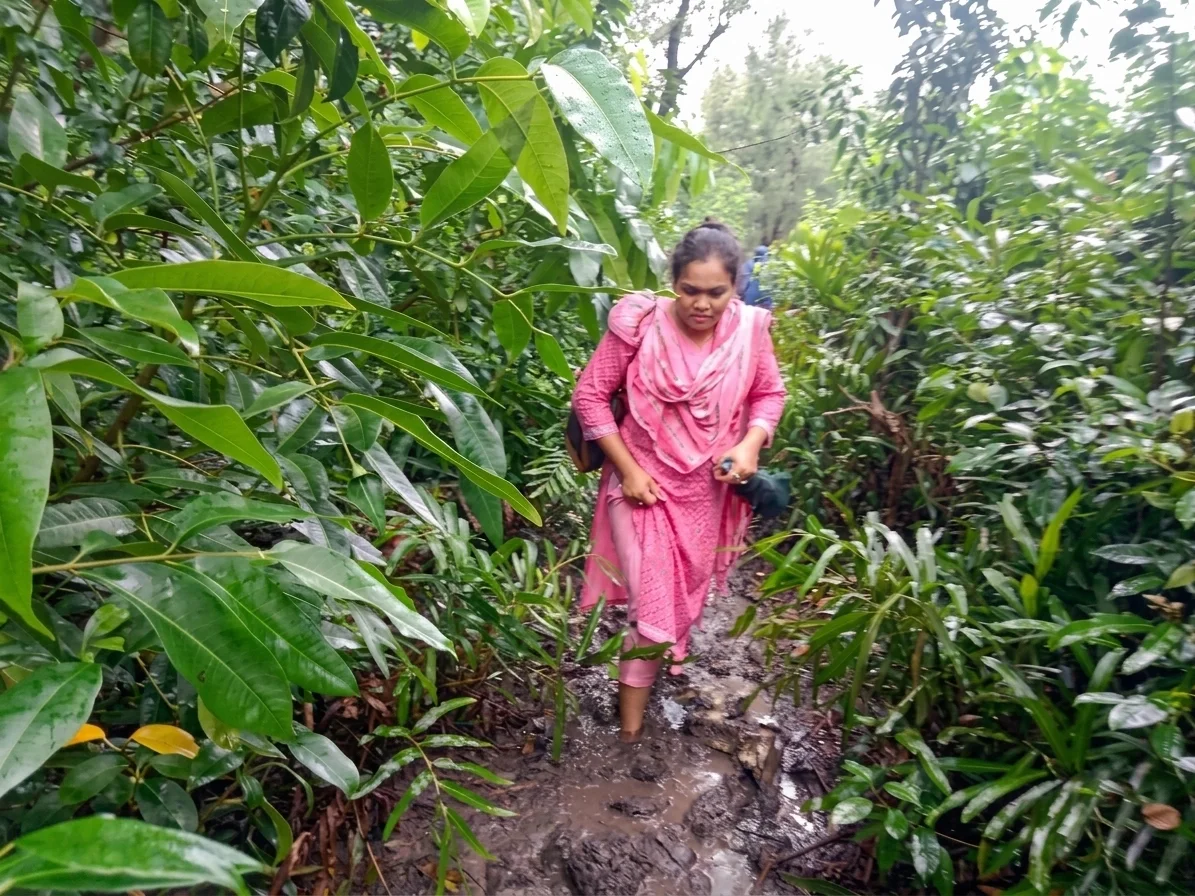
A Bangladeshi woman in a pink salwar kameez wades through muddy, water-logged terrain surrounded by dense green vegetation.

Rabeya Munni walks through mud on her way to a women's group in Barguna District, southern Bangladesh. All photos: JAGO NARI/CARE

Rabeya Munni crosses rivers by boat, travels on motorcycles through remote villages, and walks through mud to reach women in crisis-affected communities. As a project officer for a CARE-supported program in southern Bangladesh, she builds women’s leadership in emergencies from the ground up — one group, one conversation, and one changed mind at a time.

“Vehicles don’t go there,” Munni says of the final stretch to reach women’s groups in Barguna District, one of Bangladesh’s most disaster-prone coastal regions. “I must walk through mud that’s sometimes knee-deep.”

Munni has worked with JAGO NARI, a local women’s rights organization and CARE partner, for 16 years. For the past two years, she has overseen the district-level rollout of Women Lead in Emergencies (WLiE). Managed by CARE Bangladesh and CARE France, this four-year, multi-country program helps communities prepare for disasters. The initiative is funded by Agence Française de Développement. CARE International UK serves as global technical lead and the Institute of Development Studies, based in the UK, is the global research partner.

Munni has worked with JAGO NARI, a local women’s rights organization and CARE partner, for 16 years. For the past two years, she has overseen the district-level rollout of Women Lead in Emergencies (WLiE).

The WLiE project helps women and women’s organizations lead and take part in peace, security, and humanitarian action. The program operates across Bangladesh, Colombia, Ethiopia, and Ukraine. In Bangladesh, the project is building 45 community women’s groups in two cycles to help around 900 women build leadership and act together in crisis situations.

What struck Munni most was the project’s core truth: in a crisis, women are usually the last consulted and the first affected. Yet, when given support, they do not wait for outsiders to solve their problems.
Building women’s leadership in remote Bangladesh

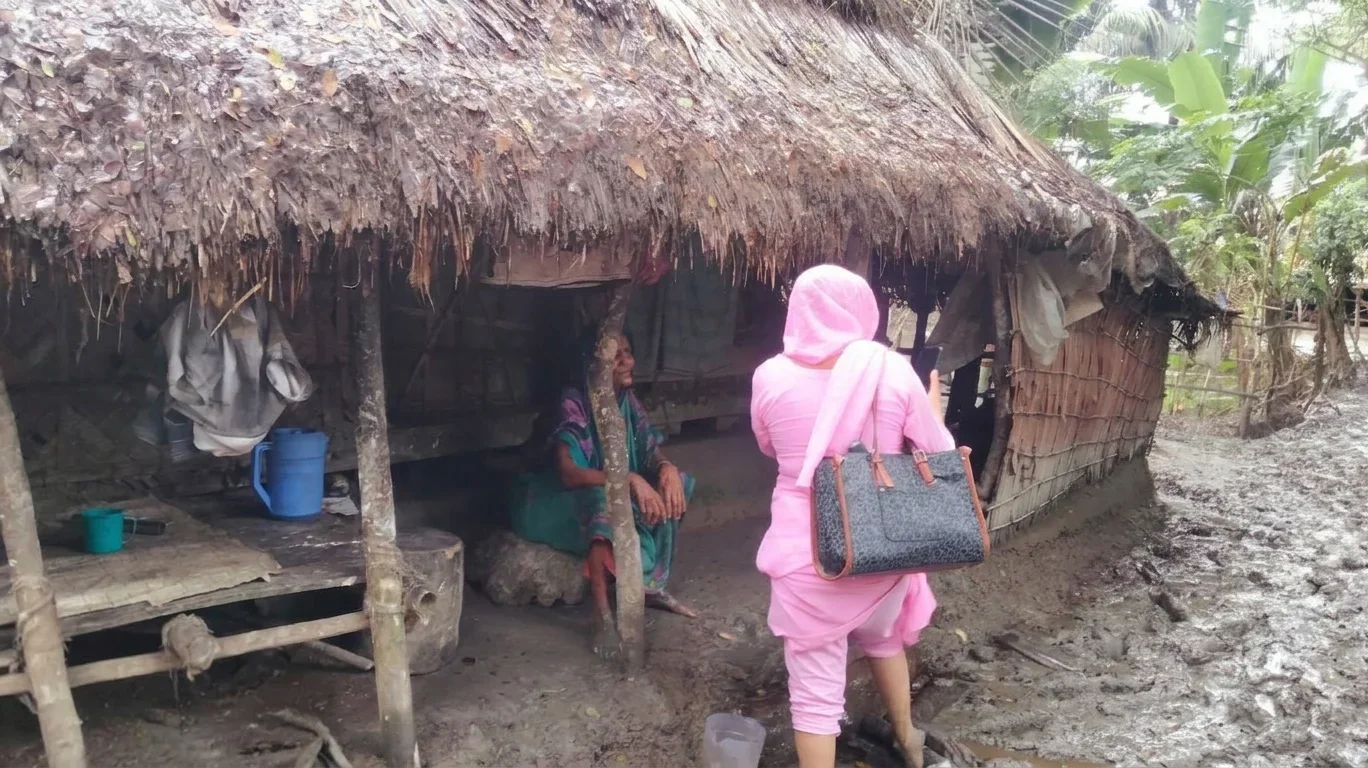
Munni visits a woman's home in a remote village as part of confirming new group members for the project.

Barguna District suffered severe destruction from Cyclone Sidr in 2007 and has faced repeated storms, most recently Cyclone Yaas in 2021 and Cyclone Remal in 2024.

The project operates in three Borguna subdistrict: Taltoli, Patharghata, and Barguna Sadar, some of which take up to two and a half hours to reach. “If a program starts at 10 a.m., I must leave home by 7 a.m.,” Munni says. “The public ferries are slow in Taltoli and Patharghata, so I travel by trawlers [local engine boats].”

Once off the boat, the shorter route to Taltoli is in terrible condition, so Munni travels the final stretch on a motorcycle taxi. Under JAGO NARI policy, a female staff member can hire a motorcycle taxi just for herself, traveling alone rather than with a companion.

Building a group of 20 to 22 members from scratch was not easy. “People in the region often assume that forming any group means receiving something or aid,” Munni says. Explaining that this project works differently — teaching women to set their own priorities rather than depend on handouts — has required patience, village by village.

Two years into the project, 20 groups are active, supported by seven field facilitators. These are not discussion circles: each group builds its own capacity to organize local projects and tackles pressing community issues. Every group receives a grant of 350,000 taka (around $2,850) to design and carry out its own initiatives, with guidance from CARE and JAGO NARI.

Munni supervises all 20 groups. Field facilitators send reports and other updates to her first, and she visits groups in person to observe sessions, or leads them herself when needed.

Where women’s leadership begins at home

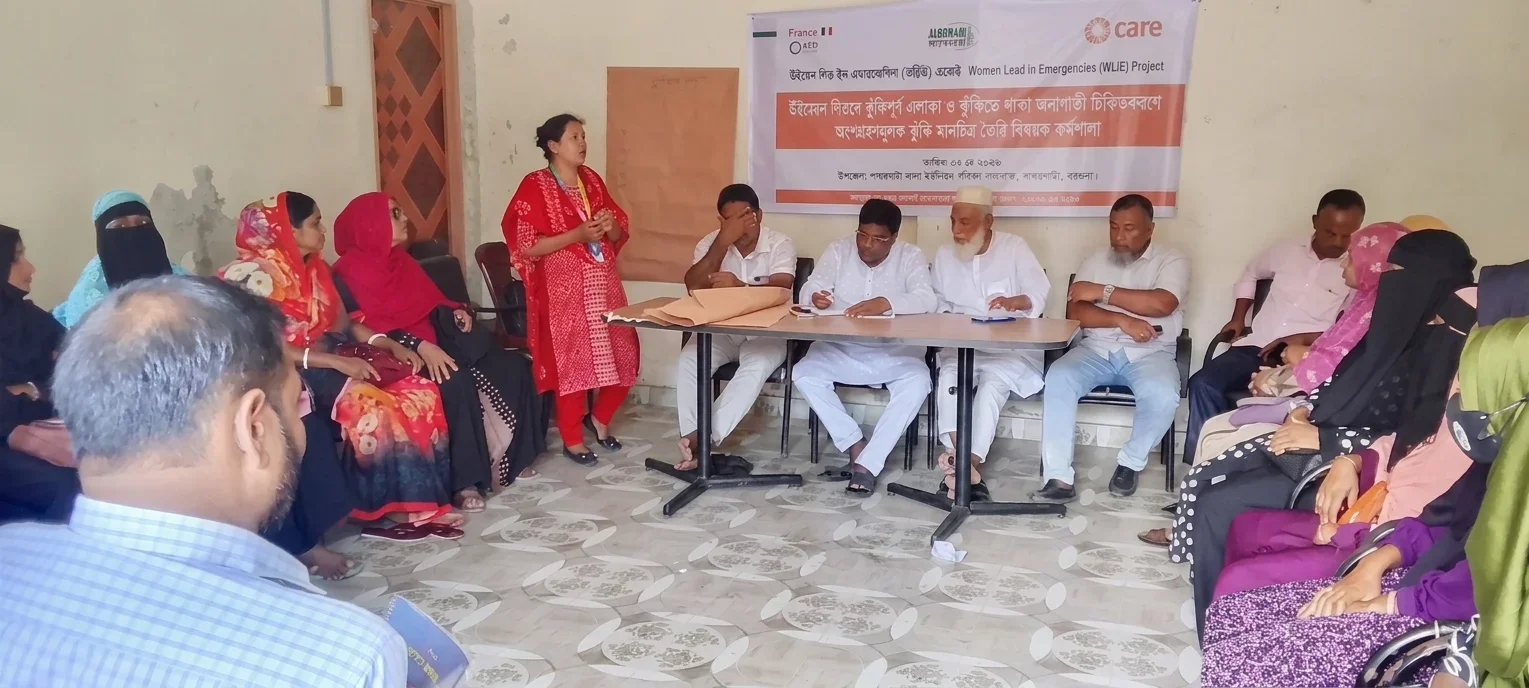
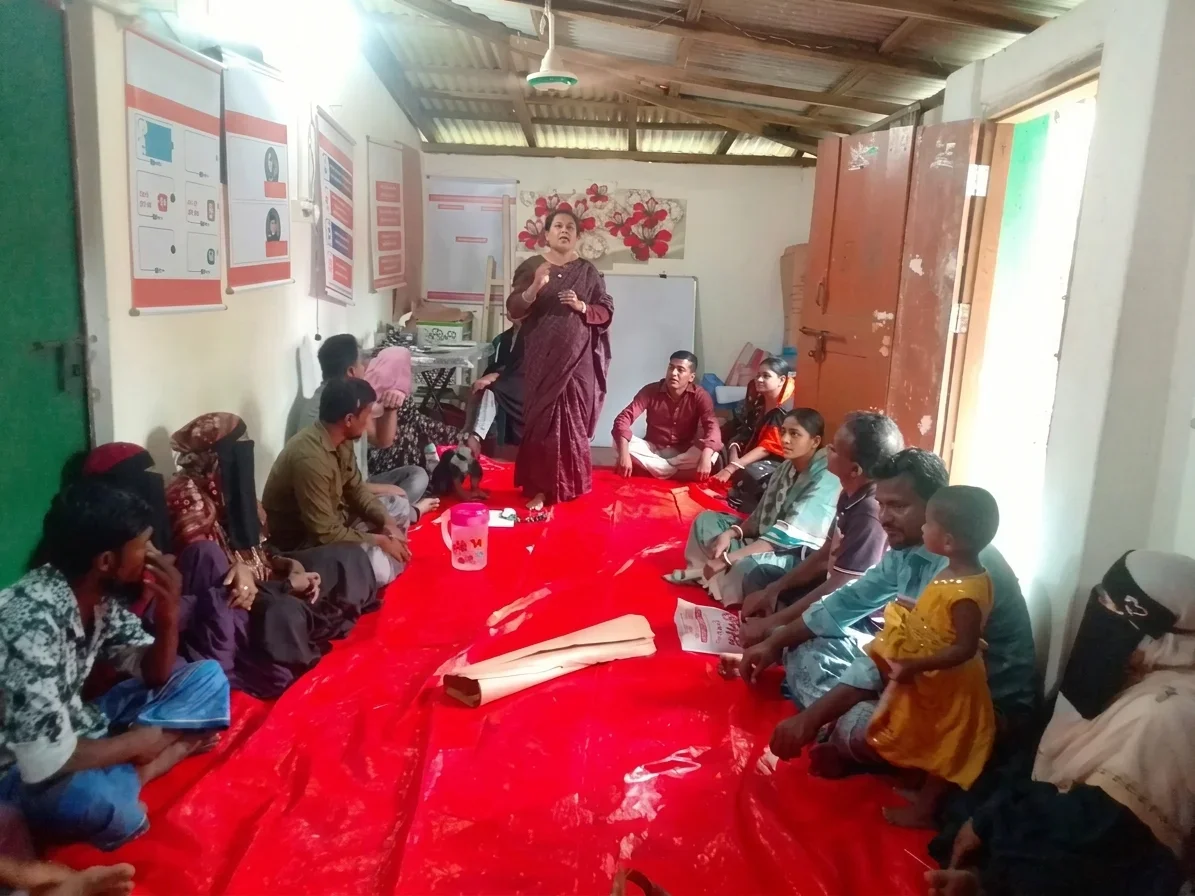
A Bangladeshi woman in workshop settings stands and speaks to a mixed group of men, women, and a child seated on a red tarp indoors.
Munni leads a dialogue session that brings men and women together to discuss their roles at home and outside, building a shared understanding of the gaps between them.

Alongside these community groups, Munni works directly with families, where women rarely hold decision-making power. She runs group dialogues, workshops for couples, and role-shifting exercises that bring husbands into the conversation.

In one exercise called the “24-hour clock,” men and women map their daily routines hour by hour, side by side. “The men realized that even when a woman sleeps, she rarely rests,” Munni says. “If a child cries, the mother gets up while the father sleeps. The men also noticed that while they spend an hour relaxing at a local shop after work, women never get a break.”

These sessions and workshops — the 24-hour clock, couple workshops, cooking competitions — produce visible shifts. Women who once hesitated to speak in public now do so confidently in public and community spaces. Men who once made every decision alone now consult their wives. One husband put it simply: “I used to think I worked harder because I earned income outside the house. After the workshop, I understood that my wife’s workday never ends. I try to help her much more now.”

These shifts create a powerful ripple effect. Women who learn to speak up at home soon begin advocating for their rights across their communities.

Securing a seat at the decision-making table

Through the CARE-supported project, more than 10 women from local groups now sit on Union Disaster Management Committees, bringing essential new perspectives to government’s disaster planning.

Across Barguna District, women in these groups now meet with local council members — the Union Parishad — to advocate for their own safety and disaster recovery needs.

Before joining the program, many of these women had no experience with government processes or civic leadership. “I used to believe women like us could never lead,” says Rahima Begum, president of a local women’s group. “Now I understand that when women are informed and united, we can support each other and solve our problems.”

“I never thought my voice mattered,” adds Jahanara Begum, a group member. “Now I speak with confidence and know that I deserve a better life.”

What does this change look like in practice? In one village, the answer is concrete — both figuratively and literally.

From voice to action: Rebuilding vital infrastructure

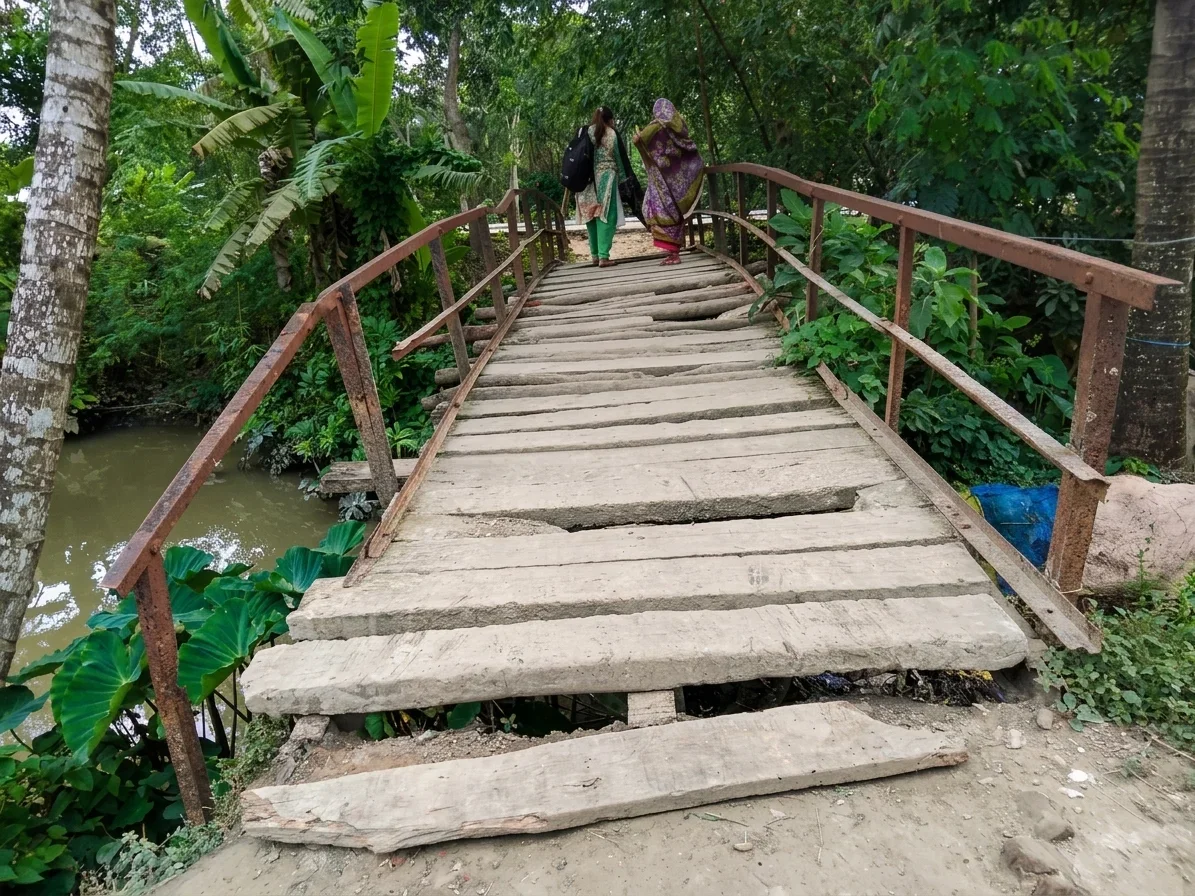
Two women walk across a worn wooden footbridge with metal railings spanning a small river in rural Bangladesh.
A resident crosses the crumbling Molla Bari Bridge before repairs. The local Newton Women's Group secured funding from both the government council and their own grant fund to rebuild it.

In the village of Dakshin Itbaria, the Newton Women’s Group made repairing the deteriorating Molla Bari Bridge their top priority. The bridge provides the village’s only access to the main road, but it had grown unstable. Pregnant women struggled to cross, children risked falling into the water on their way to school, and local drivers were cut off entirely.

Rather than wait for outside help, the women convinced the local council chairman to donate 96,000 taka (about $785) worth of construction materials. They then contributed 257,110 taka ($2,100) from their own grant budget to complete the repairs.

“As long as this bridge stands, people will remember what our women’s group achieved,” the members said.

“In the past, many villagers assumed NGOs only provided relief goods or micro-finance,” says Proma Israt, CARE Bangladesh technical coordinator for the project. “Now they know there’s a budget, the state is responsible, and they can demand public allocations.”

“Women Lead in Emergencies is designed differently,” explains Rafiqul Islam, CARE Bangladesh project manager for WLiE. “It works on women’s power, participation, and decision-making. The model makes women realize how far behind they are in terms of power and decision-making.”

But none of this happens without people like Munni — who start before dawn and cross rivers to reach the women who need them.

A mother’s dedication

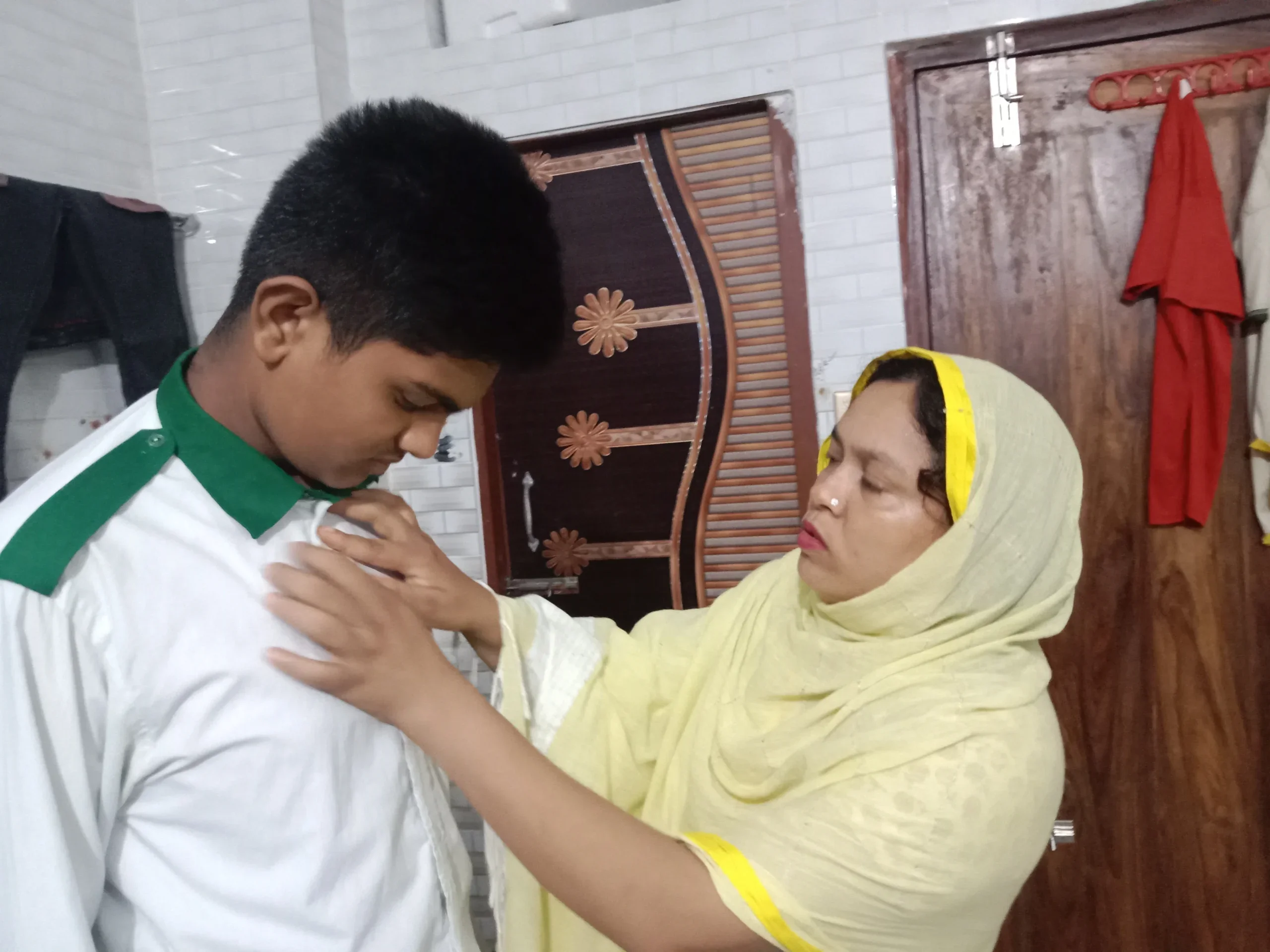
A Bangladeshi woman adjusts the collar of a teenage boy's white school uniform in a home.
Munni helps her son get ready for school before starting her workday.

Every day, before dawn, Munni wakes up. Her morning starts with cooking and household chores before she helps her son get ready and heads off to work.

Her 12-year-old son, Jubayer, now in seventh grade, attends a city school for a better education. To make his commute possible, she rents a house there in the city.

Despite her relentless schedule, Jubayer deeply respects her mother’s mission. “Even if my mother can’t spend much time with me, I feel very proud of her work,” he says. “Because my mother goes to villages and works hard for the development and awareness of women.”

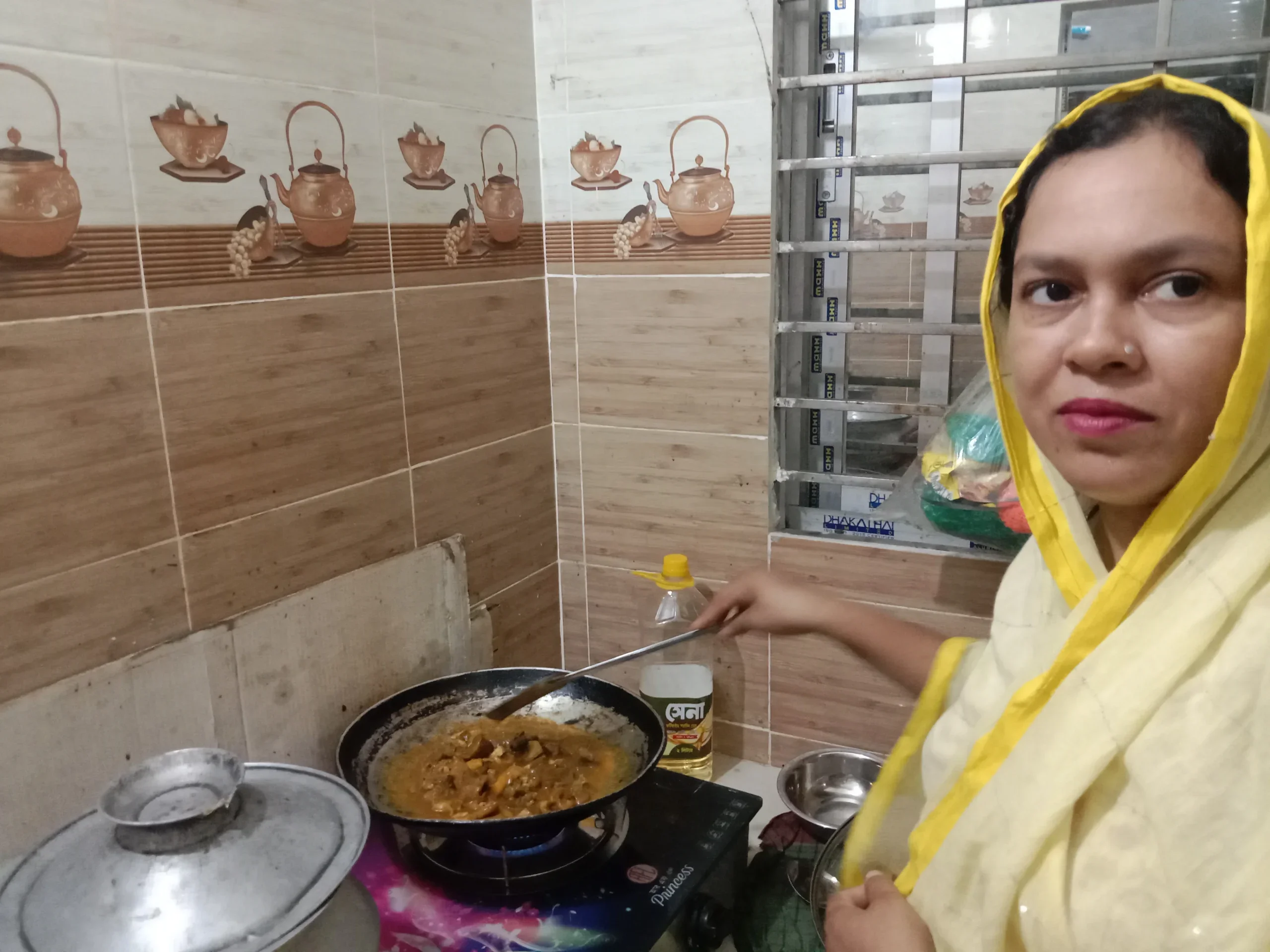
A Bangladeshi woman in a yellow headscarf stirs a pan of curry on a gas stove in a home kitchen.
Whether before dawn or late at night, Munni prepares all the meals for her family while managing a demanding full-time career.

When she returns home in the evening, her domestic responsibilities continue with cooking, washing, and cleaning.

Asked whether being a woman traveling to remote areas alone makes this harder, she does not hesitate.

“Our social system is still not entirely women-friendly,” she says. “But I see myself as a human being, and as a human, we can do it. We have the courage and mental strength for it. Work is work, regardless of being a man or a woman.”

What sustains her is watching a husband in a couple’s workshop finally grasp that his wife’s day never ends. “Seeing them realize that the daily life women lead is not easy,” she says, “that realization is what I enjoy the most.”

It is that conviction — not a schedule or a job description — that carries her to the next village, the next group of women deciding what their own leadership should look like.


CARE in Bangladesh: CARE has worked in Bangladesh since 1949, supporting communities affected by poverty, conflict, and disaster. CARE Bangladesh’s work currently focuses on three major program areas: women and youth, humanitarian and resilient futures, and health and nutrition. Last year, CARE directly reached over 4.7 million people through 41 projects across 36 out of 64 districts. Working alongside local partners, the organization focuses on enhancing health and nutrition systems, expanding opportunities for women and youth, and building disaster preparedness to ensure communities lead secure and dignified lives.

Support humanitarian workers around the world

Around the world, CARE staff continue serving families through conflict, disasters, and crises. Your help makes that work possible.

Donate now.
Back to Top