Adolescent Health

Re-IMAGINE aims to improve adolescent girls' lives in Niger by delaying marriage and childbirth.

Child marriage in Niger

Girls in Niger experience the highest rates of child marriage and adolescent pregnancy in the world, along with the highest birth rate. These challenges, combined with the lowest levels of secondary education in Sub-Saharan Africa, create a cycle: girls marry early, begin childbearing early, and have limited access to education. Early marriage and early childbearing increase maternal mortality and illness among adolescent girls. These factors also reduce girls’ educational and economic opportunities and place them at risk of violence 

Through Re-IMAGINE, CARE addresses the combination of reasons girls are forced into marriage young – leading to improved education, health, livelihoods, and other positive outcomes. At the same time, CARE helps bolster education, health, and economic opportunities to protect girls from early or forced marriage. 
of girls in Zinder, Niger, marry before they turn 18

of girls in Zinder, Niger, have attended school

How does Re-IMAGINE help delay child marriage in Niger?

Much work has been done to meet the needs of married adolescent girls in Niger, but significant gaps persist. The Gates Foundation-supported Inspiring Married Adolescent Girls to Imagine New Empowered Futures (IMAGINE) focused on the needs of married girls, specifically aiming to improve their access to education and healthcare and delay the timing of their first birth.

While IMAGINE focused on girls who are already married, Re-IMAGINE aims to delay child marriage by increasing girls’ education and skills. It also works to address harmful social norms so communities can better support girls who choose to continue school or pursue other opportunities before marriage.

Specifically, Re-IMAGINE aims to significantly delay the age of marriage in Zinder, Niger, for girls aged 11 to 15. The program plans to reach 4,500 out-of-school girls in 76 communities. It is also building evidence on which interventions are most effective in delaying marriage and age at first birth, particularly those that can be replicated and scaled in similar settings.

Re-IMAGINE adapts the Centre for Girls’ Education (CGE) Pathways to Choice program, which was successfully implemented in northern Nigeria, and adapts it to the context in Niger. The program includes all components of the original Pathways to Choice program, like safe spaces, academic support, vocational training, and mentorship. It also involves community, traditional, and religious leaders to build wider support for girls’ futures. 

Re-IMAGINE envisions a world where adolescent girls have the power to take control of their futures

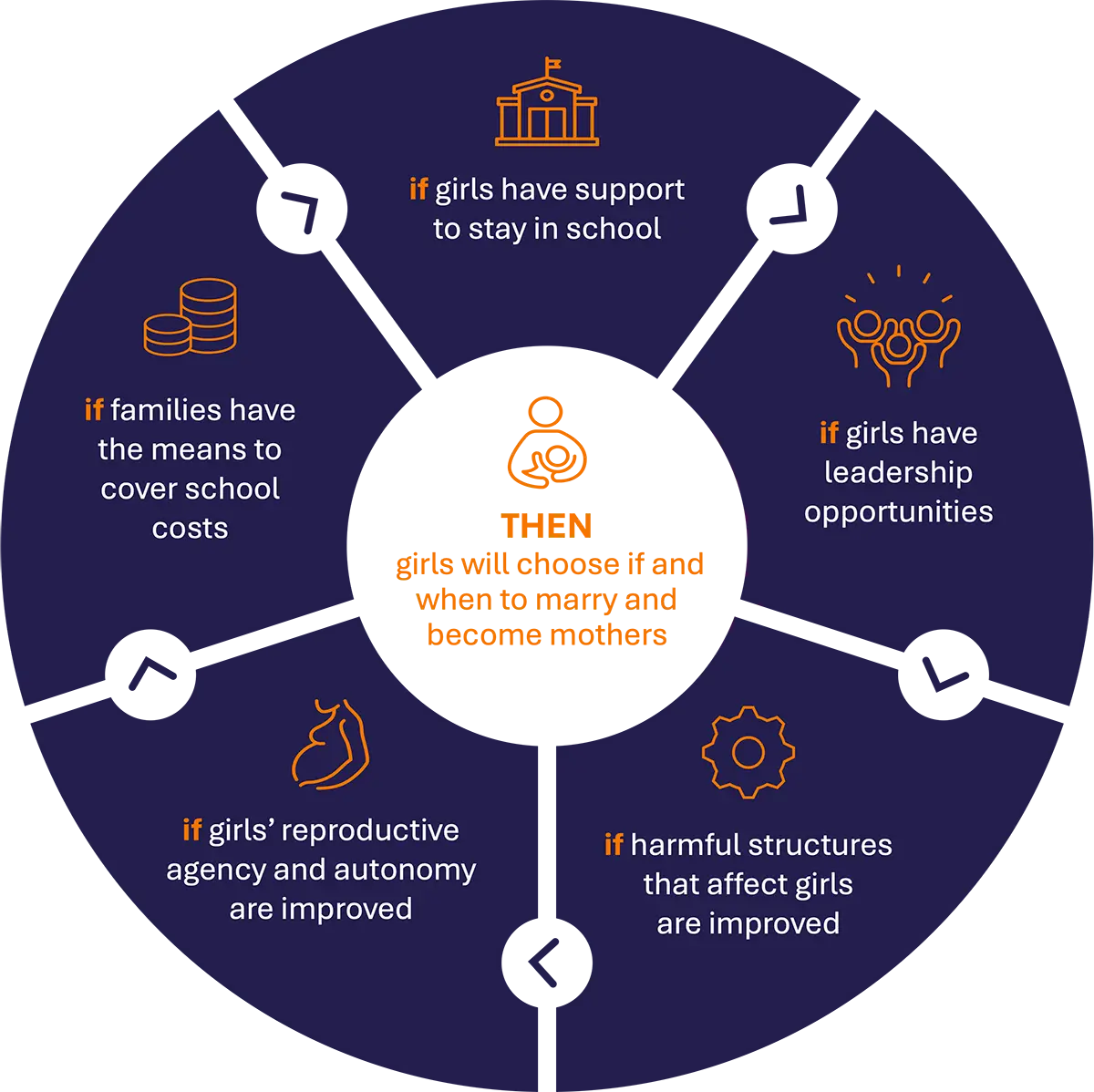
The Re-IMAGINE theory of change posits that if systems change to better support girls' access to education and healthcare, they will marry and have children later.

Delaying child marriage through accelerated education

Re-IMAGINE enrolls out-of-work and unmarried girls in a 10-month accelerated education program focused on foundational learning. This program builds on the CGE accelerated learning curriculum, Niger’s national passerelle accelerated basic education program, and CARE’s proven global models.  

Girls learn literacy and numeracy skills, as well as age-appropriate leadership, life skills, health, social transformation activities. They also learn financial skills through CARE’s Power Within model. Trained facilitators and mentors (many of whom are retired teachers who are trained and paid by their communities) deliver this curriculum through girls’ collectives. After completing the accelerated learning program, girls can re-enroll in a local school. Girls’ collective facilitators can then provide additional tutoring to help them adjust, succeed academically, and feel more comfortable in their new school environment.  

Older girls who choose not to return to formal schooling will be offered the choice to pursue a vocational livelihood pathway modeled after the CGE apprenticeship program. These apprenticeships provide girls with literacy and numeracy education, vocational training, and leadership skills. Girls learn a trade, practice it in small groups, and complete relevant apprenticeships. They also receive start-up kits so they can begin earning income immediately.