
Executive Summary
Background
Water is essential for socioeconomic development, food production, ecosystem health, overall well-being, and is key to climate change adaptation. In South America, the Andes Mountains are crucial for water supply, but climate change and unsustainable agricultural practices often driven by poverty have increased water insecurity. Despite rich biodiversity and ecosystems, Ecuador faces serious water security challenges, especially in the páramo, high altitude grasslands that provide critical water resources and ecosystem services. Páramos capture and retain water, and deliver water to communities and downstream urban centers. Ecuador is home to 13,371 km² of páramo. However, this ecosystem has been degraded by human activities and global climate change, leading to increased risk of fires and a decrease in water availability.
Since 2016, CARE Ecuador has worked with local government, public water utilities and communities in the Andean region to increase adaptive capacities of communities, scale agroecology practices with women producer groups, and protect and restore the páramo ecosystem. As part of this support under the Adaptation to Climate Change for Andean Populations – ACCRE (2016-2019) and Mujeres Andinas (2021-2024) projects, CARE and local partners established and supported the startup, creation, and ongoing implementation of the Pedro Moncayo Water Fund (2016-present). This water fund is a public-community managed fund that generates resources to protect and restore the municipality’s páramo and ensure the sustainability of water for 200,000 people. CARE is currently scaling this model to three other municipalities under its Mujeres Rurales project (2024-2027).
In 2025, CARE conducted an ex-post evaluation to document the process history of the water fund, analyze its effectiveness and sustainability, and identify recommendations for the Pedro Moncayo municipality and considerations for scaling the model to other municipalities in Ecuador.
Context
Ecuador is a pioneer in the creation of water funds, starting with the Environmental Fund for the Protection of Water in Quito (FONAG) in 2000, designed to protect the city’s drinking water sources. This model has been replicated in other territories in Ecuador and in several Latin American countries, where there are currently around 30 water funds.
These water funds operate off a variety of governance models and revenue sources. For example, the Tungurahua Fund in central Ecaudor is a publicendowment model whose interest feeds a revolving fund while other funds like FONAG operate under a public-private endowment model that receives funding from water user fees collected by public utilities as well as contributions from private companies and international donors.
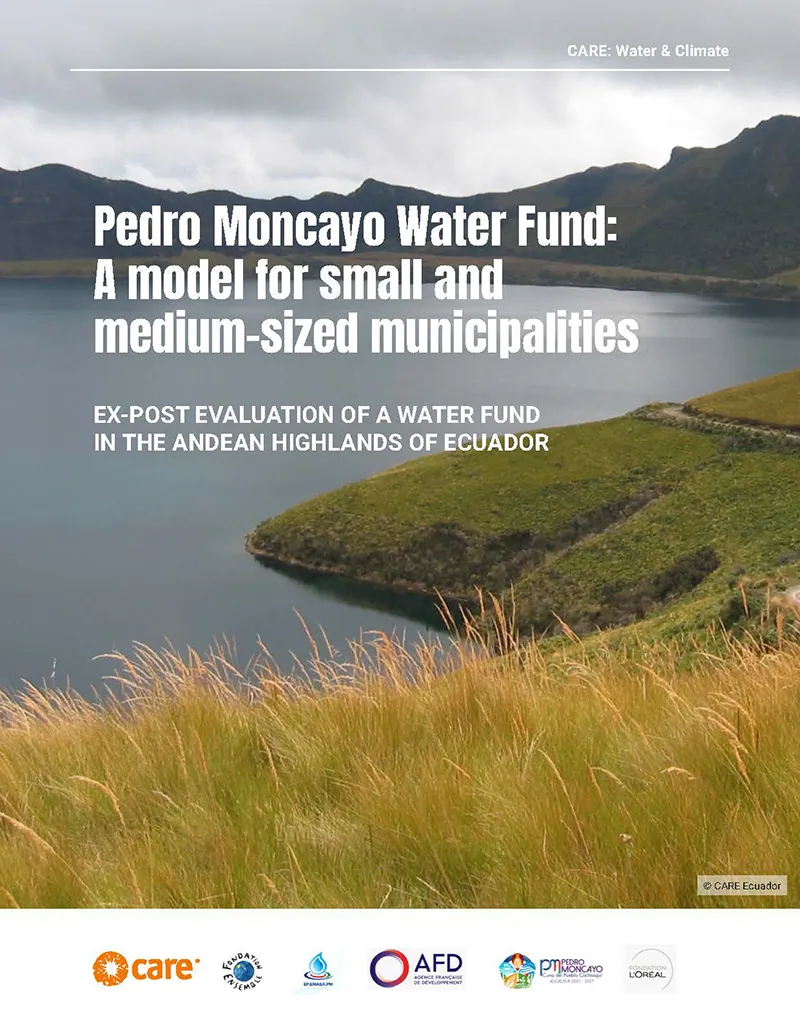
The PM Water Fund was established alongside the legal protection process for two conservation areas also established by the Pedro Moncayo municipality and national government of Ecuador with support from CARE. The Mojanda Conservation and Sustainable Use Area (Área de Conservación y Uso Sostenible – ACUS) declared in 2019 protects the Mojanda Lake Complex, a series of freshwater lagoons and páramos that covers 6,000 hectares and supplies water to 200,000 people in the Pedro Moncayo municipality. The Mojanda Water Protection Area (Área de Protección Hídrica Mojanda – APH) was declared in 2021 and is a nationallevel declaration that specifically protects the freshwater ecosystems within the Mojanda ACUS – strengthening legal protections for water resources inside the ACUS. The ACUS and APH each have their own management structure and committee which manages the governance and administration of these legally protected areas. The ACUS and APH created a landscape-based conservation framework that helps the PM Water Fund coordinate, plan, and finance conservation activities more effectively.
Results
The ex-post evaluation used participatory research methods including focus groups and semi-structured interviews with local partners and participating groups, as well as direct observation to validate the information. Key results included:
Mapping of PM Water Fund process (2016-2019)
The PM Water Fund was legally established in 2019 by a municipal ordinance. However, the process to establish the fund took place over three years between 2016 and 2019. The first two years included technical studies, feasibility assessments, and workshops to design its management structure and financial model. This part of the process required intensive stakeholder engagement and consensusbuilding. The review, public discussion and approval of the municipal ordinance (legal instrument that formally established the fund) took nearly a year and was aligned with the establishment of the Mojanda ACUS. This phase depended on mayoral leadership and support.
The final phase in 2019 established the Water Fund Management Committee (WFMC), put the municipal ordinance into practice, and activated the disbursement of funds from the public water utility to the PM Water Fund. However, this phase encountered challenges as it coincided with municipal elections and subsequent turnover of municipal staff. As is common in Ecuador, new mayoral administrations often revise political and developmental agendas and give lower priority to actions started under previous administrations. This paused progress of the PM Water Fund and prevented the use of the funds for conservation activities.
Water Fund Form and Structure
The structure of the PM Water Fund is legally defined by the ordinance approved in 2019. The fund has a public-community governance structure and is managed by the Water Fund Management Committee, which includes the mayor and environmental technical staff from the municipality, the manager of the public utility and one representative from civil society. The WFMC is responsible for quarterly review meetings, annual plans and budgets, monitoring and evaluation of conservation activities, and information sharing with local authorities and residents. The PM Water Fund’s management plans and strategic vision are intended to align with those of the ACUS and APH to ensure conservation and nature-based solutions are coordinated across the municipality.
The study identified key structural gaps within the WFMC, particularly around expanding participation of community-based structures beyond just one representative from civil society. Groups not yet represented include the community-managed Drinking Water Management Boards (Juntas Administradoras de Agua Potable – JAAP) as well as women producer groups and irrigation user groups.
Operation of the PM Water Fund
Although the PM Water Fund has a clear mandate and strong institutional and legal framework, the WFMC faces operational challenges, and no funds have been disbursed to carry out activities directly. Although the public utility fulfilled its yearly financial commitment (5% of revenue), approximately $300,000 raised since 2019 remains unused, though reserved for the fund, in the public utility’s bank account. The WFMC has been inactive since 2019 which has stalled quarterly meetings, coordination with the ACUS and APH, and annual planning and budgeting cycles. The study identified two key barriers to disbursing funds: concerns about transparency and lack of formal and legal agreement between the municipality and the public utility that delegates decisionmaking and approval of plans and finances to the WFMC. Although the municipal ordinance already assigned this responsibility to the WFMC, it requires an additional instrument to institutionalize and formalize responsibility. The study also noted that the municipality does provide ongoing leadership and funding to conservation activities in the páramo through other budget sources. Women’s producer groups have also continued practicing agroecology and other conservation-based activities.
Long-term financing
The Water Fund’s long-term financial viability remains a challenge because it relies on the public utility’s 5% annual contribution as it’s only revenue source highlighting a need for more diversified contributions from other sources. There are promising signs however. Groups that rely on the health of the páramo, including Drinking Water Management Boards (JAAP), Irrigation Committees, and floriculture companies, have expressed interest in contributing to the fund.
Communication and public awareness
In addition to the structural and operational challenges discussed above, the study noted that public awareness of the PM Water Fund, ACUS, and APH is low and that residents have a limited understanding of the importance of protecting and restoring the páramo as a way to support access to water for drinking and agriculture.
Conservation framework at landscape level
The PM Water Fund has a strong potential for impact because the ACUS and APH conservation mechanisms have been established, which have created a protected area of 6,000 hectares in the Mojanda Lake System. However, the bottlenecks to using the PM Water Fund’s existing balance must be overcome and in the future the annual planning of the Water Fund, ACUS, and APH should be conducted jointly to better coordinate activities and budgeting.
Conclusions and recommendations
Key conclusions include:
- Water funds can be viable solutions but require several years of commitment and significant financial/technical investment from a range of partners. The Pedro Moncayo Water Fund is presented as a viable solution for small and medium-sized municipalities (40,000 – 150,000 people) seeking to establish conservation financing mechanisms. The process is dynamic, complex and requires 2-3+ years of assessments of technical, financial and institutional feasibility, stakeholder engagement, consensus-building, and drafting and review of legal mechanisms. Government elections and staff turnover have slowed progress.
- Water funds should be created, planned, and managed alongside conservation mechanisms to strengthen results. The joint and coordinated establishment of the PM Water Fund, the Mojanda ACUS, and the APH provide a framework for a coordinated model for high-altitude landscape conservation in Ecuador that finances the protection and restoration of the páramo and Mojanda Lake complex to ensure water availability for drinking and agriculture and protect ecosystem health and biodiversity.
- Water funds need sustained political support, clarity, and legal agreements on roles and responsibilities around use of funds and financial transparency. The PM Water Fund has a clear mandate, strong legal and institutional framework, and has raised approximately $300,000 as of March 2025. However, a lack of political will and a need for clarity and legal agreement on roles and responsibilities around use of funds and financial transparency between the municipality and the public utility have limited the WF Management Committee’s ability to plan, budget and disburse funds for conservation and restoration activities in the páramo. This highlights the need for ongoing technical support, including legal, to help resolve bottlenecks.
- Women, particularly Indigenous women, often lead local water stewardship actions, holders of ancestral and place-based knowledge about the location and protection of water springs and play the primary role in collecting and using water at the household level. Women play a crucial role in conserving water resources, but they often have fewer opportunities to take part in decision-making activities. Their engagement in conservation processes is fundamental to implementing effective actions, and the Water Fund must create more opportunities for women to participate in its governance.
Key lessons learned and recommendations include:
- Lesson Learned – Legal and regulatory challenges often require support from a legal advisor. Recommendation – Urgently develop a regulation for the PM Water Fund’s municipal ordinance that clearly outlines roles and responsibilities between the WFMC, the municipality (GAD-PM) and public utility (EMASA-PM) and formally delegates planning and financial decision-making to the WFMC and the use of a separate PM Water Fund bank account managed by the WFMC. Although the municipal ordinance of 2019 dictated this role to the WFMC, the GAD-PM and EMASA-PM require a legal instrument to ensure compliance. To address legal and regulatory challenges, future water funds should consider a temporary or permanent legal advisor.
- Lesson Learned – Water fund structures must include water user groups that have have had fewer opportunities to participate in decision-making. Recommendation – Amend the structure of the WFMC to include representatives from other community-level groups and consider participation from the private sector, such as the floriculture companies. Among the community-level actors, it’s important that the Drinking Water Management Boards (JAAP), women’s producer groups and irrigation actors join the WFMC. The WFMC will need to implement a participatory and rigorous process to select the form and function of the private sector’s participation, and ensure women producer groups and other groups that have had fewer opportunities to participate can help shape decisions.
- Lesson Learned – Water funds need to be understood and valued by the people, communities, and institutions they are designed to serve. Recommendation – Conduct communication campaigns and other awareness activities to improve public education and increase understanding of the PM Water Fund and the ACUS and APH.