
Understanding adaptation, migration, and displacement in communities facing high climate risks
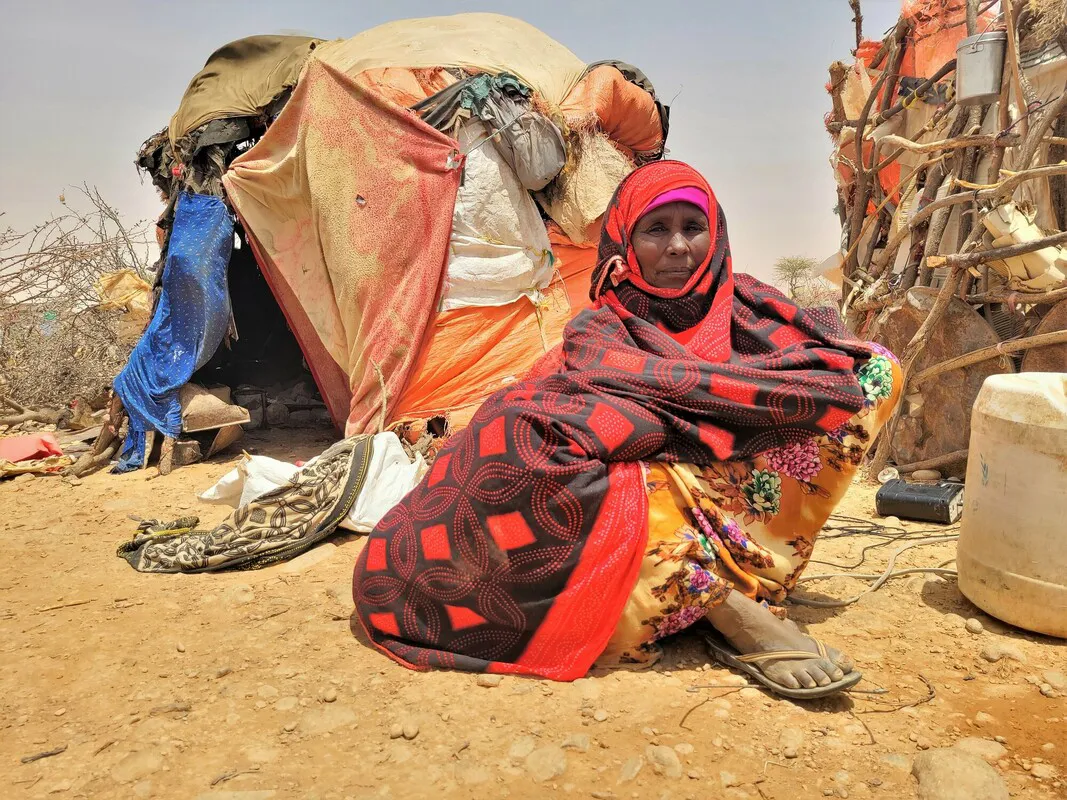
Traditional early warning systems look at floods or droughts predicted a few days, or if you’re lucky, a week, before they hit. New evidence from CARE Somalia across 5 districts shows that families know trouble is coming long before the early warning system kicks in. Their safety systems erode for months before the final shock. Current early warning systems track the weather hazard, but not what’s happening to people on the ground. Those systems might catch the very last trigger that forces someone to leave home, but they leave little time to prevent displacement.
This new research asks the simple question: when families move, what data do they see that we are missing?
About this research
CARE Somalia conducted Displacement Drivers Assessments in five districts between late 2025 and early 2026, examining climate pressures, livelihoods, conflict dynamics, household decision-making, and the different experiences of women and men.
Locations: Afgoye, Beledweyne, Bardhere, Erigavo, and Las’anod
Funding: Royal Danish Embassy to Somalia
Partners: Saferworld, World Food Programme, iRise Hub, WARDI, and WAAPO
Download the full learning brief
Research findings
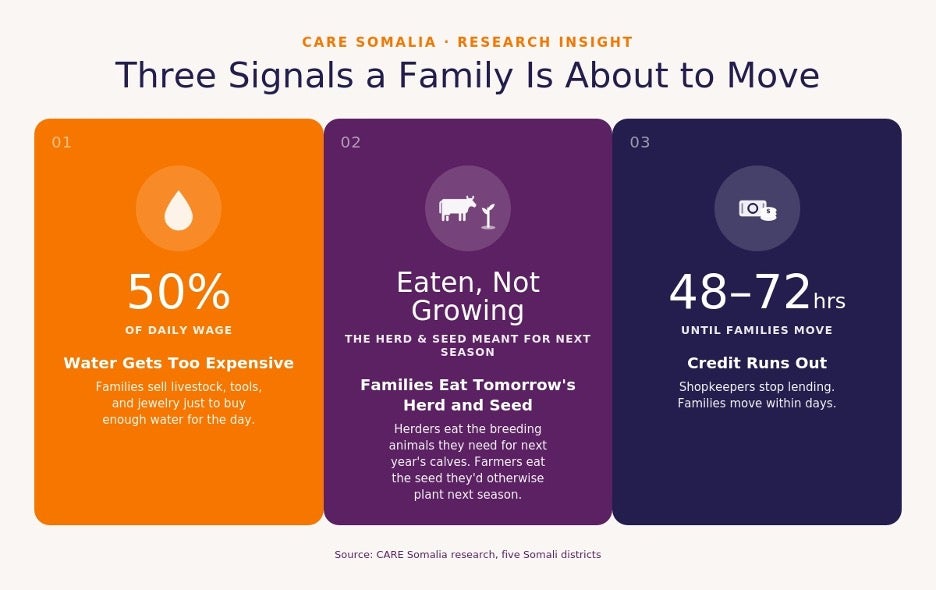
CARE Somalia’s assessments identified three measurable thresholds that can signal when households are moving from coping toward displacement.
- Water becomes unaffordable. When 20 liters of water costs more than 50% of a household’s daily wage, families may begin selling livestock, tools, jewelry, and other productive or valuable assets to afford it.
- Families consume the resources they need for the future. Pastoralist families may lose livestock needed to sustain their herds, while farming households may resort to eating the seed intended for the next planting season.
- Informal credit disappears. When local traders stop extending credit, movement can follow within 48 to 72 hours. At that point, the window for helping families remain safely in place may have closed.
From climate hazard to household signals
Across the five districts studied, households moved through a recurring progression:
- Stress absorption
- Asset erosion
- Social support breakdown
- Movement
While the pace and dominant pressures varied, the pattern suggests that anticipatory-action systems could pair weather forecasts with household-level signals such as water prices, livestock conditions, seed consumption, and access to informal credit.
Displacement does not affect everyone in a household equally
The research also found significant differences in who moves, when they move, and who has the least ability to make those decisions. Young men often move first in search of work, while other household members may remain longer to protect assets or care for children.
Young women ages 18 to 35 were among the most constrained. Restrictions on independent travel, safety risks along migration routes, and social norms can limit their ability to decide whether or when to move. The findings suggest that programs built around a single household-level trigger, or delivered only through the head of household, risk missing people facing the greatest constraints.
Acting before displacement becomes inevitable
Somalia already has climate policy infrastructure in place. The National Climate Change Policy (2020) names both displacement risks and early warning systems as priorities. The country’s NDC 3.0 (2025) directly identifies displaced people, women, and youth as priority vulnerable populations. The Somali Disaster Management Agency joined the Risk-informed Early Action Partnership (REAP) in 2023 and is currently developing a national framework for drought anticipatory action.
This research implies a small but significant change to Somalia’s finance systems. Right now, the country doesn’t have an explicit priority to act before people are forced to migrate, and adding that option would increase the chances to support family resilience. Programming that would act on the three thresholds CARE’s research identifies, and not on hazard forecasts alone.
CARE’s research highlights the importance of investing before people are forced to leave as a core adaptation and resilience priority. A 2023 FAO report on disaster impact estimates that every dollar invested in anticipatory action could save an average of 3 dollars in avoided losses. The 2020 CERF Anticipatory Action pilot in Somalia already produced evidence that early intervention reduces migration in targeted communities. What is missing is the specific mechanism for programming that acts on household-level signals rather than only on rainfall.