Building Financial Resilience Against Digital Risk

July 16, 2026

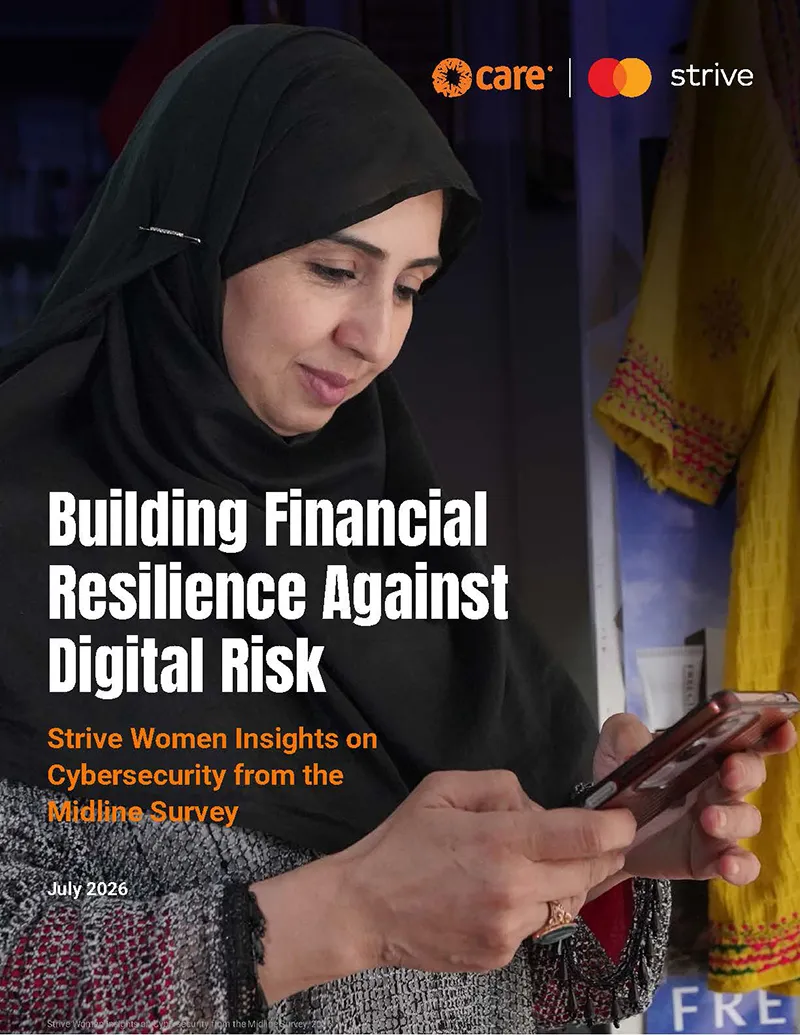
The cover of

Digital access without protection isn't inclusion. For a woman running a micro or small business, going digital is a growth strategy. A mobile wallet lets her track high volumes of transactions. Social media reaches customers her storefront never could. Digital access to her bank account keeps her money safe. But the same activity that drives her growth also expands her exposure. Every new channel is another way for a scam to reach her.

Download the Strive Women Midline Survey (2026) (English)
The cover of

About the report

For a woman running a micro or small business (WMSE), going digital is a necessary growth strategy. A mobile wallet lets her conduct and track high volumes of transactions. Social media reaches customers she could never have served from her storefront. Digital access to her bank account provides her a safe place to store her money.

But the same digital activity that drives growth also expands the opportunity for fraud or consumer protection risk. Every new channel is another way for a scam to reach her.

Strive Women, a four-year program led by CARE, is part of Mastercard Strive, a portfolio of philanthropic small business programs supported by the Mastercard Center for Inclusive Growth. It focuses on growth-oriented entrepreneurs who have been in business for at least two years and have at least one employee. While there is variation among participants, the typical entrepreneur is a married woman in her late 30s to early 40s with a secondary school education. Her business is most often urban-based, unregistered, and operates in the retail sector.

The findings in this learning brief draw on the Strive Women Midline Survey, conducted by 60 Decibels, which measured how women micro and small enterprise owners across Pakistan, Vietnam, and Peru experience and respond to digital financial risk and fraud.

Download the report

Related Reports

Food & Nutrition

From Evaluation to Action: Locally Financed Water Funds in Ecuador

CARE, CARE France, and CARE Ecuador are excited to share the results of an ex-post evaluation of the Pedro Moncayo Water Fund, a conservation financing mechanism established in 2019 that protects, conserves, and restores freshwater ecosystems used by 200,000 people for drinking water and livelihoods in Ecuador.

Food & Nutrition

Why Food Loss and Waste Technologies Scale or Fail: The Role of Women in Building Scalable, Circular Food Systems

Around the world, CARE works with farmers, fishers, pastoralists, businesses, and governments to identify and grow practical solutions that reduce food loss and waste, strengthen livelihoods, and improve food security. This paper brings together evidence from 21+ countries and 25+ projects to understand why effective food loss and waste solutions so often fail to scale – and what it takes to achieve durable, system-level change. It reflects CARE's commitment to contributing to Sustainable Development Goal 12.3 and to advancing women-centered, market-aligned food loss and waste strategies that deliver lasting impact. 

Disaster Response

What it Takes to Eat: Conflict and Sudan’s Fragile Food System

The report, produced together with Action Against Hunger, the International Rescue Committee, Mercy Corps, and the Norwegian Refugee Council, shows how the war in Sudan is pushing communities toward famine by making access to food dangerous—and in some cases deadly.