

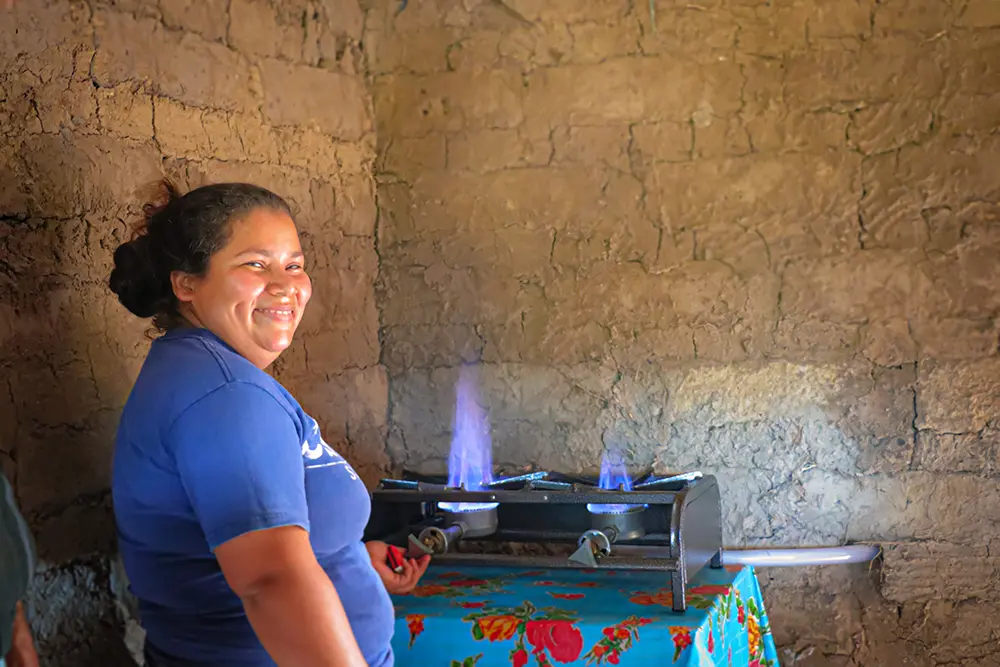
A Honduran woman shows the biodigester in her home.

Photo credit: CARE

Impact Magazine: Issue 32

In Honduras, nearly half of the population relies on firewood for cooking. This practice is harmful for the environment and for women. Cooking with firewood generates greenhouse gases, increases deforestation, and requires women to spend many hours sourcing wood, often in unsafe conditions. It also raises the risk of respiratory illness, which disproportionately affects women since they are the primary cooks.

A recent pilot program, however, indicates that this can change. With funding from Cargill, CARE partnered with 10 families, private company Sistema.bio, and local governments in central and northern Honduras to design and provide biodigesters tailored specifically to meet women’s needs and priorities.

Using biodigesters, which convert animal waste into fertilizer and clean fuel, participants were able to reduce their carbon emissions by 86%. They were also able to save 74% of their annual income, and women regained three hours each day that they would otherwise have spent gathering firewood.

Participants were able to reduce their carbon emissions by 86%.

Participants were able to reduce their carbon emissions by 86%.

Women regained three hours each day that they would have spent gathering firewood.

Women regained three hours each day that they would have spent gathering firewood.

The pilot program succeeded because women were involved in the design process from the start. CARE and its partners worked with Honduran women to understand why previous clean cookstove and fuel innovations hadn’t worked. Together, they developed a plan to help women adopt and expand the use of biodigesters.

“The biodigester has improved the health of my children and myself,” says Norma Hernandez, a small-scale pig farmer. “We no longer breathe the smoke and soot produced by firewood.”

CARE’s team was a finalist for the 2024 UN FAO Farmer Field Schools Innovation Award for their groundbreaking work in making clean technology accessible to women. The award recognizes local innovations that help create sustainable food systems.