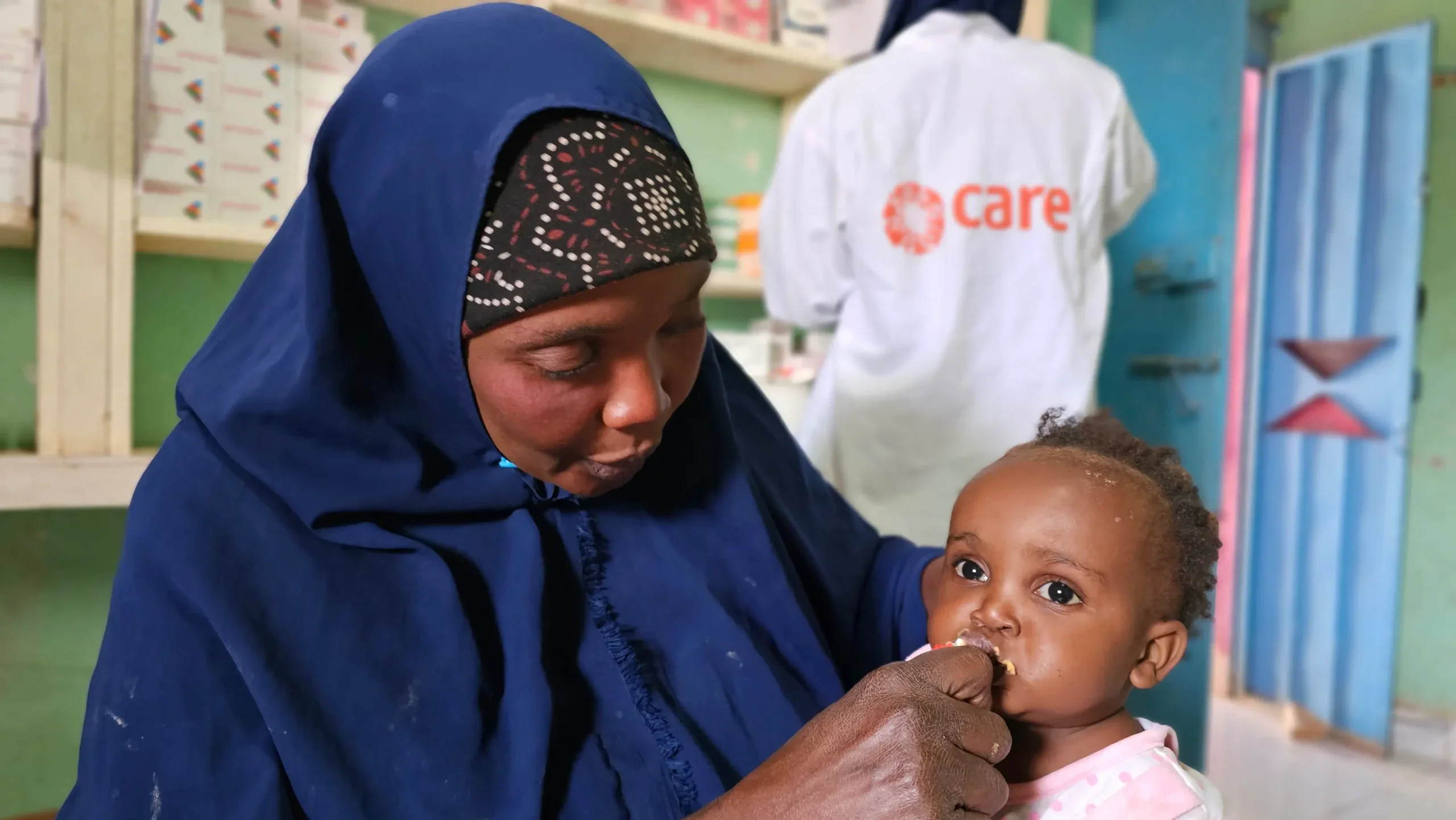
CARE health centers in Somalia are a lifeline for families and malnourished children — but funding cuts are forcing them to close

By Sarah Easter September 30, 2026

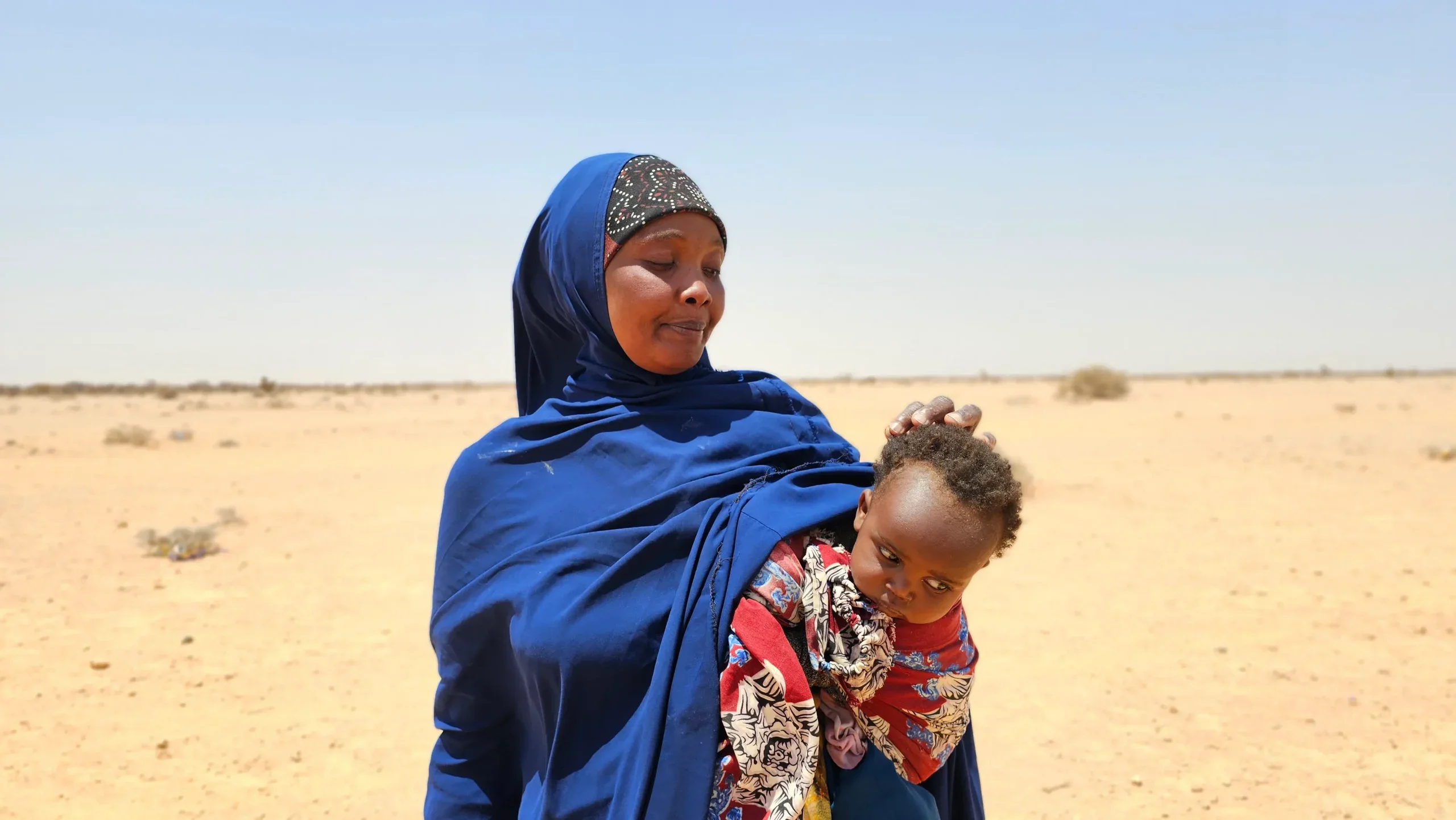
A mother holding her baby in the desert on a sunny day.

Aisha holds her youngest child near the displacement camp where they currently live near Dhahar, Somalia. Photo: Sarah Easter/CARE.

In a displacement camp outside Dhahar, Aisha struggles to find enough food and water for her nine children. The CARE health center treating her malnourished 1-year-old daughter is one of 11 in the region expected to close in October because of funding cuts.

“Today we did not eat or drink water yet,” says Aisha. The 35-year-old lives with her nine children in a displacement camp about 2.5 miles outside of Dhahar. The area is dry, almost desert-like. The kitchen in her shelter has no water and nowhere for her to cook.

It’s already past noon when Aisha can finally get water for her children. Her 1-year-old daughter, Shukri, clutches a small sippy cup emblazoned with the word Baby in red letters. Her tiny fingers wrap tightly around the handles as she takes her first drink of the day.

Aisha watches her youngest daughter drink. She does not drink herself.

Water is hard to come by in the camp. The main borehole that supplied the area ran dry weeks ago. Tanker trucks now dominate the streets, filling water storage units with water that many displaced families, including Aisha’s, cannot afford. Because money is so scarce, a makeshift credit system has sprung up. The manager of the water storage unit records the amount owed in a debt book. Aisha will need to find the money to pay it back later.

But today, it’s the only way for her to get water for her children.

She ties the yellow 5-gallon water container to her back and heads home, where her children immediately gather around her to drink. When they’ve filled their cups, the neighboring children come running from all corners of the camp. They’re thirsty, too, and Aisha shares what little there is.

She still has not had even a single drop of water.

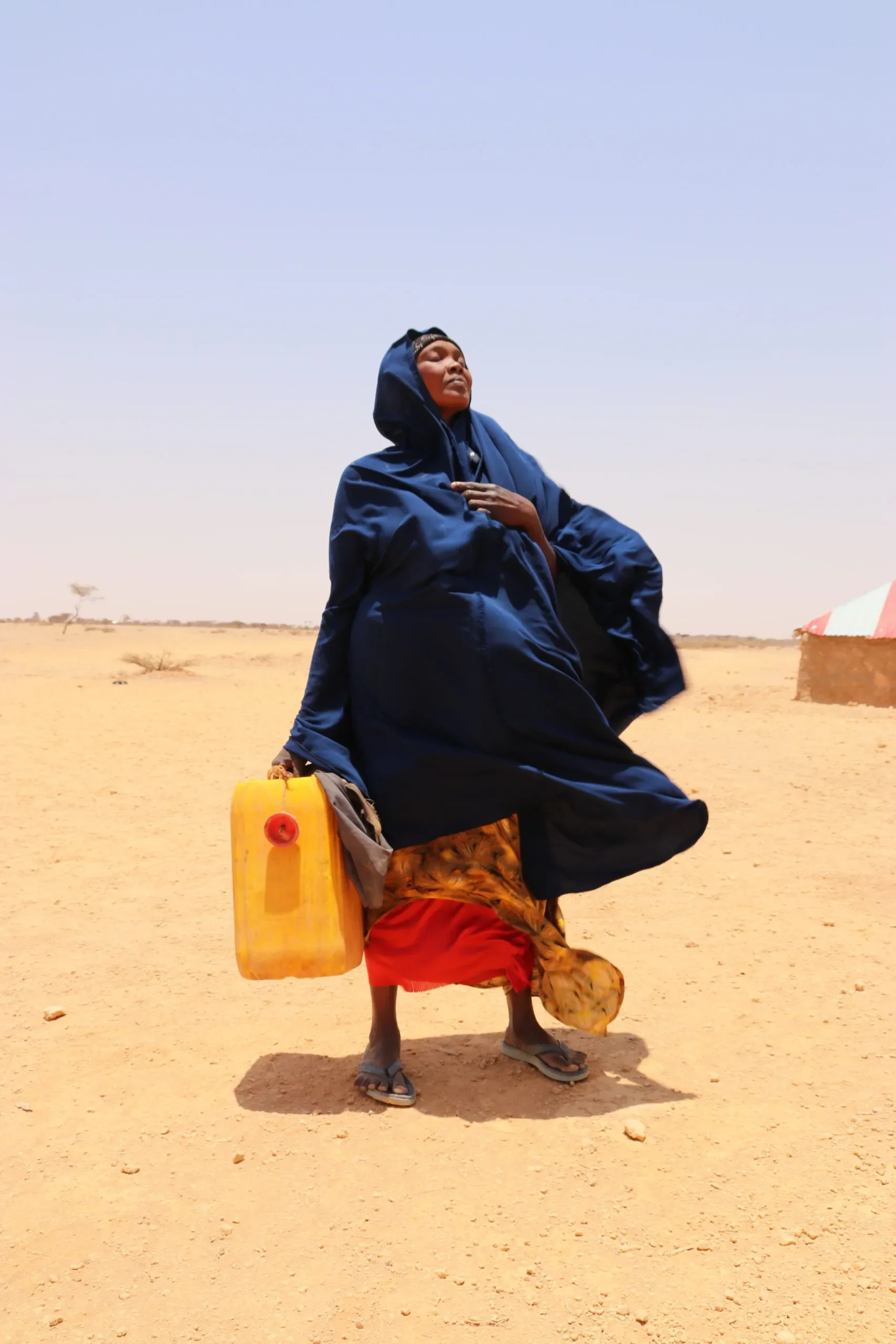
Woman standing in the desert holding an empty yellow water container.
Aisha struggles to afford water, food, and medical care for children. Photo: Sarah Easter/CARE

Aisha is not alone in her struggle. Across Somalia, an estimated 6.5 million people are facing acute hunger, as drought, conflict, and economic hardship continue to drive humanitarian needs. Despite the immense needs, funding cuts have forced many support services to scale back or close altogether.

Throughout 2026, 50 CARE-supported health centers have closed in Somalia and Somaliland as funding cuts have reduced access to essential health services. More closures are still to come. By October, CARE expects to close the health center in Dhahar and 10 others in the region. An estimated 500 health facilities in Somalia have closed in recent years because of funding shortages.

For some people in this area, the centers can be the difference between life and death.

In Somalia, and around the world, women bear the heaviest burden. Mothers like Aisha make serious sacrifices in the hopes that their children will survive. They are the last ones to eat and drink, even when they are pregnant and breastfeeding. These restrictions pose dangerous health risks for both mothers and children.

When nearby health centers close, families may have to travel farther to find treatment, adding another barrier for people already struggling to afford food and water. Their journeys to safety can take hours, days, even months.

As these health centers prepare to close, Somalia is also in the grips of another severe drought. Its effects are already visible around Aisha’s camp.

Driving along the main street of Dhahar, at least 50 water trucks are waiting to fill up the water storage tanks in camps like Aisha’s. There, the water storage regularly runs dry because the residents cannot afford to keep it filled.

For Aisha, water is usually bought on credit. Each refill adds another line of debt to the notebook kept by the managers of the water storage unit.

One 5-gallon can of water costs about US $0.20.

“Water is a big challenge, but food is another,” says Aisha. “We are starving, there is nothing left for us to survive on here. We are just waiting.”

A long journey

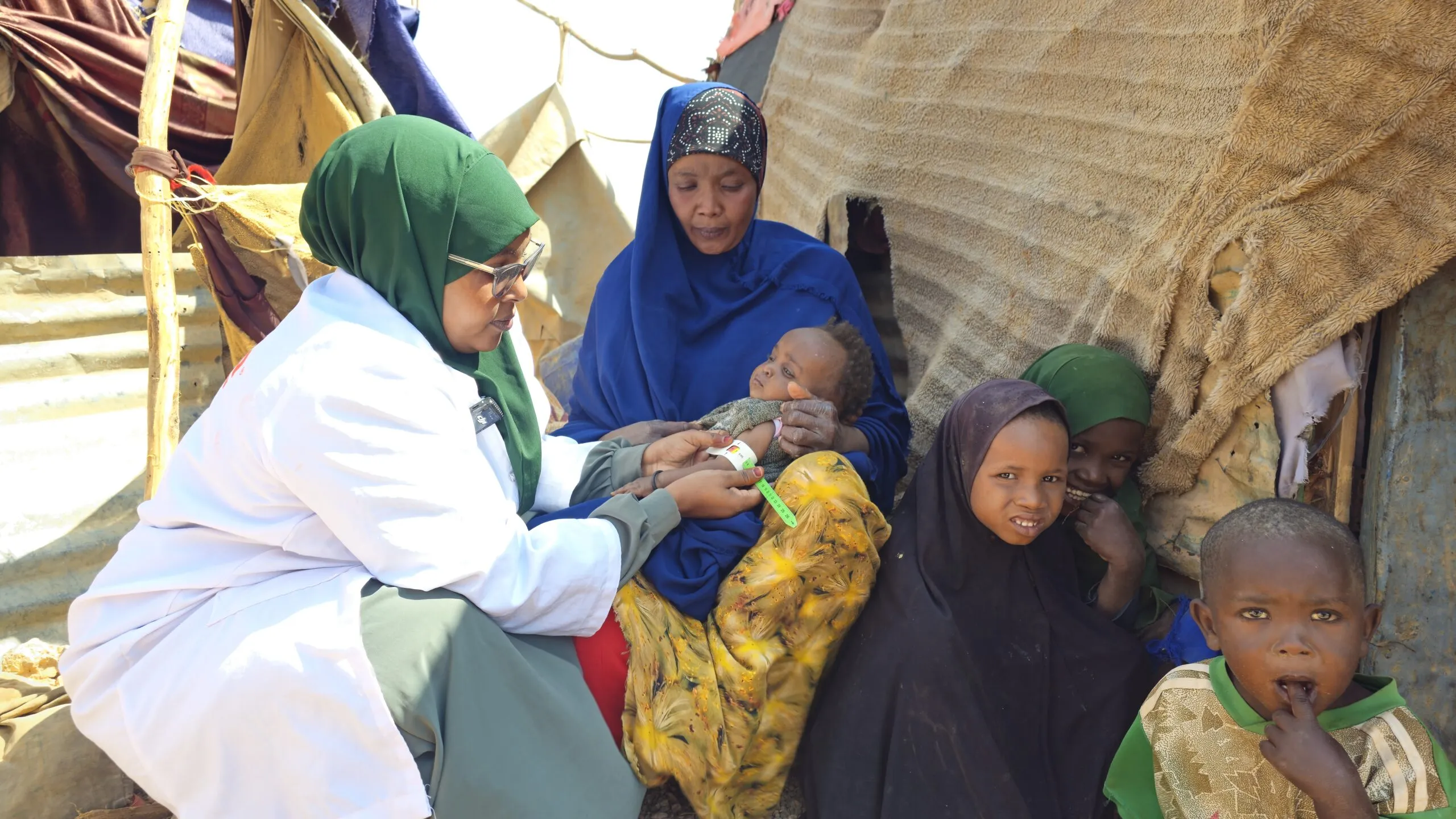
A health worker examines a baby while a mother and other children sit nearby.
Aisha and some of her children receive free treatment from a CARE worker. Photo: Sarah Easter/CARE.

The settlement where Aisha and her children live is home to around 30 displaced households. Most of the structures are made from corrugated iron sheets, sticks, and torn cloth.

The wind here is fierce. It shreds the cloth walls throughout the camp until only a few strips remain, whipping in the air. There are no trees, no bushes, and no solid walls to act as windbreaks.

“We fear the wind here. It destroys everything that we have left,” Aisha tells us. “We have nothing, and the wind takes even that.”

Her journey to this camp began years ago. Aisha once lived in south-central Somalia, where armed groups killed her husband. His death left the family without its primary source of income. Aisha fled with her children to Bosasso.

“One day, we heard several gunshots very close to our hut,” Aisha says. “Only cloth and sticks protected us from the bullets flying towards us. The children were screaming. I was so afraid for them.”

The gunfire grew louder. They could hear bullets passing overhead. “We laid down on the floor. I covered the children with my body as well as I could. I was having a panic attack and no hope left. For the first half hour I could not even move and did not dare to check outside what was happening.”

When the shooting paused, Aisha gathered her courage and stepped outside.

“I saw the dead bodies of my neighbors. A mother of three young children. She was pregnant and dead,” Aisha says. “We ran and never returned.”

Since then, the family has been living in this camp in Dhahar. The dangers around her have changed, but her role has not. Years ago, she covered her children with her own body to shield them from gunfire. Today, she protects them in quieter ways: making sure they drink first, eat first, and receive care before she attends to her own needs.

The shoeshine boys

Women and children make up almost everyone in Aisha’s camp. There are hardly any boys older than six, because every morning they head to town to try to earn money shining shoes.

At 7 a.m., Aisha’s three boys, aged 11, 9, and 7, walk to Dhahar carrying an old cloth and a little bit of shoe polish. They spend the day waiting in public squares and near restaurants, hoping someone will pay to have their shoes shined. They earn about 10 cents per pair. Together, the boys might earn about $2.50 on a good day — enough to buy rice and a few tomatoes. Sometimes they come home with nothing.

“All boys go. There is no other option if we want to survive. On bad days, we go to sleep when we are hungry and wake up even hungrier,” Aisha says quietly, wiping sand from her face.

“Three or four days a week we don’t eat at all. The children ask me for food, and I tell them we are waiting for their brothers to return with money, but then they often just fall asleep exhausted.”

The children aren’t the only ones exhausted. Hunger is especially concerning for Aisha because she has diabetes. Regular meals are an important part of managing the disease, and going without food can cause dangerous changes in blood sugar.

“They are more important than me”
A mother feeding her baby therapeutic food in a CARE health center.
Aisha feeds her malnourished baby therapeutic food in a CARE health center that will be closing soon due to funding cuts. Photo: Sarah Easter/CARE.

Yet when food does arrive, Aisha eats last – if she eats at all.

“I give my children [food] first and wait for them to finish. Sometimes there is nothing left, but they are more important than me.”

Her youngest daughter, 1-year-old Shukri, is already paying the price. When a CARE community health worker, Saytuun, visits the camp, she moves from shelter to shelter screening children under five for malnutrition.

When she wraps the mid-upper arm circumference (MUAC) band, a multi-colored measuring tape used to identify malnutrition, around Shukri’s arm, the measurement indicates severe acute malnutrition. The little girl is also suffering from a fever and a cough.

Saytuun tells Aisha that she can go to the CARE health center in Dhahar to get treatment for free. Aisha immediately prepares to embark on the 2-mile journey on foot. She wraps her daughter in a colorful cloth, ties her onto her back, then pulls her abaya around both of them to shield her from the wind, sun, and blowing sand.

At the health center, staff screen and diagnose Shukri with severe malnutrition. At 1-year-old, Aisha’s daughter weighs just 5.9 kilograms — about 13 pounds. The median weight for a girl her age is closer to 20 pounds, according to World Health Organization growth standards.

Shukri then receives treatment and Plumpy’Nut, a ready-to-use therapeutic food high in calories, protein, vitamins, and minerals.

And Aisha accepts a bottle of water that she finally drinks. Her first water of the day in the late afternoon hours.

For families like Aisha’s, funding cuts are not an abstract budget decision. The health facility treating Shukri is going to close at the end of September. After that, there are no other humanitarian aid organizations working in Dhahar. Across Somalia, nearly 2 million children are acutely malnourished, and the crisis is growing. Drought, conflict, and unpredictable weather are making water and food harder for displaced families like Aisha’s to afford. As health centers like the CARE facility in Dhahar close, mothers like Aisha are left with few or no places to turn for help.

Aisha finds it too hard to think about.

“There will be nothing left for us to survive on that day. That day will be our darkest day.”

CARE’s Dhahar health center recently received a package of medical supplies that can cover nutrition and medical needs through October, but key staff members are expected to leave the facility to begin looking for new opportunities. Saytuun says she will continue providing treatment for people at the center for as long as the supplies last.

Once the CARE health center runs out of supplies, Aisha will have to find ways to pay for treatment.

For now, Shukri can receive the treatment for severe acute malnutrition. But Aisha knows that “for now” is running out. Without that support, she will return to the same waiting: waiting for rain, waiting for work, waiting for water, waiting for food.


CARE has been working in Somalia since 1981. Our main program activities since then have included projects in water and sanitation, sustainable pastoralist activities, civil society and media development, small-scale enterprise development, primary school education, teacher training, adult literacy, and vocational training. We work in partnership with Somali and international aid agencies, civil society leaders, and local authorities.

Most recently, CARE has broadened its work to include economic empowerment, food and nutrition security, humanitarian response, and reproductive health.

Support humanitarian workers around the world

Around the world, CARE staff continue serving families through conflict, disasters, and crises. Your help makes that work possible.

Donate now.
Back to Top