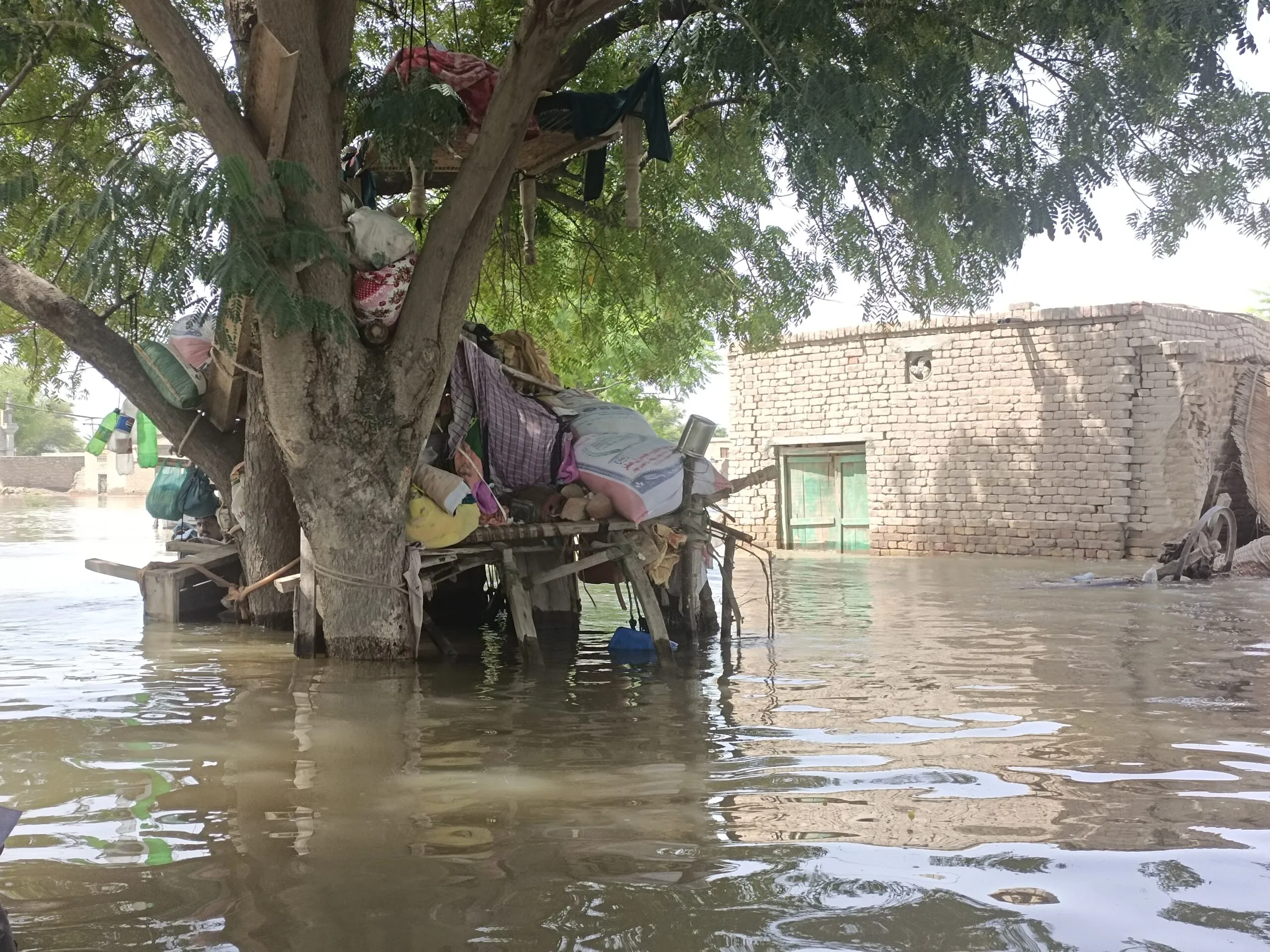
Islamabad, Pakistan, 13 October 2025 – The monsoon emergency in Pakistan – driven by unprecedented rainfall, cloudbursts, urban flooding, and glacial lake downpours – has claimed more than 1,000 lives and affected nearly 7 million people since June. Overflowing rivers forced 4.7 million from their homes in the Punjab province alone. At least 4,700 villages were affected, according to the Pakistani government. CARE has elevated its emergency response in affected areas, expanding its humanitarian operations to reach the most affected districts of Punjab, Khyber Pakhtunkhwa (KPK), and Gilgit-Baltistan.
The findings from UNOHCA’s rapid needs assessment conducted in over 1900 villages in Punjab, reveal that malaria is reported in 64 percent of the villages assessed, followed by skin infections (58 percent), diarrheal diseases (41 percent) and Dengue (32 percent), among other water borne diseases. Furthermore, the floods have devastated agriculture and livestock across Punjab, wiping out the primary sources of income and food for millions. With household food stocks running out and prices soaring, families are facing shrinking purchasing power and growing food insecurity.
“Communities that once relied on their own crops and animals are now forced to depend on markets and humanitarian assistance to survive,” says Adil Sheraz, CARE Director in Pakistan, “Urgent support is needed to restore livelihoods through agricultural inputs, livestock restocking, rehabilitating water and sanitation facilities, and by providing cash assistance to help families rebuild.”
Another critical concern is the risk of resurgence of polio, exacerbated by unsanitary conditions and the postponement of vaccination campaigns due to flooding of critical infrastructure. According to the Pakistan Polio Eradication Program, Pakistan has already reported 27 polio cases in 2025, underscoring the urgent risk of further spread.
On September 12, 2025, CARE conducted a Rapid Needs Assessment in Multan, Muzaffargarh and Jhang, three of the most critically affected districts of Punjab. Communities urged for the deployment of mobile medical units, maternal and child health services, and other interventions to prevent the spread of infectious diseases and address outbreaks of diarrhea, malaria, skin infections, and respiratory illnesses.
“The crisis is disproportionately affecting the most vulnerable, with women and children at the highest risk,” notes Sheraz. “Pregnant and breastfeeding women struggle to access proper nutrition and medical care.”
CARE staff and local partners also say that the lack of privacy, safe toilets, and secure shelters put women and girls in daily danger. Moreover, girls are more at risk of dropping out of school, while entire families grapple with profound fear and trauma.
Speaking to CARE staff, Sameena*, a mother of three from Jalalpur Pirwala, Multan who was displaced by the flooding, said: “I lay awake each night consumed by anxiety, unsure of what the future holds. I am barely producing enough milk for my youngest child. We do not know how long we will be stranded here.”
“The scale of this disaster requires a response that moves swiftly from relief to early recovery. As floodwaters recede in KPK and Punjab, the full impact is now surfacing. Families are returning to destroyed homes and lost livelihoods,” says Sheraz. He added: “CARE is scaling up its operations across multiple locations, working with local partners to provide essentials like emergency shelter, health and hygiene kits, food and non-food items, as well as cash assistance.”
Sheraz says this lifesaving work hinges on donor support: “Investing in climate-resilient systems is essential to help communities recover with dignity and build a stronger defense against future extreme weather events. This type of work has a high return on investment”
Across multiple provinces, CARE and its local partners are delivering critical humanitarian aid to villages impacted by the floods. CARE’s goal is to assist at least 100,000 people in various flood affected areas across Pakistan. This work will help mitigate the immediate impact on affected communities and ensure a swift response to the evolving situation.
To ensure a coordinated and effective humanitarian response, CARE is collaborating with a broad coalition of international and local partners. Sheraz underscores that, “forging partnerships is essential for aligning efforts, avoiding duplication, and ensuring that aid reaches the most vulnerable efficiently as first-responders transition from emergency relief to early recovery.” This approach is even more essential when funding remains scarce.
* First name used only to protect the identity of those affected by the flooding
Note to editors:
CARE began working in Pakistan in 2005. Our work spans health, education, women’s economic empowerment, food security, nutrition, water and sanitation, and emergency preparedness and response. CARE has also provided life-saving assistance during major emergencies, including the 2010 and 2022 super floods, earthquakes, and large-scale displacement.
For media inquiries, please email usa.media@care.org or contact Muhammad Mudabbir Maajid, CARE communications specialist in Pakistan at email: mudabbir.maajid@care.org.