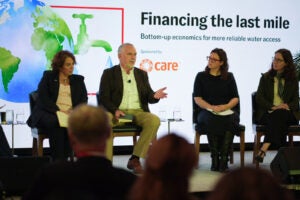


Following a week of discussions, it was clear to all that partnerships built on trust, shared expertise, and business value are now at the center of this work.
CARE President and CEO Michelle Nunn summed up the one message that was heard in every room CARE sat in:
“Inaction is our biggest risk.”
The answer is new ways of working. We need corporate, philanthropic, and government partners applying their own expertise, data, and infrastructure alongside CARE’s community knowledge—co-building resilience rather than paying for it after the fact.
Throughout the week, CARE and partners returned to a few consistent threads:
- Getting ahead of a crisis costs far less than responding after it hits.
- Resilient communities and resilient businesses are not separate goals. They reinforce each other.
- The people closest to a problem should drive its solution. In conversations and meetings, the same question kept surfacing: Are local leaders actually driving its solution, or only being invited to react to one designed elsewhere? CARE’s position: climate financing and real decision-making power need to reach local organizations directly, especially for nature-based solutions where communities often hold the expertise first. The same test applies to AI — it’s only as useful as the local leadership shaping how it’s used.
- The partnerships that are working look less like funding and more like co-building. Companies are bringing operational expertise, not just capital, to solve problems.
Corporate Council
CARE’s Corporate Council, convened more than 20 companies for a conversation focused on “Getting Ahead of the Next Global Crisis.”

Two themes carried the discussion:
Humanitarian response is the starting line, not the finish line. It is necessary but not sufficient. The deeper challenge is building households and communities that can withstand the next shock before it becomes a crisis. According to the UN Security Council, more than 147 million people are facing “acute conflict-induced” food insecurity. That scale of need makes the case for anticipatory action impossible to ignore. We need pre-positioned teams, predictive tools, and flexible funding that can move within hours, not weeks.
The private sector’s role is shifting from support to infrastructure. Corporate partners are increasingly being asked not just to fund resilience, but to help build it. They apply the same logistics, supply-chain, and operational expertise they bring to their own businesses to communities. These partnerships need to be deep and agile enough to move before a crisis hits, not just respond once it has.
CARE’s Solutions Salon
One of the week’s most consequential conversations happened in a smaller room: CARE held its first Solutions Salon with former Secretary of State Hillary Clinton and a small group of partners to chart what a new, 21st-century international development system should look like after historic U.S. funding cuts.
The message from the room was direct: “America is back” rings hollow the second time. What comes next has to be built, not rebuilt. It must be specific, cost-accountable, and able to show results in terms that business and government partners alike can act on. That means being honest about what hasn’t worked, and humble enough to change course. It means making one case that connects American economic and security interests, not separate arguments for separate audiences. And it means building a real coalition, with room for the stories and the leadership of the women already solving these problems in their own communities.